

Copper Nickel Alloy (Cupronickel) C70600 vs C71500: 90/10 and 70/30 Properties, Applications & Standards
Copper nickel alloys — also called cupronickel or cupro nickel — are Cu-Ni alloys containing 10–30% nickel, with controlled iron and manganese additions. The two most widely specified grades are C70600 (90/10: 90% copper, 10% nickel) and C71500 (70/30: 70% copper, 30% nickel). Both offer outstanding resistance to seawater corrosion, biofouling, and erosion, making them the preferred material for marine piping, condensers, heat exchangers, desalination plants, and offshore infrastructure across UAE, GCC, and global markets.
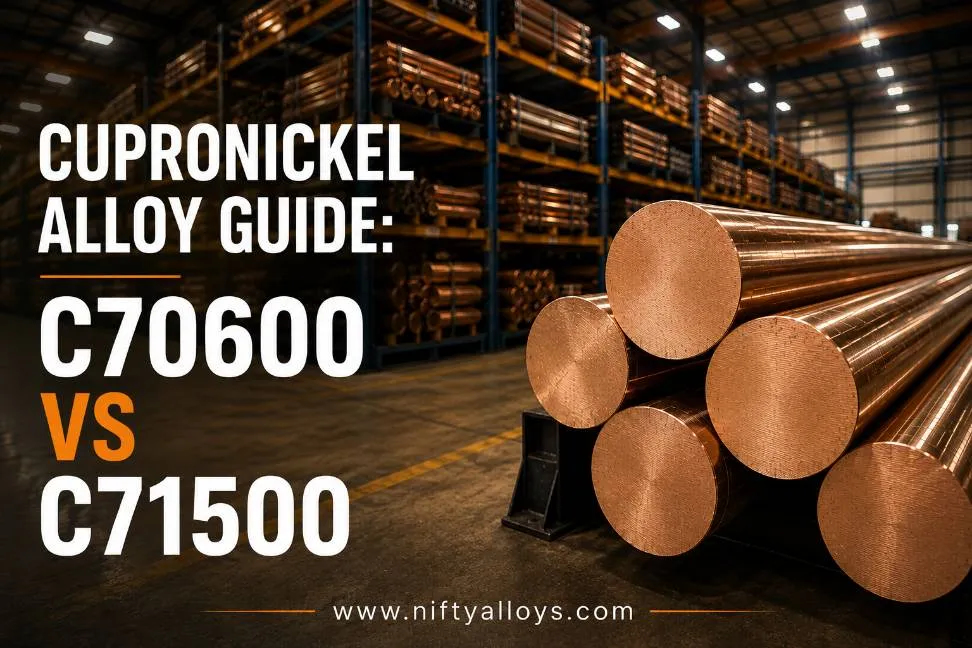
When engineers and procurement teams specify materials for seawater service — whether for a marine heat exchanger, a desalination brine circuit, a shipboard piping system, or an offshore platform cooling loop — copper nickel alloys appear at the top of the selection matrix for good reason. No other commercially available alloy family combines seawater corrosion resistance, biofouling resistance, thermal conductivity, ease of fabrication, and long service life at comparable cost. Cupronickel has been the material of choice for naval and marine applications for over a century, and remains the specification standard in oil and gas, marine, and water treatment projects across the UAE, GCC, and global markets.
This guide covers the two main cupronickel grades — C70600 (90/10) and C71500 (70/30) — their properties, applicable ASTM and ASME standards, key differences, and how to specify them correctly on a purchase order. For an overview of how Nifty Alloys handles material certification and MTC documentation for copper nickel supply, visit our certifications page.
What Is Cupronickel? The Copper Nickel Alloy Family
Cupronickel (cupro nickel) alloys are binary copper-nickel solid solutions in which nickel is the primary alloying element. Unlike many alloy systems, copper and nickel are completely miscible — they dissolve in each other in any proportion — resulting in a single-phase face-centred cubic (FCC) microstructure that delivers excellent ductility, formability, and weldability across the full composition range.
The two commercially dominant wrought grades are designated by their approximate copper-to-nickel ratio:
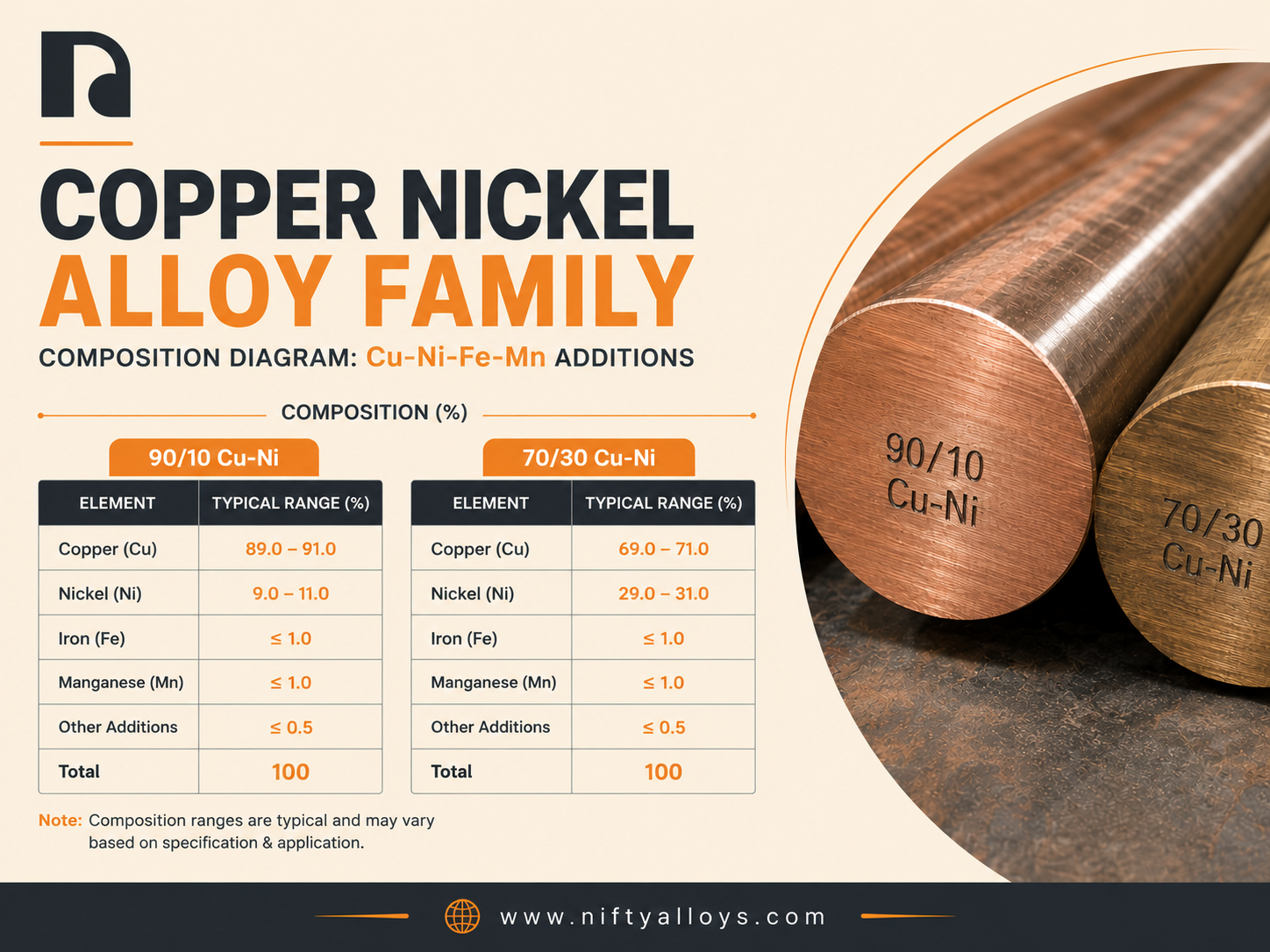
- 90/10 Cupronickel (CuNi10): nominally 88–90% copper and 9–11% nickel, with controlled additions of iron (1.0–1.8%) and manganese (0.5–1.0%). UNS designation C70600; EN equivalent CuNi10Fe1Mn (CW352H).
- 70/30 Cupronickel (CuNi30): nominally 68–70% copper and 29–33% nickel, with iron (0.4–1.0%) and manganese (0.5–1.5%) additions. UNS designation C71500; EN equivalent CuNi30Mn1Fe (CW354H).
The iron and manganese additions are critical to the performance of both grades. Iron improves resistance to impingement attack — the erosion mechanism caused by high-velocity or turbulent seawater — while manganese contributes to deoxidation and weldability. A modified 70/30 grade with higher iron and manganese content (sometimes designated CuNi30Mn1Fe or per EEMUA 234) offers even better impingement resistance for demanding offshore and high-velocity applications.
Why Copper Nickel for Seawater Service?
The selection of cupronickel for seawater and marine environments is driven by a combination of properties that no other alloy family replicates at the same cost-performance point:
- Outstanding seawater corrosion resistance: both 90/10 and 70/30 grades form a stable, adherent oxide film in seawater that provides continuous protection against general corrosion, pitting, and crevice attack — even in stagnant or low-flow conditions.
- Biofouling resistance: copper nickel alloys are inherently anti-biofouling. The release of copper ions creates a surface environment hostile to marine organism attachment — barnacles, mussels, algae, and microbial biofilm. This makes cupronickel the standard material for ship hulls, offshore platform cooling systems, and seawater intake screens where biofouling control is critical.
- Resistance to stress corrosion cracking (SCC): unlike many stainless steel grades that are vulnerable to SCC in chloride environments, cupronickel alloys are largely immune to stress corrosion cracking in seawater — a significant advantage in high-stress structural and piping applications.
- Good mechanical properties: cupronickel offers adequate strength, excellent ductility, and good fatigue resistance for marine service conditions. The 70/30 grade provides higher strength and is preferred where elevated pressure or temperature resistance is required.
- Excellent thermal conductivity and heat transfer: the thermal conductivity of C70600 (~45 W/m·K) and C71500 (~29 W/m·K) makes both grades highly efficient for condenser and heat exchanger tube applications.
- Ease of fabrication and welding: both grades are readily formed, drawn, and welded using standard techniques. The recommended filler metal is AWS A5.7 ERCuNi for both grades.
C70600 vs C71500: 90/10 vs 70/30 — Which Grade Do You Need?
The choice between 90/10 (C70600) and 70/30 (C71500) copper nickel is driven by the severity of the corrosion environment, required mechanical strength, operating velocity, and project economics. The table below provides a direct comparison across the critical selection criteria:
Feature | 90/10 Copper Nickel (C70600) | 70/30 Copper Nickel (C71500) |
| UNS Designation | C70600 | C71500 |
| EN / DIN Equivalent | CuNi10Fe1Mn (CW352H) | CuNi30Mn1Fe (CW354H) |
| Nominal Composition | 90% Cu, 10% Ni + Fe, Mn | 70% Cu, 30% Ni + Fe, Mn |
| Tensile Strength (annealed) | ~300 MPa | ~380 MPa |
| Yield Strength (annealed) | ~100–110 MPa | ~125–140 MPa |
| Seawater Corrosion Resistance | Excellent | Superior |
| Impingement / Erosion Resistance | Very good — preferred for condenser tubing | Excellent — preferred for high-velocity service |
| Max Service Temperature | ~315°C (600°F) | ~315°C (600°F) |
| Relative Cost | Lower | Higher — ~25–40% premium over 90/10 |
| Primary Applications | Condensers, heat exchangers, ship hulls, bilge systems | Seawater piping, offshore risers, desalination brine, high-pressure service |
| Key ASTM Standards | B111, B171, B466, B151 | B111, B171, B466, B151 |
When to Specify C70600 — 90/10 Copper Nickel
C70600 is the workhorse grade — the most widely specified copper nickel alloy globally. It is the preferred choice for:
- Condenser and heat exchanger tubing in power generation, desalination, and process plants where moderate seawater velocities apply (typically below 3 m/s).
- Ship hull sheathing and offshore platform splash zone cladding, where biofouling resistance and general seawater corrosion protection are the primary drivers.
- Bilge, ballast, and seawater cooling piping on commercial and naval vessels where cost efficiency is a priority alongside corrosion performance.
- Seawater intake and screening systems, including box coolers and keel coolers.
- Marine fittings, flanges, and fabricated assemblies in moderate corrosion service.
In cost-sensitive applications where the corrosion environment is not highly aggressive — typical seawater pH, moderate temperature, flow velocities within design limits — C70600 delivers excellent service life at a lower material cost than C71500.
When to Specify C71500 — 70/30 Copper Nickel
C71500 is specified where conditions exceed the capability of 90/10 or where mechanical strength requirements demand a higher-performance alloy:
- High-velocity seawater service — offshore risers, subsea flowlines, and pump discharge lines where flow velocities exceed 3 m/s and impingement erosion is a design risk.
- Desalination brine circuits — particularly high-temperature brine stages in MSF (multi-stage flash) distillation plants where both corrosion resistance and elevated temperature performance are required.
- High-pressure seawater injection systems in oil and gas — where the combination of pressure, velocity, and seawater chemistry exceeds C70600 capability.
- Naval and defence applications — where military specifications mandate 70/30 for critical piping systems on naval vessels.
- Offshore platform firewater and utility seawater systems — where classification society specifications call for enhanced corrosion resistance.
The 70/30 grade commands a 25–40% material cost premium over 90/10. The decision to upgrade should be based on operating conditions, design life requirements, and total lifecycle cost — not specification conservatism alone.
ASTM and ASME Standards for Copper Nickel Supply
Copper nickel alloys are supplied to a well-established set of ASTM and ASME standards that define composition, mechanical properties, dimensional tolerances, and testing requirements. The table below covers the standards most commonly referenced in marine, offshore, and process industry purchase orders:
| ASTM/ASME Standard | Covers | Grade(s) |
| ASTM B111 / ASME SB-111 | Seamless Cu-Ni tube and pipe for condensers and heat exchangers | C70600, C71500 |
| ASTM B171 / ASME SB-171 | Cu-Ni plate and sheet for pressure vessels, condensers, heat exchangers | C70600, C71500 |
| ASTM B466 / ASME SB-466 | Seamless Cu-Ni pipe and tube (general service) | C70600, C71500 |
| ASTM B151 / ASME SB-151 | Cu-Ni rod and bar | C70600, C71500 |
| ASTM B369 | Cu-Ni alloy castings | C96200 (90/10), C96400 (70/30) |
| MIL-T-16420 | Military specification — Cu-Ni tubing for naval vessels | C70600, C71500 |
For marine classification society-approved supply (for shipbuilding, FPSO, and offshore platform projects), copper nickel materials must additionally be certified per the applicable society's rules — typically ABS, DNV-GL, or Lloyd's Register. These certification bodies require witnessing and countersigning of the test certificate, equivalent to an EN 10204 Type 3.2 inspection certificate. Specify the required certificate type explicitly in your purchase order.
Key Applications of Copper Nickel Alloys in Marine, Offshore, and Industrial Service
Cupronickel is the dominant material in a range of critical infrastructure applications across the UAE, GCC, and global markets:
Desalination Plants
The UAE and wider GCC region operate some of the world's largest seawater desalination capacity. Copper nickel — primarily C70600 for condenser tubing and C71500 for high-temperature brine circuits — is a core material in multi-stage flash (MSF) and multi-effect distillation (MED) desalination plants. The combination of thermal efficiency, biofouling resistance, and seawater corrosion performance makes cupronickel the standard specification for heat transfer surface tubing and associated piping in these facilities.
Marine and Shipbuilding
Copper nickel alloys are specified across a broad range of shipbuilding applications: seawater piping systems, condenser and heat exchanger tube bundles, hull sheathing on commercial vessels and workboats, shaft sleeves, propeller components, and seachest gratings. C70600 is the standard grade for most marine piping and heat exchanger applications; C71500 is used where higher flow velocities or greater corrosion severity is encountered.
Offshore Oil and Gas
Offshore platforms and FPSOs specify copper nickel for seawater lift systems, cooling water distribution, firewater systems, and utility seawater piping. In sour service environments, cupronickel alloys do not fall within the scope of NACE MR0175 / ISO 15156 (which governs materials for H2S-containing service) — copper nickel selection in these environments is governed by the process conditions and design standard rather than NACE classification. Confirm with your project materials engineer when H2S or CO2 is present alongside seawater.
Power Generation and Process Industry
Steam surface condensers, auxiliary cooling systems, and process heat exchangers in thermal power stations and petrochemical plants use C70600 condenser tubing extensively. The combination of high thermal conductivity, long service life in seawater cooling duty, and low maintenance requirement makes cupronickel the preferred alternative to stainless steel in once-through cooling water applications.
How to Specify Copper Nickel in a Purchase Order
A well-written purchase order for copper nickel material should include:
- Grade and UNS designation: state 'C70600 (90/10 Cu-Ni)' or 'C71500 (70/30 Cu-Ni)' explicitly. Do not rely on shorthand alone — C706 and C715 are commonly used but can create ambiguity with suppliers in different markets.
- ASTM/ASME standard: specify the applicable product form standard — e.g. 'ASTM B111 seamless condenser tube' or 'ASTM B466 seamless pipe'. Include the UNS number within the standard reference: 'ASTM B466 UNS C70600'.
- Dimensions and tolerances: OD, wall thickness (or schedule), and length to applicable ASTM dimensional tolerances.
- Temper / condition: most applications specify annealed (OS025) or light drawn (H55). Confirm with your design standard.
- Certificate type: EN 10204 3.1 MTC as minimum for industrial and offshore supply. Classification society-witnessed EN 10204 3.2 where naval or class-approved shipbuilding is involved.
- Test requirements: state whether hydrostatic, eddy current, or other NDT is required in addition to standard ASTM mill testing.
For detailed guidance on EN 10204 certificate types — including when 3.1 vs 3.2 is required — refer to our EN 10204 certification guide.
Conclution
Nifty Alloys LLC is a Dubai-based specialist metals stockist supplying certified copper nickel alloys to marine, offshore, desalination, and industrial projects across the UAE, GCC, and global export markets.
We supply C70600 (90/10) and C71500 (70/30) copper nickel in pipe, tube, plate, rod, bar, and fittings — to ASTM B111, B171, B466, and B151 — with EN 10204 3.1 MTCs as standard. Classification society-witnessed EN 10204 3.2 certification is available on request. For our full range of nickel alloys and copper alloy products, including Monel, Alloy 625, and Alloy 825, visit our nickel alloys page.
All material certificates are reviewed by our in-house QA/QC team before dispatch. View our material quality and certifications page for our full certification and compliance capabilities.
 Let's Talk




Elevate Your Projects with
with
 Our Superior Steels
