

EN 10204 2.2 vs 3.1 vs 3.2 Certification Explained for Industrial Buyers
EN 10204 defines inspection document types for metallic products. Type 2.2 is a manufacturer's test report based on non-specific batch data. Type 3.1 is an inspection certificate with actual test results from the specific batch supplied, signed by the manufacturer's independent quality representative. Type 3.2 adds independent third-party or buyer-appointed verification — the highest assurance level under the standard, routinely required on oil and gas, offshore, and safety-critical projects.
When you raise a purchase order for nickel alloys, duplex stainless steel, titanium, or any engineered alloy in a project environment, the certificate type you specify on that PO determines who tests the material, which batch is tested, and whether an independent party validates the results before shipment. Getting this wrong — or leaving it unspecified — creates downstream QA problems, rejected material at incoming inspection, and potential project delays.
Every certified metallic product ships with a mill certificate or MTC (Mill Test Certificate) — but not all certificates carry the same weight. EN 10204 (also referenced as EN ISO 10204:2004) is the internationally recognised standard that defines exactly what each document type must contain. This guide focuses on the three certificate types most relevant to industrial procurement — Types 2.2, 3.1, and 3.2 — explaining when to specify each and how they differ. The full four-type framework including Type 2.1 is shown in the comparison table for reference.
What Is EN 10204? The Standard Every Industrial Buyer Should Know
EN 10204 — formally titled Metallic Products: Types of Inspection Documents — is a European standard originally derived from the German DIN 50049 specification, also widely referenced as DIN EN 10204 in German-speaking and European industrial markets. It was first published in 1991 and substantially revised in 2004 to produce the current framework in force today (EN ISO 10204:2004).
The standard applies to any metallic product delivered to a purchaser: plates, bars, pipes, tubes, forgings, castings, and fittings. Its purpose is to standardise what a manufacturer must document, test, and sign before handing over a consignment — providing buyers with a clear, auditable basis for material traceability and compliance.
The standard is referenced in purchase orders, inspection and test plans (ITPs), project specifications, and classification society requirements worldwide. Understanding its document types is a daily requirement for procurement engineers, QA/QC professionals, and project buyers working in oil and gas, marine, petrochemical, and heavy engineering sectors.
The Three Key Certificate Types at a Glance
EN 10204:2004 defines four document types in ascending order of assurance. The three most commonly specified on industrial projects are:
- Type 2.2 — Test Report: manufacturer declares compliance and provides test results, but from non-specific (generic) production batches.
- Type 3.1 — Inspection Certificate 3.1: specific batch test results, validated by the manufacturer's own independent inspection representative (independent of the production department).
- Type 3.2 — Inspection Certificate 3.2: same as 3.1, plus countersigned by an independent third-party inspector (TÜV, BV, DNV-GL, SGS, LR, or customer-appointed representative).
EN 10204 Type 2.2 — Test Report (Non-Specific)
A Type 2.2 certificate includes a declaration of compliance plus test results — but from non-specific inspections. The results are drawn from representative samples of the general production batch or product type, not necessarily from the exact heat or lot being shipped to you.
The tests are conducted under the manufacturer's internal quality control procedures and are not independently verified. Type 2.2 does not provide the heat-specific traceability that most project specifications demand. It may be acceptable for general engineering or light fabrication work where the risk profile does not justify the cost of full 3.1 certification.
EN 10204 Type 3.1 — Inspection Certificate (Manufacturer-Signed)
A 3.1 certificate EN 10204 is the most widely specified inspection document on industrial, oil and gas, and petrochemical projects. It provides actual test results from the specific lot or heat of material being supplied — giving full traceability from the heat number to the delivered item.
The certificate is issued and signed by the manufacturer's authorised inspection representative, who must be independent of the manufacturing department (typically the QA/QC manager or test laboratory supervisor). This internal independence is a core requirement of the standard.
A 3.1 MTC typically includes: chemical composition test results, mechanical property test results (tensile, yield, elongation), impact testing where specified, hardness results, dimensional inspection data, and a statement of conformity to the applicable material standard (ASTM, EN, or equivalent).
For materials such as Monel K500, Alloy 625, UNS S32205 Duplex, S32750 Super Duplex, and C95800 Naval Bronze used in oil and gas, marine, and petrochemical projects across the UAE and GCC — a 3.1 certificate is the minimum acceptable standard in most project and EPC contractor specifications.
EN 10204 Type 3.2 — Inspection Certificate (Third-Party Verified)
EN 10204 3.2 is the highest assurance level under the standard. It contains all the content of a 3.1 certificate but adds a second layer of validation: an independent third-party inspector or the buyer's own authorised inspection representative witnesses and countersigns the document.
Third-party bodies commonly involved in 3.2 certification include Bureau Veritas (BV), DNV-GL, TÜV, SGS, Lloyds Register, and ABS. The third party performs or witnesses the testing independently, then validates and signs the certificate alongside the manufacturer's inspector.
Type 3.2 is specified on projects where the consequences of material failure are severe: offshore platforms, subsea pipelines, LNG terminals, nuclear-adjacent process equipment, and classification society-governed marine construction. The additional cost and lead time associated with EN 10204 type 3.2 certificates should be factored into procurement schedules — requesting a 3.2 certificate after material is already in stock typically requires additional testing and can delay supply.
Side-by-Side Comparison: EN 10204 Type 2.1 vs 2.2 vs 3.1 vs 3.2
All four certificate types are shown below for complete reference. Types 2.2, 3.1, and 3.2 are the most relevant for industrial procurement.
Feature | Type 2.1 | Type 2.2 | Type 3.1 | Type 3.2 |
| Full Name | Declaration of Compliance | Test Report | Inspection Certificate 3.1 | Inspection Certificate 3.2 |
| Test Results Included? | No | Non-specific (generic batch) | Yes — specific batch supplied | Yes — specific batch supplied |
| Who Signs? | Manufacturer | Manufacturer | Manufacturer's independent inspector (QA/QC dept) | Manufacturer + 3rd party / buyer's inspector |
| Third-Party Verification? | No | No | No | Yes (TÜV, BV, DNV-GL, SGS, LR, etc.) |
| Heat/Batch Traceability? | No | Partial | Full | Full |
| Cost & Lead Time | Lowest | Low | Standard | Higher — plan in advance |
| Typical Application | General commercial, low-risk components | Non-critical engineering, standard structural | Oil & gas, petrochemical, pressure vessels, marine | Critical offshore, nuclear-adjacent, high-consequence process lines |
Which Certificate Does Your Project Actually Need?
The answer depends on your project specification, industry, and the consequence of material non-conformance. Below are the standard requirements across the main sectors served in the UAE, GCC, and global export markets.
Oil & Gas and Petrochemical Projects
For EPC contractors, major operator supply chains, or any upstream/downstream oil and gas application — Type 3.1 is the minimum. Where classification society approval (ABS, DNV-GL, LR) is required, or where the purchase order references third-party witnessing, Type 3.2 applies. Nickel alloys, duplex and super duplex stainless steels, and titanium grades for process and downhole service are routinely supplied with 3.1 MTCs, with 3.2 available on specific project request.
Marine and Offshore Applications
Shipbuilding, FPSO fabrication, and offshore structural applications referencing ABS, DNV-GL, or Lloyd's Register rules require 3.2 certification for most structural and pressure-retaining components. Naval bronze alloys (C95800), nickel alloys, and stainless steel for marine service are typically procured with 3.2 where class society sign-off is part of the fabrication scope.
General Engineering and Fabrication
For non-pressure, non-safety-critical general engineering work — brackets, frames, non-critical piping, support structures — Type 2.2 or 3.1 is commonly acceptable depending on the end-user's quality plan. Always check your project ITP and purchase order conditions before specifying a lower certificate type; discrepancies discovered at incoming inspection are expensive to resolve.
Frequently Asked Questions
Is a 3.1 certificate the same as a Mill Test Report (MTR)?
Yes — in common industrial usage, the terms mill test certificate (MTC), Mill Test Report (MTR), and 3.1 certificate are often used interchangeably for specific-batch inspection documents. Technically, 'EN 10204 3.1' describes the document type and validation standard, while MTC/MTR describes the document format. On most projects, a 3.1 MTC satisfies the MTR requirement.
Can a 3.1 certificate be upgraded to 3.2 after delivery?
Not in the standard sense. A 3.2 certificate requires independent witnessing or verification of the actual tests at the time of testing. Retrospective third-party sign-off on an existing 3.1 certificate is not compliant with EN 10204 requirements unless specifically agreed in the purchase order and witnessed accordingly. Always specify 3.2 in the PO before material is produced.
Does EN 10204 apply to non-European material?
Yes. EN 10204 is an internationally referenced standard adopted globally across project supply chains regardless of where the material is manufactured. ASTM-produced material from US or Asian mills can — and often is — certificated to EN 10204 3.1 or 3.2 by agreement with the buyer. Many EPC and operator specifications in the Middle East and Asia-Pacific explicitly require EN 10204 certification regardless of material origin.
What is the difference between a 3.1 and a 3.2 for NACE MR0175 materials?
NACE MR0175 (ISO 15156) is a material qualification standard for sour service, not a certification document standard. It defines which alloys and conditions are acceptable for H₂S environments. The EN 10204 certificate type (3.1 or 3.2) validates that the specific batch of NACE-compliant material was tested and conforms to the order. For sour service projects, a 3.1 MTC confirming NACE MR0175 compliance is the standard minimum; 3.2 may be required by the operator or project engineer for critical components.
Which EN 10204 certificate should I specify in my purchase order?
State it explicitly in the PO line item: e.g. 'Certificate Type: EN 10204 3.1' or 'EN 10204 3.2 — countersigned by [third-party body].' Leaving it unspecified gives the supplier discretion and may result in a 2.2 document that your project QA will reject at incoming inspection.
Source Certified EN 10204 Materials from Dubai
Nifty Alloys LLC is a Dubai-based specialist metals stockist supplying certified engineered alloys to oil and gas, marine, petrochemical, and heavy engineering sectors across the UAE, GCC, and global export markets.
We supply nickel alloys (Monel K500, Alloy 625), duplex and super duplex stainless steels (UNS S32205, S32750), titanium (Ti-6Al-4V), naval bronze (C95800), and a full range of stainless and tool steels — with EN 10204 3.1 MTCs as standard and 3.2 certification available on request against project specifications.
All certificates are reviewed by our in-house QA/QC team before dispatch. NACE MR0175, ABS, and DNV-GL certified supply is available for relevant grades
 Let's Talk
Oil and gas relies mainly on carbon and low-alloy steels, upgraded to corrosion-resistant alloys whe...
Super duplex is used in firewater and seawater piping because its PREN of 40 or more resists pitting...
A complete nickel alloy bar order states the UNS number, the ASTM or ASME product standard and grade...
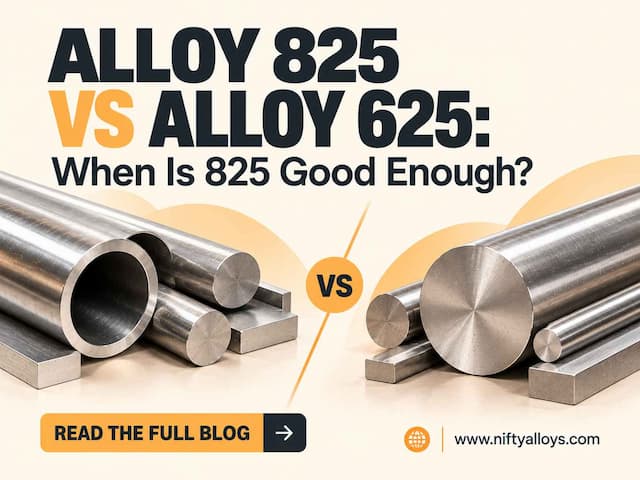
Alloy 825 is a nickel-iron-chromium alloy with 2.5–3.5% molybdenum plus copper, suited to sulfuric a...




Elevate Your Projects with
with
 Our Superior Steels
