

4140 Steel Heat Treatment: Temperature, Hardness & Tempering Chart
This guide provides a technical deep dive into AISI 4140 mechanical properties across various conditions. We will cover the science behind heat treatment, detailed hardness ranges, tensile and yield strength data, and the practical differences between buying stock material versus ordering custom specifications. Our goal is to equip you with the data needed to make informed purchasing decisions for your projects in the UAE, GCC, and beyond.
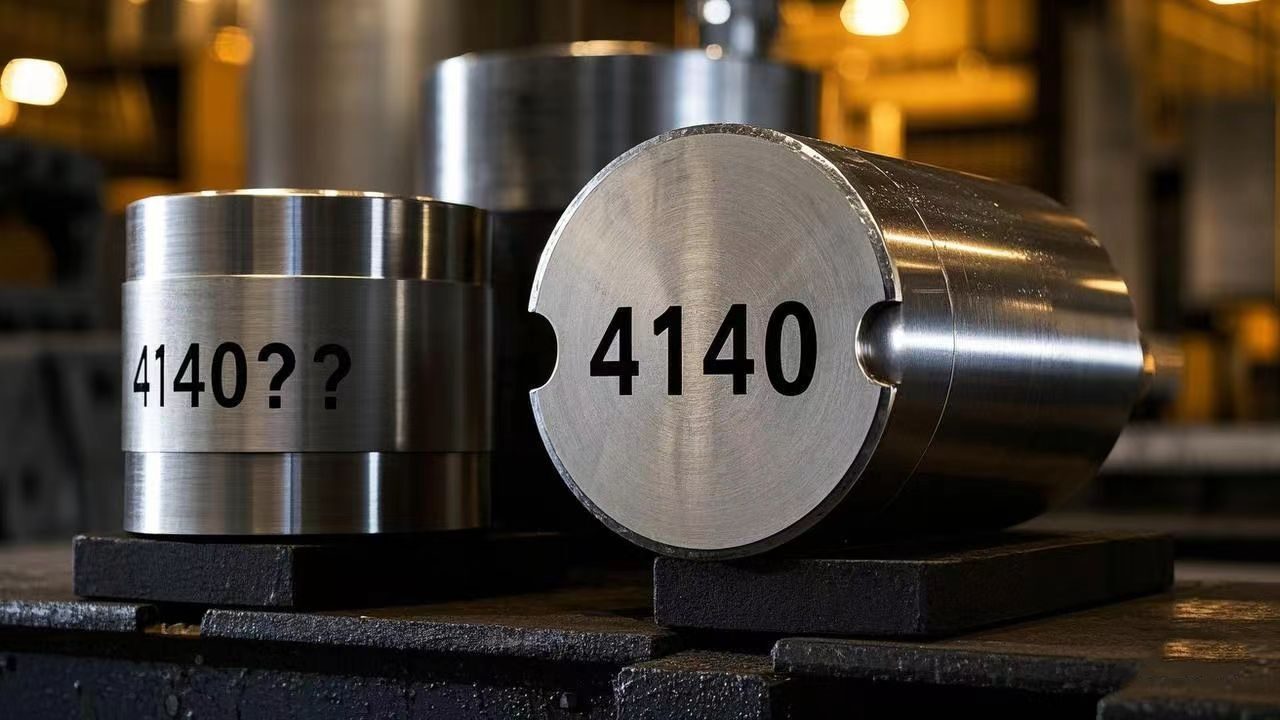
4140 steel is heat treated by austenitizing at 845–870°C, oil quenching, then tempering between 200°C and 650°C depending on the required hardness. Properly tempered AISI 4140 achieves between 28 HRC and 57 HRC. This guide covers the full heat treatment process, hardness ranges, mechanical properties, and equivalent grades for procurement and engineering teams in the UAE, GCC, and global markets.
Understanding the relationship between 4140 material properties and thermal processing is critical for specifying the right material for your application. Whether you require high 4140 tensile strength for a power transmission shaft or a specific 4140 hardness range for
Heat treatment procedure for 4140 steel
4140 steel (42CrMo4 / EN19T) responds well to all standard heat treatment processes. The following temperatures are the industry-standard references for each condition:
Heat treatment reference table
| Condition | Temperature | Quench medium | Typical hardness | Notes |
| Annealing | 840–870°C | Furnace cool | 197 HB max | Softens for machining |
| Normalising | 870–900°C | Air cool | ~217 HB | Relieves internal stress |
| Hardening (austenitising) | 845–870°C | Oil quench | 55–60 HRC | Maximum hardness |
| Tempering at 200°C | 200°C | — | 54–57 HRC | High hardness, some brittleness |
| Tempering at 400°C | 400°C | — | 46–50 HRC | Balanced hardness/toughness |
| Tempering at 550°C | 550°C | — | 32–38 HRC | High toughness, good strength |
| Tempering at 620°C (T condition) | 600–650°C | — | 28–32 HRC / 277–331 HB | Standard EN19T / 42CrMo4 +QT |
| Pre-hardened (PH) condition | 28–34 HRC | — | As-supplied | Ready for direct machining |
What Is AISI 4140 Alloy Steel?
AISI 4140 is a low-alloy steel containing chromium, molybdenum, and manganese. It falls under the general classification of medium-carbon steel but offers significantly improved hardenability and fatigue strength compared to plain carbon alternatives like AISI 1045. The "41" in its designation indicates a chromium-molybdenum alloy, while "40" represents an approximate carbon content of 0.40%.
4140 Steel Chemical Composition
While standards vary slightly between ASTM, SAE, and international equivalents, the typical chemical composition of AISI 4140 is:
| Element | Symbol | Composition (%) |
|---|---|---|
| Carbon | C | 0.38 – 0.43 |
| Manganese | Mn | 0.75 – 1.00 |
| Silicon | Si | 0.15 – 0.35 |
| Chromium | Cr | 0.80 – 1.10 |
| Molybdenum | Mo | 0.15 – 0.25 |
| Phosphorus | P | ≤ 0.035 (max) |
| Sulfur | S | ≤ 0.040 (max) |
| Iron | Fe | Balance |
This specific chemistry allows AISI 4140 alloy steel to achieve deep hardening during heat treatment. The chromium adds hardness and strength, while the molybdenum enhances toughness and hardenability. This makes it far superior to plain carbon steels, which often suffer from brittleness when treated to high hardness levels.
In its "as-rolled" or annealed condition, general AISI 4140 mechanical properties provide decent machinability but relatively low strength. To maximize its utility in high-stress environments—such as downhole drilling tools or hydraulic machinery—heat treatment is not optional; it is essential.
For detailed product specifications and stock sizes, visit our AISI 4140 alloy steel page.
Why Heat Treatment Matters for 4140 Steel
Heat treatment is the controlled heating and cooling of metals to alter their physical and mechanical properties without changing the product shape. For AISI 4140, this process is the primary dial engineers turn to control the trade-off between strength and ductility.
Microstructural Control
At the microscopic level, heat treatment manipulates the steel's grain structure. Heating the steel above its critical temperature (austenitizing) transforms the internal structure into austenite. Rapid cooling (quenching) traps carbon atoms in the crystal lattice, forming martensite—a hard, strong structure. Subsequent heating (tempering) relaxes this structure slightly to regain toughness.
Controlling Mechanical Outputs
The specific heat treatment cycle directly dictates:
- 4140 hardness: The resistance to indentation and wear.
- 4140 tensile strength: The maximum stress the material can withstand while being stretched before breaking.
- 4140 yield strength: The stress level at which the material begins to deform plastically (permanently).
Without proper heat treatment, a 4140 shaft might either be too soft to transmit torque (annealed) or too brittle to withstand shock loading (as-quenched). By selecting the correct process—whether normalizing for uniformity or quenching and tempering for high strength—you ensure the component will survive its service life.
Common 4140 Heat Treatment Processes
The versatility of AISI 4140 lies in its response to different thermal cycles. Below are the standard treatments available from suppliers and heat-treat facilities.
Annealed 4140 Steel
Annealing involves heating the steel to approximately 815°C (1500°F) and then cooling it very slowly in the furnace. The goal is to soften the steel as much as possible to improve machinability and ductility.
- Purpose: To relieve internal stresses and prepare the material for extensive machining or cold forming.
- 4140 Annealed Hardness: Typically ranges from 197 to 217 HB (Brinell).
- Machinability: This is the easiest condition to machine. If you are manufacturing complex parts that will be heat-treated later, buying annealed stock is often the most cost-effective strategy.
- Applications: Use annealed 4140 for parts requiring heavy metal removal before the final hardening process.
It is important to note that 4140 material hardness in the annealed state is insufficient for most structural applications; it is strictly a processing state.
Normalized 4140
Normalizing involves heating the steel to roughly 870°C (1600°F) and allowing it to cool in still air. This cooling rate is faster than annealing but slower than quenching.
- Difference vs. Annealed: Normalizing refines the grain size and homogenizes the microstructure. It produces a harder and stronger material than annealing.
- Property Improvements: It provides a consistent structure that machines well and offers moderate strength (roughly 850–1000 MPa tensile).
- Use Cases: Normalized 4140 is frequently used for large forgings or structural parts where quenching might cause distortion or cracking, but higher strength than plain carbon steel is required.
Quenched & Tempered (Q&T) 4140
This is the most common condition for finished engineering components. It is a two-step process:
- Hardening (Quenching): Heating to ~845°C–870°C, holding until uniform, and quenching in oil. Oil quenching is preferred over water to reduce the risk of cracking.
- Tempering: Reheating to a temperature between 200°C and 650°C to achieve the desired hardness.
- 4140 Hardness Ranges (HRC): Depending on the tempering temperature, hardness can range from 28 HRC to over 50 HRC. Common pre-hardened stock (like 4140HT) is usually supplied at 28–32 HRC.
- Tensile & Yield Strength: Lower tempering temperatures yield higher strength but lower toughness. Higher tempering temperatures increase ductility but lower the tensile strength.
Selecting Temperatures:
- 205°C Temper: ~50–55 HRC (High wear resistance, low toughness)
- 315°C Temper: ~45–50 HRC
- 540°C Temper: ~32–36 HRC (Excellent balance of strength and toughness for shafts)
For a comparison of how this differs from tool steels, refer to our Tool steel grades explained article.
Optional Treatments
- Induction Hardening: 4140 is an excellent candidate for surface hardening. The core remains tough (often Q&T to 30 HRC), while the surface is induction hardened to 50–55 HRC for wear resistance.
- Nitriding: Can be applied to increase surface hardness and corrosion resistance without the distortion associated with quenching.
In-Stock Heat-Treated 4140 Steel Options
For many projects, waiting for a custom heat-treat cycle is not feasible due to tight project timelines. Fortunately, Nifty Alloys stocks AISI 4140 in several pre-treated conditions to support urgent maintenance and fabrication needs.
- Common Stocked Conditions
- Annealed: The standard for raw stock intended for heavy machining. Available in large diameter rounds and blocks.
- Quenched & Tempered (Pre-Hardened/HT): This is the industry "workhorse." Usually supplied at 28–32 HRC (approx. 275–320 HB). This condition is machineable (though harder than annealed) and can be put directly into service after machining without further heat treatment.
Typical Forms
- Round Bars: From small diameters (20mm) up to large forged bars (800mm+).
- Shafts: Precision ground shafting (PSQ) is often available in Q&T condition.
- Flats and Blocks: Saw-cut from large forged blocks for mold bases or structural plates.
Benefits of Stock Material
- Speed: Immediate dispatch eliminates the 1–2 week lead time for heat treatment.
- Predictability: Stock Q&T bars come with defined 4140 mechanical properties verified by Mill Test Certificates (MTCs), reducing the risk of heat-treat failures during fabrication.
Visit our 4140 alloy steel supplier page to view current inventory.
Custom Heat Treatment Specifications
While stock material covers 80% of applications, critical oil & gas or aerospace components often require custom mechanical properties. When issuing a Purchase Order (PO) for custom 4140, precision in specification is vital.
How to Specify
Avoid vague terms like "heat treat to maximum hardness." Instead, specify a range:
- Target Hardness: e.g., "Heat Treat to 34–38 HRC."
- Mechanical Minimums: e.g., "Min Yield Strength 100 ksi (690 MPa), Min Impact Energy 40J @ -20°C."
- Condition: e.g., "Quenched and Tempered."
Importance of Process Control
When ordering custom-treated material, ensure your supplier provides:
- Heat Treatment Charts: Verification of time and temperature cycles.
- Mill Test Certificates (MTCs): Confirmed mechanical testing results from the specific batch (heat).
- Non-Destructive Testing (NDT): Ultrasonic testing (UT) is crucial after aggressive quenching to ensure no internal cracks have formed.
Custom treatment is mandatory when the required 4140 tensile strength exceeds standard stock levels (e.g., >1100 MPa) or when parts are too large to achieve uniform hardness through the cross-section in standard bar stock.
AISI 4140 Mechanical Properties & Hardness Table
The table below provides typical values for 1-inch (25mm) round bars. Note that properties decrease as the section size (diameter) increases due to the "mass effect" during quenching.
Condition | Tempering Temp (°C) | Hardness (HB / HRC) | Tensile Strength (MPa) | Yield Strength (MPa) | Elongation (%) |
| Annealed | - | 197–217 HB | ~655 | ~415 | 25% |
| Normalized | - | 250–300 HB | ~1020 | ~650 | 17% |
| Q&T (High Strength) | 205°C | 52–57 HRC | ~2000 | ~1600 | 8% |
| Q&T (Medium) | 315°C | 45–50 HRC | ~1700 | ~1450 | 10% |
| Q&T (Tough) | 425°C | 38–42 HRC | ~1400 | ~1250 | 12% |
| Q&T (Standard HT) | 540°C | 28–32 HRC | ~1000–1100 | ~850–950 | 18% |
| Q&T (High Ductility) | 650°C | 24–28 HRC | ~850 | ~700 | 22% |
Engineering Interpretation:
Engineers must note that 4140 yield strength drops significantly as tempering temperatures rise. If your design requires the material to remain elastic under heavy loads, you need a lower temper (higher hardness). However, if the part is subject to impact or shock (like a hammer head or axle), you must sacrifice some yield strength for elongation and impact toughness to prevent catastrophic brittle failure.
Typical Applications by Heat Treat Condition
Selecting the right condition extends the service life of your components.
Annealed 4140
- Pre-machined components: Parts with complex geometries that will be hardened later.
- Low-stress housings: Where the alloy chemistry is needed for weldability or mild corrosion resistance, but high strength is not required.
Normalized 4140
- Large Shafts: Where quenching might warp the long bar.
- Structural Tie Rods: Provides better strength than mild steel without the cost of full Q&T.
- Oil & Gas Subs: Basic downhole tools where moderate strength is sufficient.
Quenched & Tempered (Q&T) 4140
- Gears and Pinions: Usually tempered to 30–35 HRC for core strength, often followed by induction hardening on the teeth.
- Crankshafts & Connecting Rods: Requires the high fatigue strength of the Q&T condition.
- Bolts and Fasteners: High-strength B7 studs are chemically similar to 4140.
- Heavy Machinery Parts: Axles, spindles, and conveyor rolls in mining and cement industries.
AISI 4140 Equivalent Materials
Global sourcing often requires knowledge of equivalent grades. While chemistry overlaps, always verify the AISI 4140 equivalent material standards to ensure they meet your specific mechanical requirements.
| Standard / Country | Equivalent Grade | Standard Number | Notes |
|---|---|---|---|
| USA (AISI / SAE) | 4140 | SAE J404 / ASTM A29 | Base designation |
| USA (UNS) | G41400 | UNS | Unified numbering system |
| Europe (EN) | 42CrMo4 | EN 10083-3 | Most common European equivalent |
| Germany (DIN) | 1.7225 | DIN EN 10083-3 | Same as EN 42CrMo4 |
| Japan (JIS) | SCM440 | JIS G4051 | Widely used in Asia |
| China (GB) | 42CrMo | GB / T 3077 | Chinese equivalent |
| UK (BS) | 708M40 | BS 970 | Older British standard |
| France (AFNOR) | 42CD4 | NF A35-552 | French equivalent |
| ISO | 42CrMo4 | ISO 683-1 | International designation |
Warning: While "equivalent" suggests identical performance, slight variations in Manganese or Chromium can affect heat treat response. Always review the MTC before substituting 42CrMo4 for AISI 4140 in critical applications.
Nifty Alloys supplies AISI 4140 round bars, pre-hardened flats, and forged blocks to customers across Dubai, Abu Dhabi, Saudi Arabia, Qatar, Oman, and the wider GCC. Stock is available in annealed and Q&T (28–32 HRC) conditions with EN 10204 3.1 Mill Test Certificates. Contact us for cut-to-size requirements, urgent dispatch, or custom heat treatment specifications.
FAQ
What is 4140 annealed hardness?
Typical 4140 annealed hardness is between 197 and 217 Brinell (HB). This is the softest state, ideal for machining.
What hardness can 4140 reach after heat treatment?
In the as-quenched condition, 4140 can reach 55–57 HRC. However, it is rarely used in this brittle state. Practical working hardness after tempering is usually between 28 HRC and 50 HRC.
What are typical 4140 tensile and yield strength values?
For standard pre-hardened (Q&T) stock:
- Tensile Strength: ~1000–1100 MPa
- Yield Strength: ~850–950 MPa
Is 4140 good for fatigue applications?
Yes. The molybdenum content provides excellent fatigue resistance, making it ideal for cyclically loaded parts like crankshafts and gears.
Does heat treatment reduce machinability?
Yes. While annealed 4140 machines easily, Q&T 4140 (at 30 HRC) requires slower speeds and carbide tooling. Machining 4140 above 45 HRC typically requires grinding or hard turning.
How should I specify AISI 4140 mechanical properties on a PO?
Be specific. State the standard (e.g., ASTM A193 or A434), the condition (e.g., Quenched & Tempered), and the required hardness range or minimum yield strength.
Need certified 4140 alloy steel bar or plate in UAE? Nifty Alloys stocks AISI 4140 (42CrMo4) in round bar, flat bar, and plate — supplied with EN 10204 3.1 MTC. Fast delivery across Dubai, Abu Dhabi, and GCC. Enquire now.
 Let's Talk
A complete nickel alloy bar order states the UNS number, the ASTM or ASME product standard and grade...
Alloy 825 is a nickel-iron-chromium alloy with 2.5–3.5% molybdenum plus copper, suited to sulfuric a...
Carbon equivalent (Ceq) is calculated using the IIW formula — CEV = C + Mn/6 + (Cr+Mo+V)/5 + (Ni+Cu)...
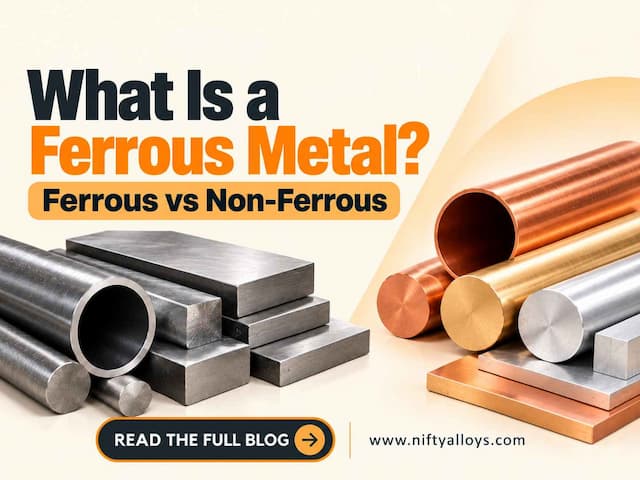
metal magnetism What Is a Ferrous Metal? Ferrous vs Non-Ferrous Explained Quick Answer ...




Elevate Your Projects with
with
 Our Superior Steels
