

EN8 Round Bar: Properties, Hardness & Applications Guide
EN8 round bar guide covering properties, hardness, machinability, applications, and UAE sourcing from Nifty Alloys. Request certified stock support fast.
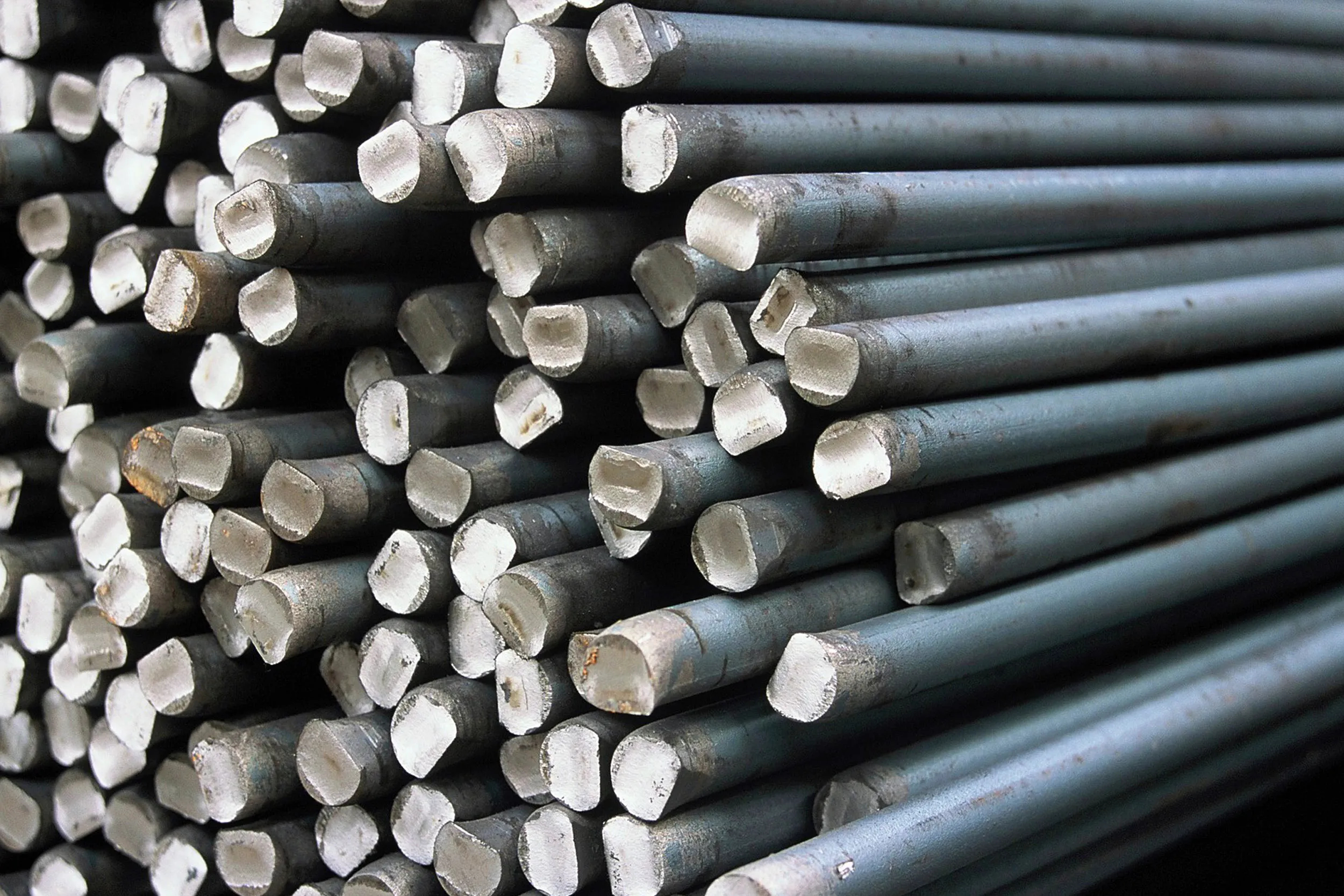
EN8 round bar is a medium-carbon engineering steel bar, commonly linked to BS 970 EN8 / 080M40, selected when shafts, axles, pins, bolts, studs, and machine components need higher strength than mild steel without the cost of alloy steel. EN8 round bar is an unalloyed medium-carbon steel product with approximately 0.36–0.44% carbon, good machinability, reasonable tensile strength, and heat-treatable surface hardness. Nifty Alloys supplies EN8 / 080M40 sourcing support in the UAE for buyers who need certified material, cut-to-size bars, and practical grade guidance for engineering applications.
WHAT IS EN8 ROUND BAR?
EN8 round bar is a solid cylindrical bar made from EN8 / 080M40 medium-carbon steel, used for machined parts that require better strength and wear performance than mild steel. It is commonly supplied as black round bar, bright drawn bar, turned bar, or normalized bar depending on tolerance, surface finish, and machining requirements. EN8 can also be flame hardened, induction hardened, or quenched and tempered where higher surface hardness or strength is required.
EN8 Round Bar Properties and Standard Designations
EN8 round bar is defined mainly by its medium-carbon chemistry, BS 970 / 080M40 designation, supply condition, and heat-treatment condition. Buyers should always confirm the exact grade, condition, and test values on the mill test certificate before machining or heat treatment.
Common EN8 designations and close equivalents include:
| Standard / System | Common Designation | Notes for Buyers |
|---|---|---|
| BS 970:1955 | EN8 | Traditional British engineering steel name |
| BS 970 / PD970 | 080M40 | Modern specification commonly used for EN8 |
| European grades | C40, C45, Ck40, Ck45 | Similar grades; not automatic substitutes without MTC check |
| Werkstoff | 1.0511, 1.1186, 1.1189 | Used in European supply chains |
| SAE / AISI | 1038, 1040, 1045 | Similar medium-carbon grades; AISI 1040 is commonly referenced as close to 080M40 |
| JIS | S40C, S45C | Similar Japanese medium-carbon steel grades |
EN8 / 080M40 equivalents vary by chemistry range, sulfur/phosphorus limits, heat-treatment route, and mechanical condition, so procurement should treat them as “near equivalents” unless the project specification permits substitution.
Typical EN8 / 080M40 Chemical Composition
| Element | Typical Range / Limit |
|---|---|
| Carbon, C | 0.36–0.44% |
| Manganese, Mn | 0.60–1.00% |
| Silicon, Si | 0.10–0.40% |
| Phosphorus, P | 0.05% max |
| Sulfur, S | 0.05% max |
| Residual Cr / Ni / Mo | May appear in small residual limits depending on supplier data |
The carbon range is what gives EN8 better strength and hardenability than mild steel, while manganese supports strength and toughness. The phosphorus and sulfur limits must be checked carefully when the component requires welding, fatigue resistance, or clean machining performance.
EN8 Round Bar Hardness and Mechanical Strength
EN8 round bar hardness depends heavily on whether the bar is normalized, bright drawn, quenched and tempered, or supplied in “R” condition. A typical normalized EN8 bar may sit around 152–207 HB, while quenched and tempered “R” condition can reach about 201–255 HB with higher tensile strength.
| EN8 Condition | Tensile Strength | Yield / Proof Strength | Elongation | Typical Hardness |
|---|---|---|---|---|
| Normalized | 550 MPa min | 280 MPa min | 16% min | 152–207 HB |
| Drawn | 650 MPa min | 510 MPa min | 8% min | Supplier-dependent |
| Q condition | 625–775 MPa | 385 MPa yield / 355 MPa proof | 16% min | 179–229 HB |
| R condition | 700–850 MPa | 465 MPa yield / 450 MPa proof | 16% min | 201–255 HB |
For purchase orders, specify hardness in HB or HRC only when the application requires it. For example, a general shaft may need normalized EN8 / 080M40, while a wear-loaded pin may need quenched and tempered or induction-hardened EN8 with hardness, case depth, and core properties clearly defined.
Machinability of EN8 Round Bar
EN8 round bar has good machinability for a medium-carbon steel, especially in normalized, annealed, or bright drawn conditions. It machines better than many higher-alloy steels, but it is not as free-cutting as sulfurized grades such as EN8DM / 212A42.
For best machining results:
- Use normalized EN8 / 080M40 for heavy roughing where consistent chip formation matters.
- Use bright drawn EN8 when the buyer needs better dimensional tolerance and surface finish.
- Leave machining allowance on black bar to remove scale, decarburized surface, or handling marks.
- Use rigid fixturing and suitable cutting fluid to reduce chatter on shafts, pins, and threaded parts.
- Consider EN8DM / 212A42 for high-volume repetition machining where improved chip breaking and surface finish are more important than standard EN8 chemistry.
EN8 is widely described as readily machinable, and some suppliers specifically offer sulfurized variants for easier machining in rounds and hexagons.
Need EN8 round bar in the UAE? Request a quote from Nifty Alloys
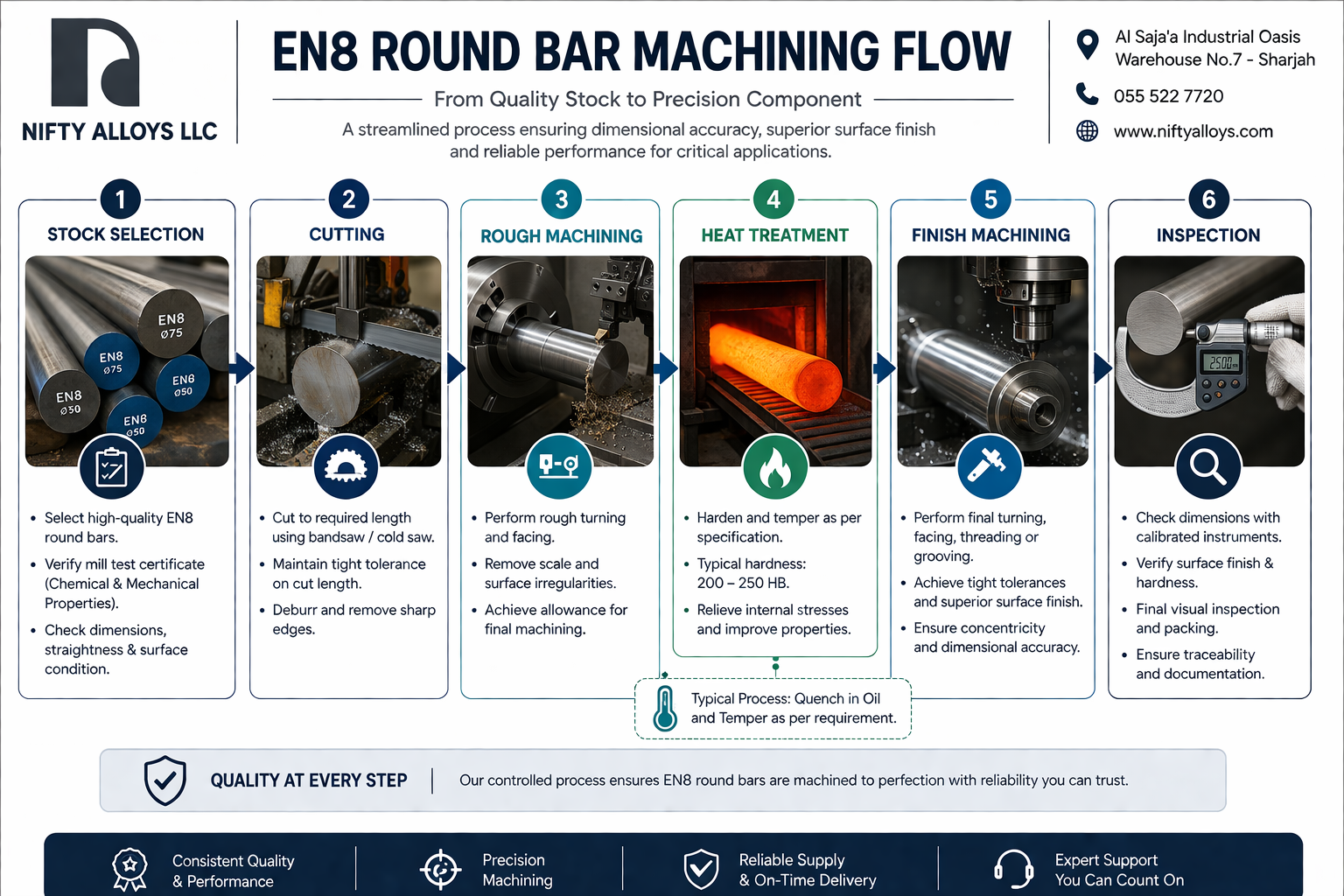
Heat Treatment, Weldability and Surface Hardening
EN8 round bar can be normalized, quenched and tempered, flame hardened, or induction hardened depending on the final component requirement. It is more heat-treatable than mild steel, but welding needs more control because EN8 has higher carbon content and reduced weldability compared with low-carbon steel.
Common heat-treatment references include:
| Process | Typical Guidance | Why It Is Used |
|---|---|---|
| Normalizing | Around 830–860°C, then air cool | Refines structure and improves consistency before machining |
| Tempering | Around 550–660°C, often after hardening | Balances hardness, strength, and toughness |
| Quenching | Oil or water depending on section and specification | Increases hardness and strength |
| Flame / induction hardening | Surface hardening process | Improves wear resistance on journals, pins, gears, and contact surfaces |
Welding EN8 should not be treated like welding mild steel. For thicker sections, preheat, controlled cooling, and post-weld heat-treatment advice may be needed to reduce cracking risk; supplier datasheets also note reduced weldability and heat-treatment requirements on larger sections.
Industrial Applications of EN8 Round Bar
EN8 round bar is used where a machined component needs medium tensile strength, wear resistance, and better performance than mild steel. It is a practical choice for general engineering, automotive, machinery, construction equipment, and mechanical maintenance parts.
Typical EN8 / 080M40 applications include:
- Shafts and motor shafts
- Axles and spindles
- Gears and gear blanks
- Studs, bolts, and threaded fasteners
- Connecting rods and crankshaft-related parts
- Bushes, pins, rollers, and collars
- General machined components
- Heavy equipment repair parts
Fabricated machine bases and brackets where higher strength is required
For Gulf industrial buyers, EN8 round bar is common in maintenance workshops, machining centers, equipment rebuilders, pump and motor repair shops, construction machinery, and general oil and gas support components that are not specified for stainless steel or corrosion-resistant alloy service. Published datasheets list automotive parts, connecting rods, studs, bolts, axles, spindles, shafts, gears, and general engineering components as common EN8 applications.
EN8 vs Mild Steel, EN9, EN19 and C45
EN8 is usually chosen when mild steel is not strong enough, but EN19 or another alloy steel would be unnecessarily costly or over-specified. Compared with EN9, EN8 has lower carbon and generally better machinability; compared with EN19, EN8 has lower alloy content and lower high-strength capability.
| Grade | Type | Typical Standard / Equivalent | Best Use Case | Buyer Note |
|---|---|---|---|---|
| Mild steel | Low-carbon steel | Common grades vary by region | Light fabrication, low-stress parts | Easier welding, lower strength |
| EN8 / 080M40 | Medium-carbon steel | BS 970 EN8 / 080M40, C40/C45, AISI 1040 range | Shafts, axles, pins, bolts, gears | Stronger than mild steel; good machinability |
| EN9 / 070M55 | Higher-carbon medium steel | BS 970 EN9 / 070M55, C55/C60, AISI 1050 | Wear-loaded shafts, gears, cams, sprockets | Higher carbon than EN8; moderate machinability |
| EN19 / 708M40 / 709M40 | Cr-Mo alloy steel | 42CrMo4 / AISI 4140 family | High-strength shafts, gears, axles, oil & gas parts | Better toughness and fatigue strength; higher cost |
| C45 | European medium-carbon steel | EN / DIN C45 family | Similar EN8-type engineering parts | Verify chemistry and mechanical condition before substitution |
Use EN8 when the requirement is balanced strength, machining economy, and general engineering reliability. Use EN19 / 42CrMo4 when the part faces higher dynamic loading, fatigue, torsion, or critical service where alloy steel performance is justified.
5 Things to Verify Before Ordering EN8 Round Bar in the UAE
Before ordering EN8 round bar, verify grade, condition, diameter tolerance, certification, and cutting requirements. These checks prevent machining delays, wrong hardness selection, and rejection during inspection.
- Confirm grade designation
Specify EN8 / 080M40 / BS 970 clearly. If C45, AISI 1040, or S40C is offered, confirm whether your drawing permits equivalent material. - Check supply condition
Ask whether the bar is black as-rolled, normalized, bright drawn, turned, ground, or quenched and tempered. The condition affects hardness, machining, and dimensional behavior. - Verify hardness and mechanical values
If the part requires a specific HB or tensile range, include it on the purchase order and request confirmation on the MTC. - Confirm diameter, length, and cutting tolerance
Round bar orders should state diameter, length, quantity, cutting allowance, and whether saw-cut, turned, or ground finish is required. - Review machining and heat-treatment route
For shafts, pins, gears, and studs, decide whether to rough machine first, heat treat second, and finish machine last. This sequence often improves dimensional control and final performance.
KEY TAKEAWAYS
• EN8 round bar is a BS 970 / 080M40 medium-carbon steel used when parts need more strength than mild steel.
• Typical EN8 chemistry includes 0.36–0.44% carbon, with normalized hardness around 152–207 HB and R condition around 201–255 HB.
• Common applications include shafts, axles, spindles, gears, studs, bolts, pins, and general machined engineering parts.
• UAE buyers should source EN8 with confirmed grade, condition, hardness, and certification support from Nifty Alloys for reliable industrial supply.
FAQ: EN8 Round Bar
1. What is EN8 round bar used for?
EN8 round bar is used for shafts, axles, studs, bolts, spindles, gears, pins, bushes, and general machined engineering components. It is selected when mild steel is not strong enough but a high-alloy steel such as EN19 is not necessary. EN8 / 080M40 is especially common in machine shops, automotive repair, general engineering, and equipment maintenance.
2. What is the hardness of EN8 round bar?
Typical normalized EN8 hardness is about 152–207 HB, while quenched and tempered R condition is commonly listed around 201–255 HB. Hardness depends on bar size, supply condition, heat treatment, and test location. For purchase acceptance, specify the required hardness range and test method instead of relying only on generic datasheet values.
3. Is EN8 round bar easy to machine?
EN8 is considered readily machinable for a medium-carbon steel, particularly in normalized or bright drawn condition. It machines better than many alloy steels but is not as free-cutting as sulfurized grades such as EN8DM / 212A42. For high-volume turning, buyers should ask whether a free-machining variant is more suitable.
4. Can EN8 round bar be hardened?
Yes, EN8 round bar can be hardened by quenching and tempering, and it can also be flame hardened or induction hardened for improved surface wear resistance. Normalizing is commonly used to refine the structure before machining or further heat treatment. Final hardness should always be confirmed after heat treatment, especially for shafts, pins, gears, and wear-loaded parts.
5. Which is better, EN8 or EN19?
EN8 is better for economical general engineering components that need medium strength, good machinability, and moderate wear resistance. EN19 is better for higher-strength, fatigue-loaded, and more critical parts because it is a chromium-molybdenum alloy steel in the 42CrMo4 / 4140 family. Choose EN19 for demanding shafts, gears, axles, and oil and gas components where EN8 may be under-specified.
6. Is EN8 the same as C45 or AISI 1040?
EN8 / 080M40 is close to C40, C45, and AISI 1040-type medium-carbon steels, but it should not be treated as automatically identical in every project. Chemistry ranges, mechanical condition, and heat-treatment requirements can differ by standard and supplier. Always compare the MTC against the project drawing, ASTM/BS/EN requirement, or approved material substitution list.
7. Is EN8 round bar weldable?
EN8 can be welded with proper procedure, but its weldability is lower than mild steel because of its higher carbon content. Thick sections may require preheating, controlled cooling, and post-weld heat-treatment review to reduce cracking risk. For welded structures, confirm whether EN8 is acceptable or whether a lower-carbon structural steel is more suitable.
8. How much does EN8 round bar cost in the UAE?
EN8 round bar price in the UAE depends on diameter, length, finish, supply condition, certification, quantity, cutting requirements, and current steel market movement. Bright drawn, turned, ground, or heat-treated EN8 will usually cost more than standard black as-rolled bar. For accurate pricing, send the grade, size, quantity, finish, and MTC requirement to a UAE engineering steel supplier.
 Let's Talk
Carbon steel and stainless steel are both iron-based alloys but differ fundamentally in chromium con...
This guide provides a comprehensive overview of low carbon steel. We will examine its fundamental pr...
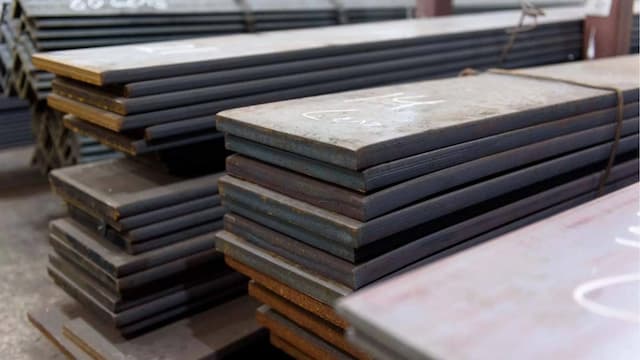
Understanding the difference between mild steel and carbon steel, or how alloy steel compares in str...
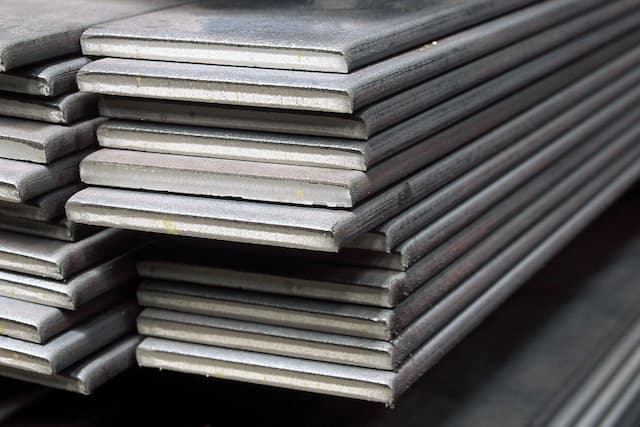
Selecting the wrong grade can lead to catastrophic component failure, increased machining costs, or ...




Elevate Your Projects with
with
 Our Superior Steels
