

Ti-6Al-4V Grade 5 Titanium: Properties, Applications & Specifications
Ti-6Al-4V (ASTM Grade 5, UNS R56400) is the most widely used titanium alloy globally, accounting for approximately 50% of all titanium consumed across industries. It is an alpha-beta alloy containing 6% aluminium and 4% vanadium, delivering an outstanding combination of high strength (tensile ~895–965 MPa), low density (4.43 g/cm³), excellent corrosion resistance in seawater and aggressive chemical environments, and heat treatability. It is the default titanium specification for aerospace, oil and gas, marine, and medical applications worldwide.
When engineers and procurement teams specify titanium for demanding structural, corrosion, or weight-critical applications, Ti-6Al-4V is almost always the starting point. First developed in 1954, Grade 5 titanium has become the dominant titanium alloy — not because it is the strongest, lightest, or most corrosion-resistant titanium in every category, but because it delivers the most balanced combination of all three properties at commercially acceptable cost. No other single titanium alloy has replicated that balance in over six decades of industrial use.
This guide covers the composition, mechanical properties, ASTM and AMS standards, heat treatment, and key applications of Ti-6Al-4V Grade 5 — including the Grade 23 ELI variant for medical and fracture-critical applications. For certified Ti-6Al-4V supply in bar, plate, pipe, and tube with EN 10204 3.1 MTCs, visit our quality and certifications page.
Ti-6Al-4V Composition and Metallurgy
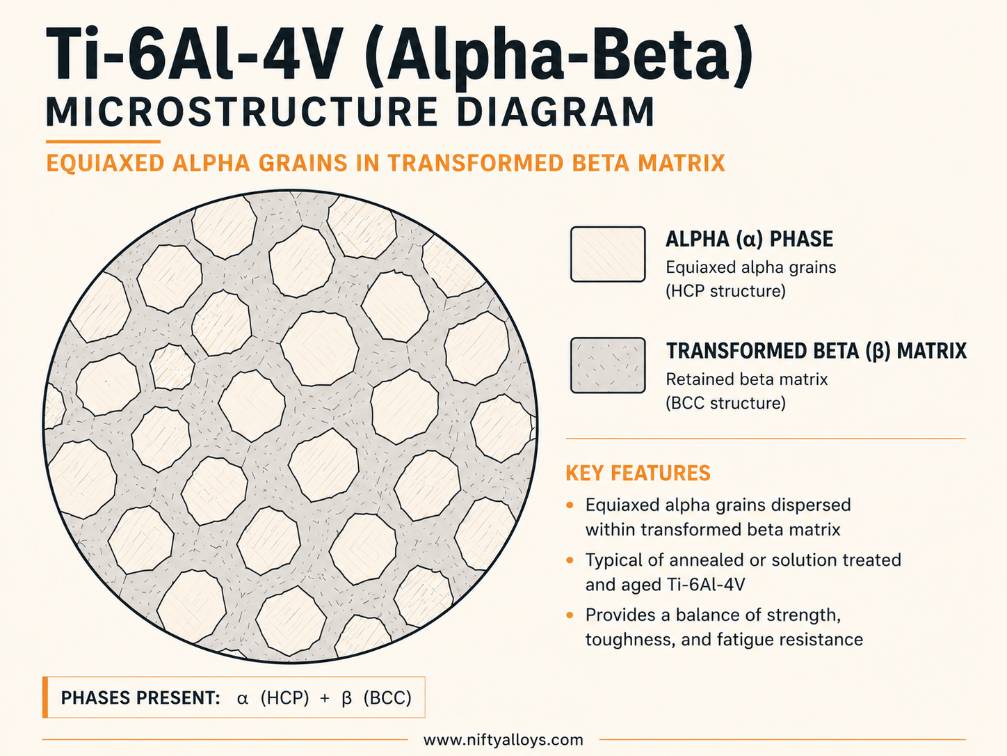
Ti-6Al-4V is an alpha-beta titanium alloy — a term that describes its two-phase microstructure. The alpha (α) phase is a hexagonal close-packed (HCP) structure stabilised by aluminium; the beta (β) phase is a body-centred cubic (BCC) structure stabilised by vanadium. The coexistence of both phases in controlled proportions is what makes Grade 5 heat-treatable and gives it the strength-ductility balance that pure (CP) titanium grades cannot match.
The nominal chemical composition per ASTM B348 / AMS 4928:
- Titanium (Ti): balance (approximately 90%)
- Aluminium (Al): 5.50–6.75% — primary alpha-phase stabiliser; increases strength and high-temperature capability
- Vanadium (V): 3.50–4.50% — beta-phase stabiliser; enables heat treatment response
- Iron (Fe): 0.40% max — residual element controlled for consistency
- Oxygen (O): 0.20% max — interstitial strengthener; higher oxygen = higher strength, lower toughness
- Carbon (C): 0.08% max · Nitrogen (N): 0.05% max · Hydrogen (H): 0.015% max
The distinction between Grade 5 (max 0.20% O) and Grade 23 ELI — Extra Low Interstitial (max 0.13% O) — is primarily the oxygen level. The ELI variant sacrifices approximately 5–10% of tensile strength in exchange for improved fracture toughness, fatigue crack growth resistance, and ductility — properties critical for medical implants and fracture-critical offshore tubulars.
Mechanical Properties — Ti-6Al-4V Grade 5 vs Grade 23 vs Grade 2 CP
The table below compares the mechanical and physical properties of Ti-6Al-4V Grade 5 (annealed condition) against Grade 23 ELI and commercially pure Grade 2 titanium for reference:
Property | Ti-6Al-4V Grade 5 (Annealed) | Ti-6Al-4V ELI Grade 23 (Annealed) | Grade 2 CP Titanium (Reference) |
| UNS Designation | R56400 | R56401 | R50400 |
| Tensile Strength | 895–965 MPa | 860–930 MPa | ~345 MPa |
| Yield Strength (0.2%) | 828 MPa min | 795 MPa min | ~275 MPa |
| Elongation | 10% min | 10% min | 20% min |
| Hardness | ~30–36 HRC (annealed) | ~28–34 HRC | ~70–80 HRB |
| Density | 4.43 g/cm³ | 4.43 g/cm³ | 4.51 g/cm³ |
| Elastic Modulus | 114 GPa | 114 GPa | 105 GPa |
| Max Service Temp | ~400°C (continuous) | ~400°C (continuous) | ~300°C |
| Oxygen Content (max) | 0.20% | 0.13% (ELI — lower) | 0.25% |
| Key Advantage | Highest strength — aerospace & oil/gas | Improved fracture toughness & fatigue — medical/offshore tubulars | Cost-effective — moderate corrosion environments |
Note: Grade 5 can be solution treated and aged (STA) to tensile strengths exceeding 1,100 MPa in sections up to 25mm. The STA condition is used for aerospace fasteners, downhole tools, and other high-strength applications where the annealed condition is insufficient.
Why Ti-6Al-4V Dominates — Key Properties Explained
Strength-to-Weight Ratio
The defining advantage of Ti-6Al-4V is its specific strength — the ratio of tensile strength to density. At a density of 4.43 g/cm³ (approximately 56% of steel at 7.85 g/cm³), Grade 5 titanium delivers tensile strength comparable to many high-strength steels. This means a Ti-6Al-4V component weighs roughly half of an equivalent steel component at the same strength level — a critical advantage in aerospace, motorsport, and any weight-sensitive application.
Corrosion Resistance
Ti-6Al-4V forms a highly stable, self-repairing titanium dioxide (TiO₂) passive film on its surface that resists attack from seawater, brine, chloride solutions, oxidising acids, and a wide range of industrial process chemistries. Unlike stainless steel, titanium does not suffer pitting or crevice corrosion in seawater or under chloride exposure. This makes Grade 5 the preferred material for offshore oil and gas components, marine heat exchangers, seawater desalination equipment, and chemical process vessels in the UAE, GCC, and globally.
Ti-6Al-4V is not susceptible to stress corrosion cracking (SCC) in seawater — a significant advantage over high-strength steels and some nickel alloys in marine applications. It does not fall within the scope of NACE MR0175 / ISO 15156 for sour service, as titanium alloys are generally not affected by sulfide stress cracking mechanisms. However, titanium can be susceptible to hydrogen embrittlement under specific conditions — consult your project materials engineer for cathodically protected offshore applications.
Heat Treatability
Unlike commercially pure titanium grades, Ti-6Al-4V can be strengthened by solution treatment and ageing (STA). The alpha-beta microstructure allows significant property tailoring — from the tough, ductile annealed condition used in most structural applications to the high-strength STA condition required for aerospace fasteners and downhole tools. The beta transus temperature (approximately 995°C) is the critical thermal boundary; processing above it produces a fundamentally different microstructure with different properties.
Weldability and Fabrication
Ti-6Al-4V is weldable by GTAW (TIG), PAW, electron beam, and laser welding processes, with strict requirements for inert gas shielding to prevent oxygen and nitrogen contamination. The recommended filler metal is ERTi-5 (Ti-6Al-4V) for matching strength or ERTi-2 (Grade 2 CP) for applications where weld ductility is more important than strength. Post-weld annealing at 700–750°C is recommended to relieve residual stresses. Ti-6Al-4V is not recommended for gas (oxy-fuel) welding or welding without inert gas shielding.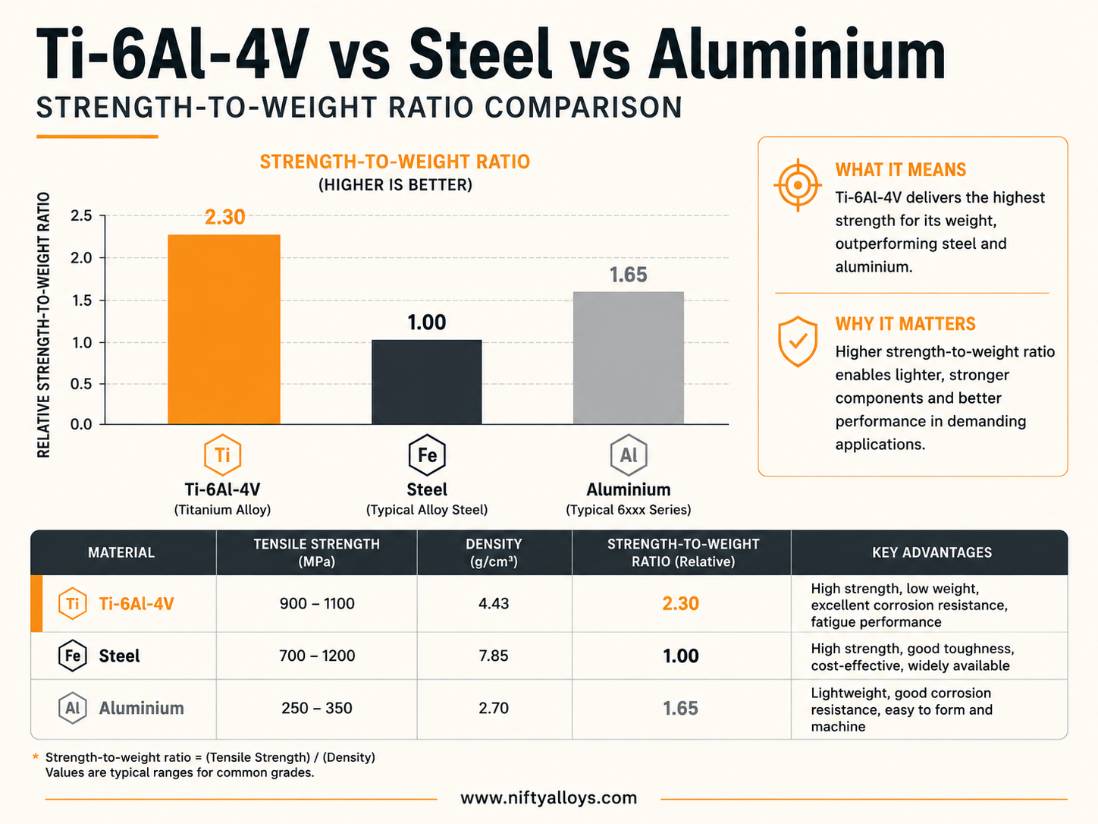
ASTM and AMS Standards for Ti-6Al-4V Supply
Grade 5 titanium is supplied to a well-established set of ASTM and AMS standards. The correct standard must be specified on the purchase order alongside the grade — 'Ti-6Al-4V' or 'Grade 5' alone is insufficient without the applicable product standard and form:
| Standard | Covers | Product Form |
| ASTM B265 | Titanium strip, sheet, and plate | Sheet / Plate |
| ASTM B348 / AMS 4928 | Bar and billet — primary procurement standard for oil & gas and aerospace bar | Round Bar / Billet |
| ASTM B381 | Titanium and titanium alloy forgings | Forgings |
| ASTM B861 | Seamless titanium pipe | Seamless Pipe |
| ASTM B862 | Welded titanium pipe | Welded Pipe |
| ASTM B338 | Seamless and welded tube — heat exchangers and condensers | Tube |
| AMS 4911 | Sheet, strip, and plate — aerospace qualification | Sheet / Plate (Aerospace) |
| AMS 4928 | Bar, billet, and extrusion — aerospace qualification | Bar / Billet (Aerospace) |
| ASTM F1472 | Wrought Ti-6Al-4V for surgical implant applications | Medical / Implant |
All Ti-6Al-4V supply should be accompanied by an EN 10204 3.1 material test certificate (MTC) as a minimum, confirming chemical composition, mechanical properties, and conformance to the ordered standard. For aerospace and classification society-governed marine or offshore projects, EN 10204 3.2 with independent third-party verification may be required. For full guidance on certificate types, see our EN 10204 2.2 vs 3.1 vs 3.2 certification guide.
Key Applications of Ti-6Al-4V Grade 5
Aerospace and Defence
Aerospace is Ti-6Al-4V's largest application domain. The alloy's combination of high specific strength, fatigue resistance, and thermal stability to 400°C makes it the default material for jet engine compressor blades and discs, airframe structural components, landing gear, fasteners, and missile and spacecraft structures. The combination of AMS 4928 (bar/billet) and AMS 4911 (sheet/plate) qualifications covers virtually all aerospace structural applications.
Oil and Gas — Offshore and Subsea
Ti-6Al-4V is widely specified for offshore oil and gas applications where the combination of seawater corrosion resistance, high strength, and low weight delivers advantages over stainless steel or nickel alloys. Key applications include: subsea wellhead components, offshore riser and tubular systems (Grade 23 ELI for fracture-critical applications), heat exchanger tubing for offshore platform cooling systems, pump shafts and impellers in seawater service, valve bodies and fittings for aggressive process environments, and fasteners and structural components for floating production and storage and offloading (FPSO) vessels. In the UAE and GCC, Ti-6Al-4V is specified on offshore projects across the Arabian Gulf and Red Sea, where high seawater temperature and salinity place demanding requirements on material corrosion performance.
Marine and Desalination
Titanium Grade 5 is used for high-performance marine components requiring both strength and seawater corrosion resistance: propeller shafts, drive shafts, and fastenings on high-performance vessels; heat exchanger tubing in desalination plants (MSF and MED) where seawater temperatures are elevated; and offshore platform structural components in splash zone service. Grade 2 CP titanium is more commonly used for desalination heat exchanger tubing at moderate stress levels; Grade 5 is specified where structural loading requirements demand higher strength.
Chemical Processing and Industrial
Ti-6Al-4V's resistance to oxidising acids, chloride environments, and wet chlorine makes it the material of choice for chemical reactors, vessels, heat exchangers, and piping in chlor-alkali, bleach, and acid production environments. Where Hastelloy or high-alloy stainless steels fail due to chloride or oxidising acid attack, titanium typically provides reliable service life.
Ti-6Al-4V Grade 5 vs Grade 23 ELI — Which to Specify?
The choice between Grade 5 (R56400) and Grade 23 ELI (R56401) is driven by the application's fracture toughness and fatigue requirements rather than corrosion performance — both grades offer essentially identical corrosion resistance.
- Specify Grade 5 (ASTM B348 / AMS 4928) for: structural aerospace components, oil and gas downhole tools and wellhead components, marine structural applications, chemical process equipment, and general high-strength engineering service where the annealed or STA condition is appropriate.
- Specify Grade 23 ELI (ASTM F1472 for medical; ASTM B348 ELI for structural) for: medical implants (hip stems, bone plates, dental implants) where fatigue life and biocompatibility are critical; fracture-critical offshore tubulars and subsea structures where crack growth resistance is a design parameter; and any application where improved toughness at the expense of some tensile strength is the correct engineering trade-off.
In practice, Grade 23 ELI commands a material cost premium of 10–20% over Grade 5. The decision to upgrade should be based on specific engineering requirements, not blanket specification conservatism.
How to Specify Ti-6Al-4V in a Purchase Order
A correctly specified Ti-6Al-4V purchase order should include:
- Grade and UNS number: 'Ti-6Al-4V, UNS R56400 (Grade 5)' or 'Ti-6Al-4V ELI, UNS R56401 (Grade 23)' — state explicitly.
- ASTM or AMS standard: e.g. 'ASTM B348, Grade 5' for bar; 'ASTM B265, Grade 5' for sheet/plate; 'AMS 4928' for aerospace-qualified bar. Do not rely on grade alone.
- Condition / temper: state 'annealed' or 'solution treated and aged (STA)' as required. Default is annealed unless higher strength is specifically required.
- Dimensions and tolerances: diameter and length (bar), thickness and width (plate), OD and wall thickness (pipe/tube) to the applicable ASTM dimensional tolerances.
- Certificate type: EN 10204 3.1 MTC as minimum — confirming chemical composition and mechanical properties from the specific heat supplied. EN 10204 3.2 for classification society-governed offshore and aerospace applications.
- Additional testing: state any supplementary requirements — ultrasonic testing, dye penetrant inspection, hardness survey, or specific certification body (ABS, DNV-GL) as applicable.
How does Ti-6Al-4V compare to Inconel 625 for offshore applications?
Ti-6Al-4V and Inconel 625 (N06625) are both specified for offshore and corrosion-resistant applications but serve different performance envelopes. Titanium Grade 5 offers a significant weight advantage (4.43 vs 8.44 g/cm³) and is generally preferred where seawater corrosion resistance combined with low weight is the primary driver. Inconel 625 offers broader chemical corrosion resistance — particularly in mixed acid and H₂S-containing sour service environments — and is accepted under NACE MR0175 / ISO 15156 Part 3 for sour service CRA applications. For offshore structural components in seawater service, Ti-6Al-4V is often more weight-efficient; for CRA piping and wellhead components in sour service, Inconel 625 is typically preferred.
Source Certified Ti-6Al-4V Titanium from Dubai
Nifty Alloys LLC is a Dubai-based specialist metals stockist supplying certified Ti-6Al-4V (Grade 5) and Ti-6Al-4V ELI (Grade 23) titanium to aerospace, oil and gas, marine, chemical processing, and heavy engineering projects across the UAE, GCC, and global export markets.
We supply Ti-6Al-4V in bar, plate, sheet, pipe, tube, and forgings — to ASTM B348, ASTM B265, ASTM B861, ASTM B338, and AMS 4928/4911 — with EN 10204 3.1 MTCs as standard. EN 10204 3.2 with independent third-party certification available on request for offshore and critical project requirements. For our full range of certified titanium and nickel alloys, visit our product pages.
All certificates are reviewed by our in-house QA/QC team before dispatch. View our material quality and certifications page for full certification and compliance capabilities.
 Let's Talk
A complete nickel alloy bar order states the UNS number, the ASTM or ASME product standard and grade...
Alloy 825 is a nickel-iron-chromium alloy with 2.5–3.5% molybdenum plus copper, suited to sulfuric a...
Carbon equivalent (Ceq) is calculated using the IIW formula — CEV = C + Mn/6 + (Cr+Mo+V)/5 + (Ni+Cu)...
metal magnetism What Is a Ferrous Metal? Ferrous vs Non-Ferrous Explained Quick Answer ...




Elevate Your Projects with
with
 Our Superior Steels
