

Inconel vs Hastelloy vs Monel: How to Choose the Right Nickel Alloy
Inconel, Hastelloy, and Monel are all nickel-based alloys, but they differ in their primary alloying elements. Inconel (nickel-chromium) is optimised for high-temperature strength and oxidation resistance. Hastelloy (nickel-molybdenum-chromium) resists a broad range of aggressive acids. Monel (nickel-copper) excels in seawater and chloride-rich marine environments. The right choice depends on your governing corrosion mechanism, temperature range, and mechanical load.
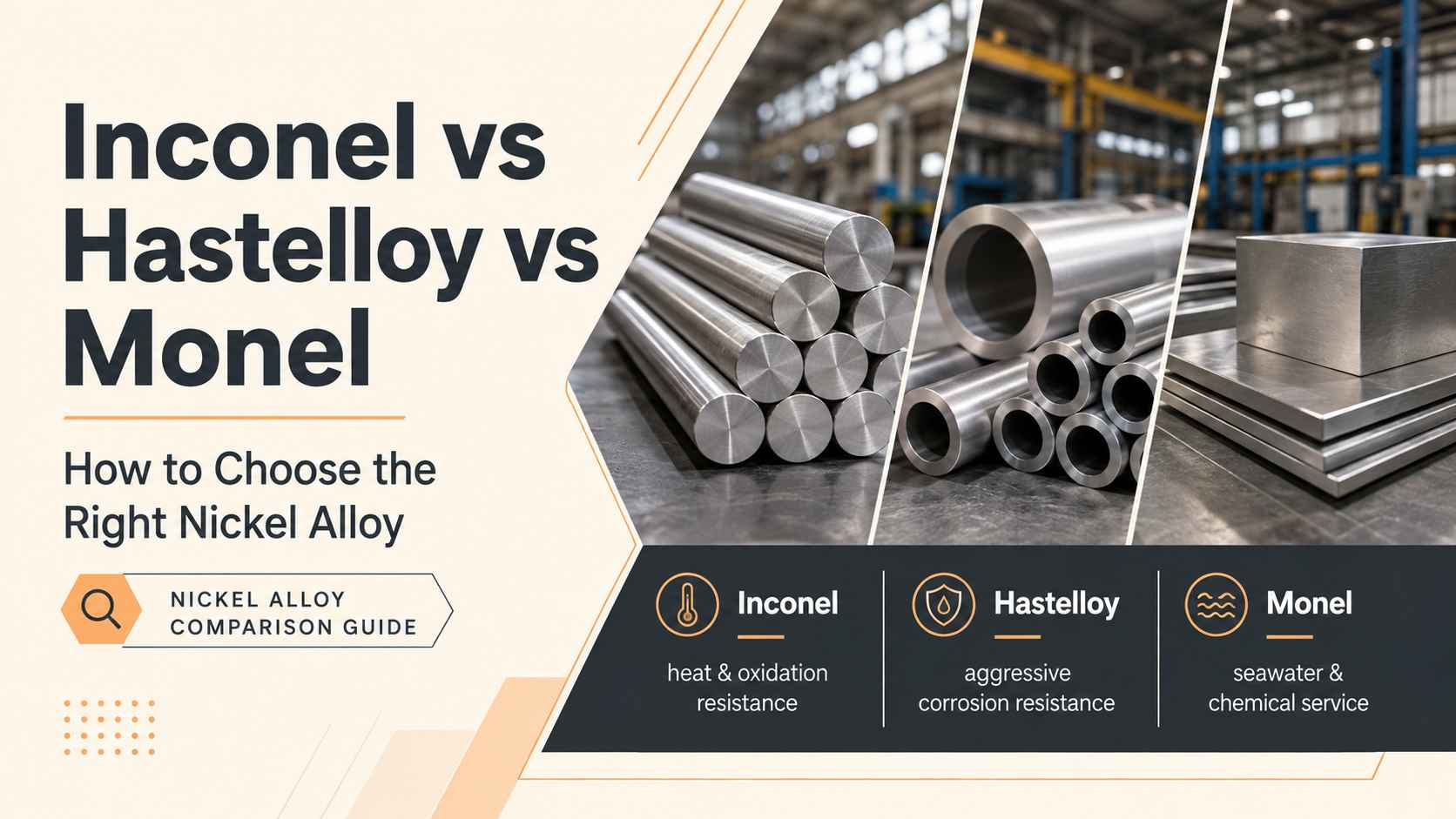
Procurement engineers and material specialists across the UAE and GCC regularly face the same decision: when a project calls for a nickel alloy, should it be Inconel, Hastelloy, or Monel? All three are premium, corrosion-resistant materials that outperform stainless steel in demanding service, but they are not interchangeable. Specifying the wrong family can mean premature failure in the field or unnecessary cost from over-specification.
This guide compares the three alloy families across composition, corrosion behaviour, temperature performance, and typical applications in oil & gas, marine, and petrochemical projects, with reference to the certification and classification-society requirements common on GCC-based procurement.
Inconel vs Hastelloy vs Monel
The table below summarises the defining characteristics of each alloy family using their most widely specified grades.
| Alloy Family | Base System | Representative Grades | Best Suited For | Governing Specs |
| Inconel | Ni-Cr(-Mo) | 625 (N06625), 718 (N07718), 600 (N06600) | High heat, oxidation, high strength at temperature | ASTM B443/B446/B637, AMS 5662/5663 |
| Hastelloy | Ni-Mo-Cr | C-276 (N10276), C-22 (N06022) | Mixed/aggressive acids, oxidizing & reducing media | ASTM B574/B575/B622 |
| Monel | Ni-Cu | 400 (N04400), K-500 (N05500) | Seawater, chlorides, hydrofluoric acid service | ASTM B127/B164/B865 |
What Separates These Three Alloy Families
Inconel — Nickel-Chromium for Heat and Oxidation
Inconel alloys are built around a nickel-chromium base, with grades such as 625 adding molybdenum and niobium for extra corrosion resistance, and 718 adding niobium and aluminium/titanium for age-hardening. The chromium content forms a stable, adherent oxide layer that protects the alloy at temperatures where most stainless steels would scale or lose strength. Inconel 625 is solid-solution strengthened and retains excellent corrosion resistance up to roughly 980°C, while Inconel 718 is precipitation-hardened for very high strength up to about 700°C — see our dedicated Inconel 718 properties and machining guide for full datasheet values. Inconel is the default choice when the governing design driver is heat, oxidation, or a combination of high temperature and moderate corrosion.
Hastelloy — Nickel-Molybdenum-Chromium for Chemical Attack
Hastelloy grades are nickel-molybdenum-chromium alloys engineered specifically for chemical processing duty. The molybdenum content gives strong resistance to reducing acids (such as hydrochloric and sulfuric acid), while the chromium content adds resistance to oxidizing media. Hastelloy C-276 is the most widely specified grade because it performs reliably across both oxidizing and reducing conditions, a combination few single alloys can match. Hastelloy is typically the right call when the process stream is chemically aggressive or its composition is variable, rather than when temperature alone is the limiting factor. Nifty Alloys stocks Hastelloy C-276 alongside our wider nickel alloys range for GCC chemical processing buyers.
Monel — Nickel-Copper for Seawater and Chlorides
Monel is a nickel-copper alloy, with nickel content typically between 63% and 70%. Unlike Inconel and Hastelloy, its corrosion resistance does not depend solely on a passive oxide film, which makes it particularly effective in reducing, chloride-rich environments such as seawater, brackish water, and hydrofluoric acid service where oxide-film alloys can be more vulnerable to pitting. Monel K-500 adds aluminium and titanium for age-hardening, delivering the same base corrosion resistance as Monel 400 with substantially higher strength — useful for pump shafts, fasteners, and other loaded marine components. For lower-strength, lower-cost seawater service, buyers sometimes compare Monel against cupronickel (C70600/C71500), another Ni-Cu family used widely in marine piping — see our dedicated cupronickel guide for that comparison.
Corrosion Resistance
Because each alloy resists a different corrosion mechanism, alloy selection should start from the process media rather than from a general "which is the best alloy" comparison.
| Media / Environment | Best Performer | Why |
| Seawater / chlorides | Monel 400 / K-500 | Chloride stress-corrosion cracking resistance; does not rely on an oxide film |
| Hydrofluoric acid | Monel 400 | One of the few alloys with good HF resistance across a wide concentration range |
| Reducing acids (HCl, H2SO4) | Hastelloy C-276 | High molybdenum content resists reducing-acid attack |
| Mixed oxidizing/reducing acids | Hastelloy C-276 / C-22 | Balanced Cr-Mo chemistry handles both mechanisms |
| High-temperature oxidation / gas turbines | Inconel 625 / 718 | Chromium oxide layer stable at elevated temperature |
| Sour service (H2S, per NACE MR0175/ISO 15156) | Inconel 625, Hastelloy C-276, Monel 400 (grade-dependent) | All three appear on NACE-qualified material lists; selection depends on H2S partial pressure, chlorides, and temperature |
Temperature and Mechanical Performance
- Inconel 718: highest room-temperature tensile strength of the three families (age-hardened, ~1,240–1,375 MPa); best where high mechanical load and elevated temperature (up to ~700°C) combine.
- Inconel 625: solid-solution strengthened; lower strength than 718 but superior high-temperature oxidation and corrosion resistance, usable to ~980°C.
- Hastelloy C-276: moderate strength; not typically selected for high mechanical load, but for chemical resistance in process equipment such as reactors and heat exchangers.
- Monel 400: moderate strength, good ductility; not intended for high-temperature service — its value is corrosion resistance, not heat resistance.
- Monel K-500: age-hardened version of 400 with markedly higher strength, used where both seawater resistance and mechanical load apply — pump shafts, valve stems, fasteners.
Where UAE and GCC Buyers Apply Each Alloy
Procurement teams across Dubai, Abu Dhabi, and the wider GCC specify these alloys most often in oil & gas, marine, and petrochemical scopes, where classification-society and industry-standard compliance is non-negotiable.
- Oil & gas (onshore and offshore): NACE MR0175/ISO 15156 is standard practice for sour service scopes across GCC upstream projects.
- Marine and offshore structures: Monel 400/K-500 for seawater pumps, valve trim, propeller shafts, and desalination plant components common along the UAE coastline; classification-society approval from ABS or DNV is frequently specified alongside material certification.
- Petrochemical processing: Hastelloy C-276/C-22 for reactors, columns, and heat exchangers handling mixed or variable acid streams; Inconel 625 where the process also involves elevated temperature.
- Desalination (a growing GCC sector): Monel and super duplex stainless steel are the two materials most commonly compared for brine-handling components, given the chloride-heavy service.
Certification and Traceability When Sourcing in the UAE
Regardless of which alloy family is selected, GCC buyers should confirm the following before order placement:
- Mill Test Certificates to EN 10204 3.1, with full chemical composition and mechanical property traceability for the specific heat/lot supplied.
- Compliance with the governing ASTM specification for the product form (bar, plate, pipe, or fitting) rather than the alloy name alone — the same alloy can be governed by different ASTM standards depending on form.
- NACE MR0175/ISO 15156 compliance documentation where the application involves H2S-containing service.
- Classification-society approval (ABS, DNV-GL) where the end use is marine or offshore, in addition to material certification.
Nifty Alloys LLC supplies certified Inconel, Hastelloy, and Monel grades from our Dubai stock with full Mill Test Certificate traceability, supporting oil & gas, marine, and petrochemical buyers across the UAE and GCC.
Conclusion
Choosing between Inconel, Hastelloy, and Monel comes down to identifying the dominant failure mechanism in your application — heat and oxidation, aggressive mixed-acid chemistry, or chloride/seawater corrosion — and matching the alloy family engineered for that mechanism. Getting this right at the specification stage avoids both premature material failure and unnecessary over-specification cost. If your application sits closer to the stainless steel / nickel alloy boundary rather than requiring a premium superalloy, our Carbon Steel vs Stainless Steel guide may also help narrow down the right material family.
Nifty Alloys LLC stocks certified Inconel, Hastelloy, and Monel grades in bar, plate, sheet, and pipe form from Dubai, UAE, with full EN 10204 3.1 traceability for oil & gas, marine, and petrochemical buyers across the GCC.
 Let's Talk
A complete nickel alloy bar order states the UNS number, the ASTM or ASME product standard and grade...
Alloy 825 is a nickel-iron-chromium alloy with 2.5–3.5% molybdenum plus copper, suited to sulfuric a...
Carbon equivalent (Ceq) is calculated using the IIW formula — CEV = C + Mn/6 + (Cr+Mo+V)/5 + (Ni+Cu)...
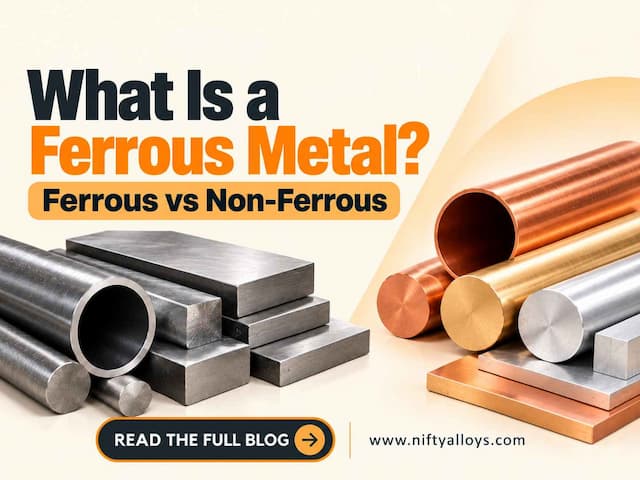
metal magnetism What Is a Ferrous Metal? Ferrous vs Non-Ferrous Explained Quick Answer ...




Elevate Your Projects with
with
 Our Superior Steels
