

6061-T6 vs 7075-T6 Aluminium: Properties, Differences & When to Use Each
6061-T6 aluminium (Al-Mg-Si) offers 310 MPa tensile strength, excellent weldability, good corrosion resistance, and cost-effective general-purpose use. 7075-T6 (Al-Zn-Mg-Cu) offers 572 MPa tensile strength — nearly double — making it one of the strongest aluminium alloys commercially available, but with lower corrosion resistance, poor weldability, and significantly higher cost. For most oil and gas, marine, and construction applications in the UAE and GCC, 6061-T6 is the correct specification. 7075-T6 is reserved for aerospace, high-load tooling, and applications where maximum strength-to-weight ratio overrides all other considerations.
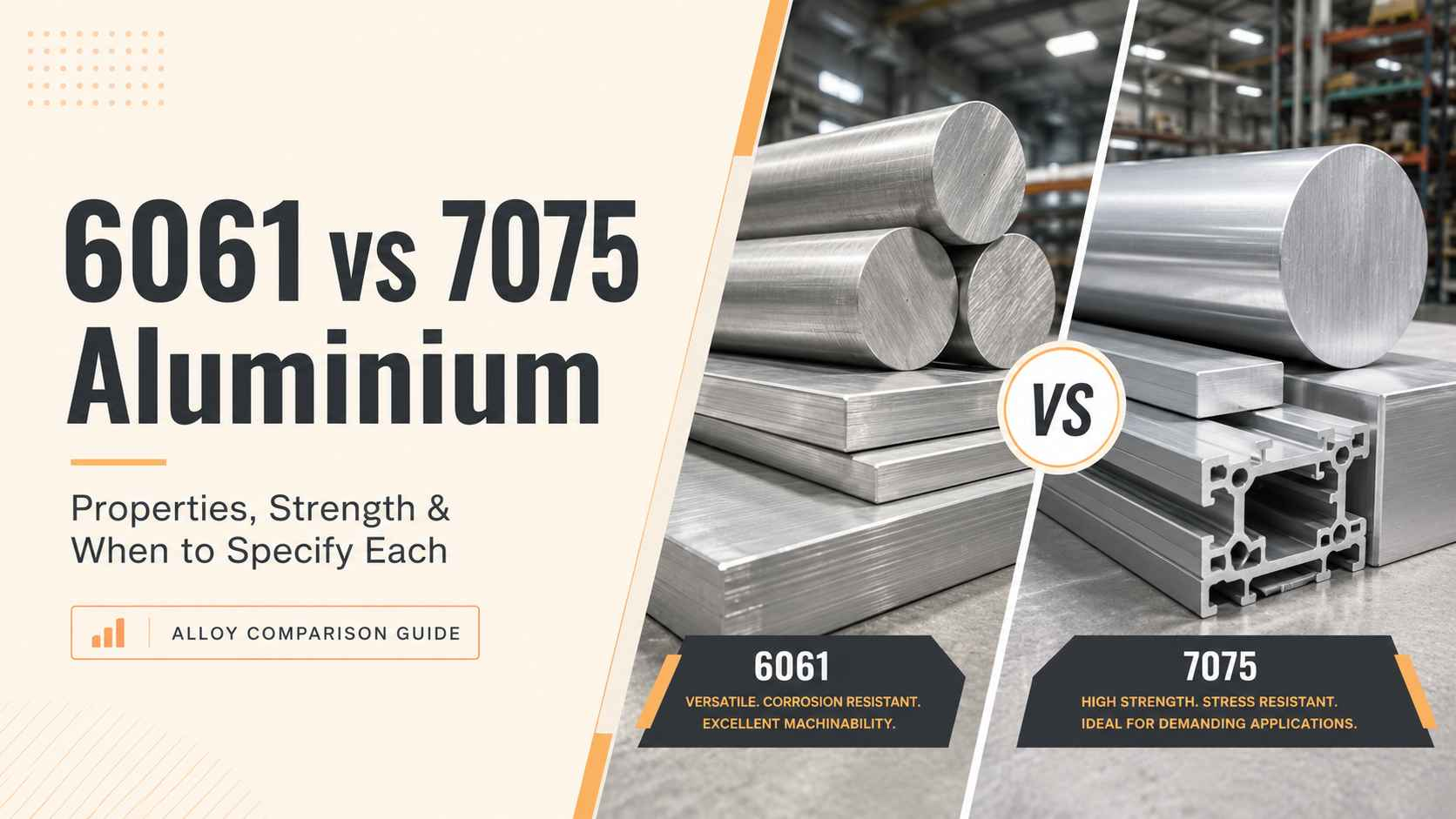
When engineers and procurement teams in the UAE and GCC specify aluminium, two grades dominate the conversation: 6061 and 7075. Both are heat-treatable, both are widely available, and both are specified in similar-looking applications — which is precisely why the choice between them is frequently misunderstood. Selecting 7075 when 6061 is appropriate adds cost and reduces corrosion performance. Selecting 6061 when structural demands require 7075 creates an underspecification risk.
This guide breaks down the composition differences, property comparison, corrosion resistance, weldability, machinability, and application selection logic for both grades — giving procurement engineers and project buyers a clear basis for specification. For aluminium casting grades, see our separate aluminium casting alloys guide.
Alloy Series and Composition — The Key Difference
6061 and 7075 belong to different aluminium alloy series with fundamentally different strengthening chemistries:
6061 — 6xxx Series (Al-Mg-Si)
6061 is an aluminium-magnesium-silicon alloy. The primary alloying elements are magnesium (0.8–1.2%) and silicon (0.4–0.8%), which form a magnesium silicide (Mg₂Si) precipitate during heat treatment that provides the strengthening mechanism. The relatively low copper content (0.15–0.40%) gives 6061 good corrosion resistance and excellent weldability — the two properties that make it the most widely used aluminium alloy in structural, marine, and industrial applications globally.
7075 — 7xxx Series (Al-Zn-Mg-Cu)
7075 is an aluminium-zinc-magnesium-copper alloy. The high zinc content (5.1–6.1%) combined with magnesium and copper creates a very dense precipitate structure during age hardening, delivering tensile strength in the T6 condition of approximately 572 MPa — comparable to mild steel at a fraction of the weight. This exceptional strength comes at a cost: the high copper content (1.2–2.0%) reduces corrosion resistance significantly, and the same microstructure that provides strength makes 7075-T6 highly susceptible to stress corrosion cracking (SCC) in chloride-containing environments.
Properties Comparison — 6061-T6 vs 7075-T6
| Property | 6061-T6 | 7075-T6 |
| Alloy Series | 6xxx (Al-Mg-Si) | 7xxx (Al-Zn-Mg-Cu) |
| Primary Alloying Elements | Magnesium (0.8–1.2%) + Silicon (0.4–0.8%) | Zinc (5.1–6.1%) + Magnesium (2.1–2.9%) + Copper (1.2–2.0%) |
| Chromium (Cr) | 0.04–0.35% | 0.18–0.28% |
| Density | 2.70 g/cm³ | 2.81 g/cm³ |
| Tensile Strength (T6) | 310 MPa | 572 MPa |
| Yield Strength (0.2%, T6) | 276 MPa | 503 MPa |
| Elongation (T6) | 12–17% | 8–11% |
| Hardness (T6) | 95 HBW | 150 HBW |
| Shear Strength (T6) | 207 MPa | 331 MPa |
| Fatigue Strength | 96 MPa | 159 MPa |
| Thermal Conductivity | 167 W/m·K | 130 W/m·K |
| Electrical Conductivity | 43% IACS | 33% IACS |
Note: all values in T6 temper (solution heat-treated and artificially aged) — the standard supply condition for both grades. 7075 is also available in T73 (overaged) which reduces strength by approximately 10–15% but significantly improves SCC resistance and fracture toughness.
Strength — Where 7075 Dominates
The strength difference between 6061-T6 and 7075-T6 is substantial and should be understood precisely:
- Tensile strength: 7075-T6 at 572 MPa is approximately 85% stronger than 6061-T6 at 310 MPa
- Yield strength: 7075-T6 at 503 MPa is approximately 82% higher than 6061-T6 at 276 MPa
- Shear strength: 7075-T6 at 331 MPa is approximately 60% higher than 6061-T6 at 207 MPa
- Hardness: 7075-T6 at 150 HBW is approximately 58% harder than 6061-T6 at 95 HBW
This strength advantage is why 7075 is the alloy of choice in aerospace structural components, where maximum strength-to-weight ratio is the primary design driver. In most industrial and construction applications in the UAE and GCC, however, 6061-T6 provides adequate structural strength — and the 85% strength premium of 7075 does not justify its higher cost and reduced corrosion performance.
Corrosion Resistance — Where 6061 Wins
| Factor | 6061 | 7075 | Winner |
| General corrosion resistance | Good — low Cu content | Moderate — high Zn+Cu content | 6061 |
| Seawater / marine | Good — widely used in marine | Limited — susceptible to SCC in saltwater | 6061 |
| Stress corrosion cracking (SCC) | Low susceptibility | High susceptibility in T6 (reduced in T73) | 6061 |
| Anodising quality | Excellent — uniform finish | Good — slightly less consistent | 6061 |
| Surface treatment need | Optional — good bare performance | Required — anodising strongly recommended | 6061 |
The corrosion resistance difference is the most important factor for UAE and GCC applications. The coastal, high-humidity, salt-laden environment of the Gulf region accelerates corrosion mechanisms in all metals. 6061's lower copper content makes it significantly more resistant to general corrosion and essentially immune to stress corrosion cracking in the T6 condition — a failure mode that affects 7075-T6 in marine and humid environments.
7075-T6 specified in seawater-adjacent or outdoor applications without adequate surface protection (hard anodising, epoxy coating, or conversion coating) will exhibit accelerated corrosion. In UAE outdoor structural and marine applications, 6061-T6 should be the default; 7075 requires specific corrosion protection to be specified alongside the material grade.
Weldability — 6061 Only for Welded Applications
This is the most critical selection criterion for fabricated assemblies:
- 6061: excellent weldability — TIG and MIG welding with 4043 or 5356 filler rod. Post-weld strength recovery achievable with full T6 re-heat treatment. Widely used in welded structural fabrications, piping, and assemblies.
- 7075: poor weldability — high susceptibility to hot cracking during fusion welding. The alloy's high zinc and copper content causes solidification cracking in the weld pool. 7075 is a wrought alloy not intended for structural welding. Mechanical joining (fasteners, rivets, adhesive bonding) is the standard method for 7075 assemblies.
If a design involves welding, 7075 is categorically excluded. This eliminates 7075 from consideration for most fabricated piping, structural frameworks, and pressure-containing components — which make up the majority of oil and gas, construction, and marine applications in the GCC market.
Machinability and Fabrication
Both grades machine well compared to steel, but there are differences relevant to precision machined components:
- 6061-T6: good machinability — softer chip formation, lower tool wear, faster cycle times. Suitable for general machined components, flanges, fittings, and valve bodies.
- 7075-T6: slightly better machinability due to higher hardness producing cleaner chip break — but harder material increases tool wear and machining cost by approximately 10–20% compared to 6061. Preferred for high-precision tooling plates, aerospace machined parts, and mould blocks where dimensional stability under load is critical.
Anodising: both grades anodise well. 6061 produces a more uniform, consistent anodic film and is preferred where colour anodising and hard anodising quality are important. 7075 requires anodising or other surface protection in corrosive environments.
Application Selection Guide — Which Grade to Specify
| Application | Recommended Grade | Reason |
| Structural framing — UAE construction | 6061-T6 | Good strength, excellent weldability, cost-effective |
| Marine fittings and offshore hardware | 6061-T6 | Seawater corrosion resistance — 7075 not suitable |
| Aerospace structural components | 7075-T6 / T73 | Maximum strength-to-weight ratio required |
| Oil & gas valve bodies and machined parts | 6061-T6 | Machinability, corrosion resistance, adequate strength |
| Motorsport and high-performance brackets | 7075-T6 | Extreme strength needed; controlled environment |
| Heat exchangers and cooling components | 6061-T6 | Higher thermal conductivity; good formability |
| Mould tooling and precision machined plates | 7075-T6 | High hardness; dimensional stability under load |
| Pipeline flanges and fittings | 6061-T6 | Weldable, certifiable, ASTM B221 compliant |
| Welded assemblies (any) | 6061-T6 | 7075 has poor weldability — 6061 only for welded joints |
Specification in UAE and GCC Projects
For the majority of industrial procurement in the UAE and GCC — oil and gas equipment, offshore structural components, marine hardware, construction profiles, and general engineering fabrications — 6061-T6 is the correct default aluminium specification. It is available in all standard product forms (plate, sheet, bar, tube, extrusion), it is certifiable to ASTM B209 (plate/sheet), ASTM B221 (extrusions and bar), and ASTM B241 (seamless pipe), and it performs reliably in the Gulf's coastal environment when specified correctly.
7075-T6 is a premium grade justified for specific high-load, non-welded, controlled-environment applications. When comparing aluminium against steel for structural applications, see our carbon steel vs stainless steel guide for cross-material context. For aluminium availability and certification in the UAE and GCC, view our aluminium product range.
Key ASTM Standards
- ASTM B209: plate, sheet, and strip — both 6061 and 7075
- ASTM B221: extruded bars, rods, wire, profiles, and tubes — primarily 6061
- ASTM B241: seamless pipe and seamless extruded tube — 6061
- ASTM B211: bar, rod, and wire — both grades
All supply should be accompanied by an EN 10204 3.1 MTC confirming chemical composition, mechanical properties, and temper designation. Confirm the temper explicitly on all purchase orders — T6, T73, or T651 for 7075; T6 or T651 for 6061. See our EN 10204 certification guide for full details.
Source Certified 6061 and 7075 Aluminium from Dubai
Nifty Alloys LLC supplies certified 6061-T6 and 7075-T6 aluminium in plate, sheet, bar, extrusion, and tube — to ASTM B209, B221, B211, and B241 — with EN 10204 3.1 MTCs as standard. Supply to oil and gas, construction, marine, and engineering projects across the UAE, GCC, and global markets.
Contact our team for availability, grade confirmation, and quotation, or view our full aluminium product range for specifications and product forms.
 Let's Talk
A complete nickel alloy bar order states the UNS number, the ASTM or ASME product standard and grade...
Alloy 825 is a nickel-iron-chromium alloy with 2.5–3.5% molybdenum plus copper, suited to sulfuric a...
Carbon equivalent (Ceq) is calculated using the IIW formula — CEV = C + Mn/6 + (Cr+Mo+V)/5 + (Ni+Cu)...
metal magnetism What Is a Ferrous Metal? Ferrous vs Non-Ferrous Explained Quick Answer ...




Elevate Your Projects with
with
 Our Superior Steels
