

Melting Point of Steel: Carbon, Stainless & Alloy Grades
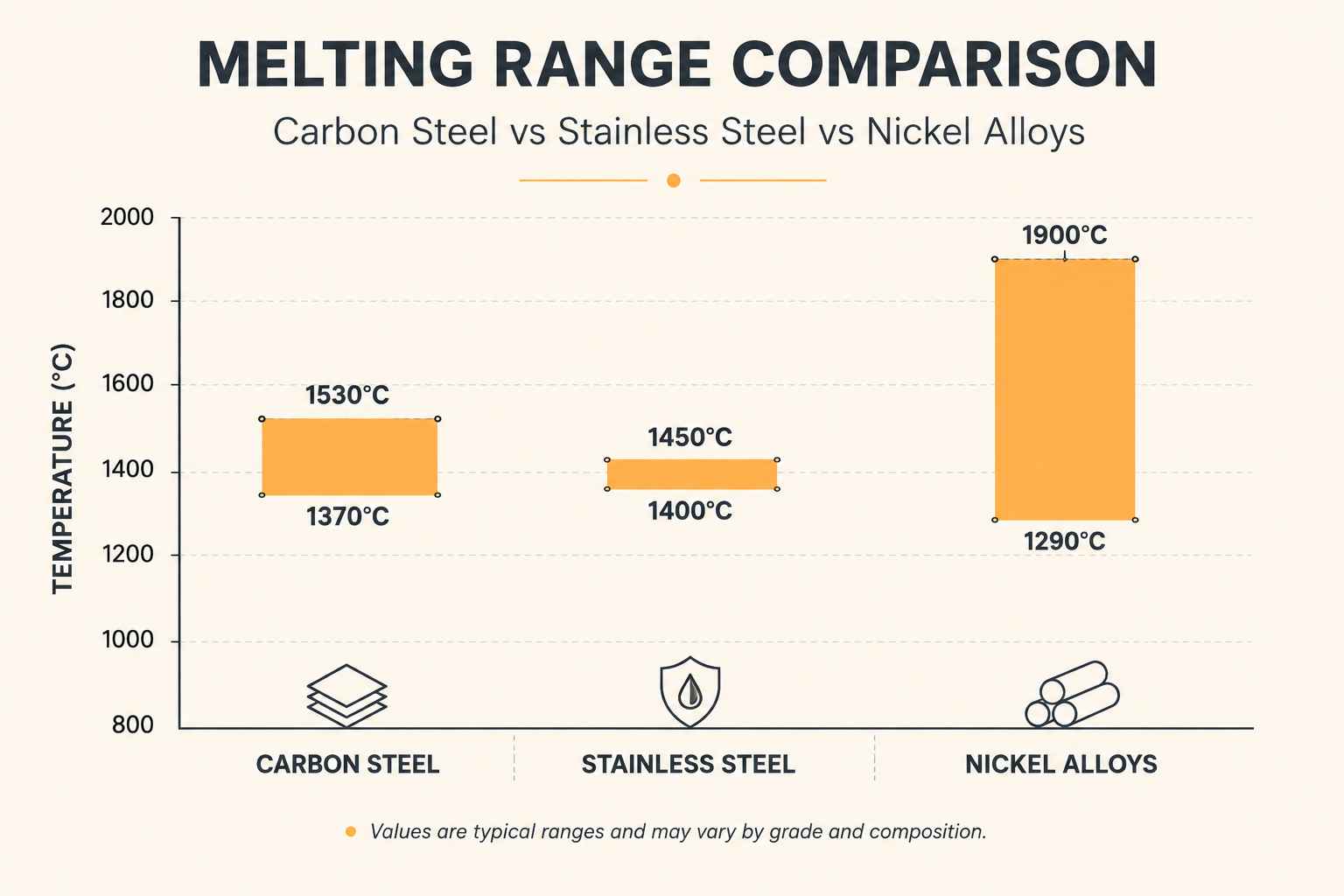
The melting point of steel typically falls between 1,370°C and 1,540°C (2,500°F–2,800°F), depending on grade. Carbon steel melts around 1,425–1,540°C, standard austenitic stainless steel (304/316) between 1,375–1,450°C, and high-alloy grades such as duplex stainless and nickel alloys lower still, often 1,290–1,430°C, because added elements shift the melting range downward.
Why Steel Melts Over a Range, Not a Single Point
Pure iron melts at a fixed 1,538°C (2,800°F). Steel departs from that number because carbon and other alloying elements disrupt the crystal lattice, and each addition changes the melting range in a predictable direction:
- Carbon: raises hardness but lowers melting point — the more carbon dissolved in the iron matrix, the wider and lower the melting range becomes.
- Chromium: raises the melting point somewhat, which is one reason some stainless grades run slightly hotter than plain carbon steel before chromium's other alloying partners pull it back down.
- Nickel: lowers the melting point relative to pure iron, an effect visible across nickel-bearing stainless grades and nickel-based alloys.
- Manganese, silicon, molybdenum, and other minor additions: each shifts the range slightly, which is why two heats of the same nominal grade can show small variation.
The practical result is that any melting point you see quoted for a grade is a range, not an exact number, and the exact figure for a specific heat depends on its certified chemical composition — one more reason mill test certificates matter for high-temperature applications.
Melting Point by Steel and Alloy Type
The table below summarises typical melting ranges for the material families Nifty Alloys stocks most frequently. Figures are representative ranges; always confirm against the EN 10204 3.1 mill certificate for the specific heat and grade you are procuring.
| Material Family | Typical Melting Range (°C) | Typical Melting Range (°F) | Notes |
| Carbon steel | 1,425 – 1,540 | 2,600 – 2,800 | Melting point falls as carbon content rises |
| Alloy steel (e.g. 4140, 4340) | 1,415 – 1,432 | 2,580 – 2,610 | Cr-Mo and Cr-Mo-Ni additions narrow the range |
| Ferritic / martensitic stainless (410, 430) | 1,480 – 1,530 | 2,700 – 2,790 | Lower alloy content keeps range closer to carbon steel |
| Austenitic stainless (304, 316) | 1,375 – 1,450 | 2,500 – 2,650 | Nickel and chromium content pulls the range down |
| Duplex stainless (UNS S32205) | 1,350 – 1,420 | 2,460 – 2,590 | Mixed austenite-ferrite structure, higher alloy content |
| Super duplex (UNS S32750/S32760) | 1,320 – 1,390 | 2,410 – 2,530 | Higher Cr, Mo and N further depress the range |
| Tool steel (e.g. D2, H13) | 1,420 – 1,460 | 2,590 – 2,660 | Carbide-forming elements affect solidus/liquidus spread |
| Monel 400 (UNS N04400) | 1,300 – 1,350 | 2,370 – 2,460 | Nickel-copper alloy, not a steel but frequently specified alongside it |
| Inconel 718 (UNS N07718) | 1,260 – 1,336 | 2,300 – 2,437 | Nickel-based superalloy, retains strength well above steel's service limits |
| Hastelloy C-276 (UNS N10276) | 1,325 – 1,370 | 2,415 – 2,500 | High Mo/Cr nickel alloy for severe corrosive service |
The duplex and super duplex figures are worth a closer look on their own — our Duplex vs. Super Duplex Stainless Steel guide covers how their mixed austenite-ferrite microstructure affects not just melting behaviour but strength and corrosion resistance as well. For the three nickel alloys in the table, Monel 400, Inconel 718, and Hastelloy C-276 each have dedicated grade guides with full composition and application data.
Melting Point vs. Maximum Service Temperature
This is the distinction most melting-point guides skip, and it is the one that actually drives material selection. Melting point marks total structural failure — the temperature at which a grade stops being a solid at all. Maximum service temperature is far lower, and it is governed by oxidation resistance and creep, not melting point.
A grade with an excellent melting point can still be the wrong choice for elevated-temperature service if its long-term strength degrades well before it approaches that number. For example:
- 304/316 austenitic stainless melt above 1,375°C, but continuous service is generally limited to around 870°C before oxidation and creep become limiting factors.
- 310 stainless, with higher chromium and nickel content, can be used up to roughly 1,050°C in continuous service despite a similar melting range to other austenitics.
- Nickel-based superalloys such as Inconel 718 have lower melting points than many steels, yet outperform steel at elevated temperature because their microstructure resists creep far longer.
For any application above roughly 400–500°C, size the material selection around documented service temperature and creep data — sourced from ASTM/ASME allowable stress tables — rather than the melting point alone. Our comparison of Inconel, Hastelloy, and Monel walks through how to weigh these nickel alloys against each other once melting point alone stops being the deciding factor.
Why This Matters for Sourcing and Fabrication in the UAE and GCC
Melting point and thermal behaviour feed directly into procurement and fabrication decisions across the sectors Nifty Alloys supplies in Dubai, the wider UAE, and the GCC:
- Welding heat input: filler metal selection and preheat/interpass temperature limits are set relative to the base metal's melting and phase-transformation behaviour, particularly for duplex and super duplex grades where excessive heat input risks secondary phase formation.
- Casting and foundry sourcing: melting range determines pouring temperature and shrinkage behaviour, which matters for cast fittings and valve bodies specified against ASTM A216/A217 and similar standards.
- Fire and process-safety design: oil & gas and petrochemical facilities specify materials partly on how they behave well below melting point, since flame or jet-fire exposure scenarios are evaluated against short-term strength retention, not the melting point itself.
- High ambient and process temperatures: GCC process plants operating in high ambient heat, combined with elevated process temperatures in petrochemical and refining service, make the melting-point-vs-service-temperature distinction a recurring specification question for procurement engineers.
Selecting the Right Grade for High-Temperature Service
- Confirm actual service temperature and duration — short excursions and continuous exposure call for different safety margins.
- Check maximum service/creep temperature, not melting point — cross-reference ASTM/ASME allowable stress tables for the intended grade.
- Verify chemistry on the mill certificate — melting range shifts with actual carbon and alloy content, so specify EN 10204 3.1 or 3.2 certification for critical applications, consistent with our Quality Standards.
- Match classification-society or code requirements — ABS, DNV-GL, or NACE MR0175 references may apply depending on sector (marine, offshore, sour service).
- Consider fabrication route — welding, casting, and forging each interact with a grade's melting and solidification behaviour differently.
FAQ
What is the melting point of steel in Celsius?
Most steels melt between roughly 1,370°C and 1,540°C, with the exact range depending on carbon content and alloying elements. Carbon steel sits toward the higher end of that range; highly alloyed stainless and nickel-bearing grades sit toward the lower end.
What is the melting point of steel in Fahrenheit?
In Fahrenheit, steel generally melts between about 2,500°F and 2,800°F, again varying by grade and alloy content.
Does stainless steel have a higher or lower melting point than carbon steel?
Generally lower. Standard austenitic stainless grades like 304 and 316 melt around 1,375–1,450°C, below the 1,425–1,540°C typical of plain carbon steel, because nickel and other alloying additions depress the melting range even though chromium alone would raise it slightly.
Can steel be used up to its melting point in service?
No. Continuous service temperature is set well below melting point and is governed by oxidation resistance and creep strength rather than the melting point itself. Most standard grades are limited to a fraction of their melting temperature in sustained service — consult ASTM/ASME allowable stress data for the specific grade and application.
Why do two heats of the same steel grade sometimes show slightly different melting points?
Because melting point depends on exact chemical composition, and composition varies within the allowable range for a specification even between compliant heats. This is one reason mill test certificates matter for temperature-critical procurement.
Sourcing Certified Steel and Alloy Grades in the UAE
Nifty Alloys LLC supplies certified carbon steel, stainless steel, duplex and super duplex grades, and nickel alloys across the UAE, GCC, and export markets, backed by EN 10204 3.1 documentation and, where required, ABS, DNV-GL, or NACE MR0175 compliance. For guidance on the right grade for high-temperature or corrosive service, see our comparison of Inconel, Hastelloy, and Monel, or our detailed guide to Duplex vs. Super Duplex stainless steel. Contact our team for a quotation with full material traceability.
 Let's Talk
A complete nickel alloy bar order states the UNS number, the ASTM or ASME product standard and grade...
Alloy 825 is a nickel-iron-chromium alloy with 2.5–3.5% molybdenum plus copper, suited to sulfuric a...
Carbon equivalent (Ceq) is calculated using the IIW formula — CEV = C + Mn/6 + (Cr+Mo+V)/5 + (Ni+Cu)...
metal magnetism What Is a Ferrous Metal? Ferrous vs Non-Ferrous Explained Quick Answer ...




Elevate Your Projects with
with
 Our Superior Steels
