

AISI 304 vs SUS304 vs EN 1.4301: Are They the Same?
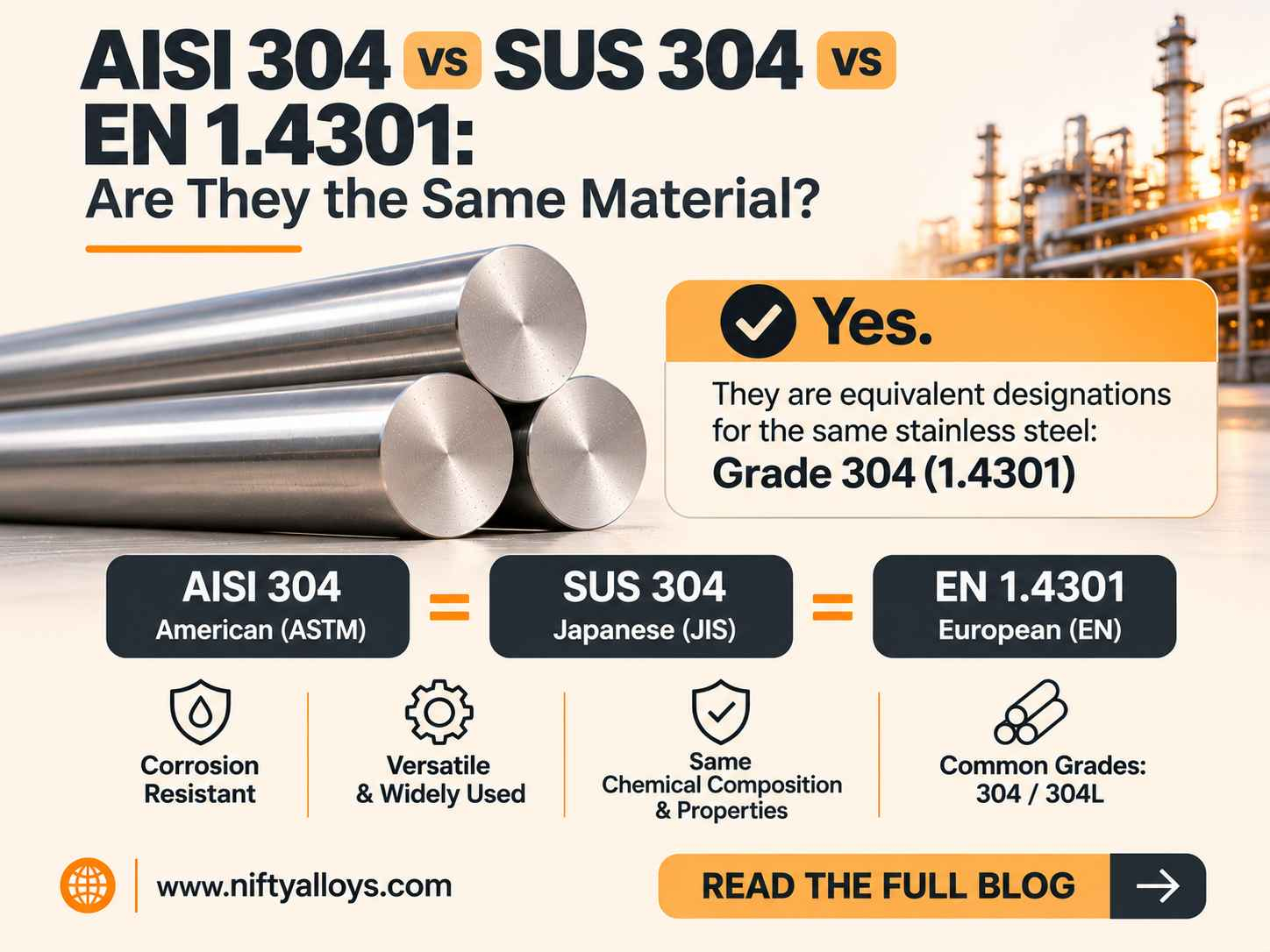
AISI 304 vs SUS 304 vs EN 1.4301: Are They the Same Material?
A European consultant's drawing says 1.4301, the Japanese equipment package calls for SUS304, and the mill certificate reads ASTM A240 Type 304. For buyers and inspectors on UAE and GCC projects, this mix is routine. So are these one material, or three?
AISI 304, SUS304 and EN 1.4301 describe the same 18Cr-8Ni austenitic stainless steel family, and in most general applications they behave identically. They are not automatically interchangeable on a purchase order. Each standard sets slightly different chemical and mechanical limits, so a heat that complies with one may fall outside another.
What Each Designation Means
The three names come from different national systems, and each one points to a different set of documents.
| Designation | System | Common name or number | Typical governing documents |
| AISI 304 | American (legacy AISI numbering) | UNS S30400 | ASTM A240 (plate, sheet, strip), ASTM A276/A479 (bar), ASTM A312 (pipe), ASTM A182 (forgings) |
| SUS304 | Japanese Industrial Standards (JIS) | "Steel Use Stainless" 304 | JIS G4304/G4305 (plate, sheet), JIS G4303 (bar) |
| EN 1.4301 | European (EN 10027-2 material number) | X5CrNi18-10 | EN 10088-2 (flat products), EN 10088-3 (long products), EN 10216-5/10217-7 (tube) |
Note that "AISI 304" is a grade name, not a specification. The enforceable requirements sit in the product standard, such as ASTM A240 or A276.
How Do the Chemical Limits Compare?
This is where "equivalent" stops meaning "identical." The table below summarises maximum limits (or ranges) in weight percent as published in common product standards. Always check the edition your project specifies.
| Element | ASTM A240 304 (flat) | ASTM A276 304 (bar) | JIS SUS304 | EN 1.4301 |
| Carbon | 0.07 | 0.08 | 0.08 | 0.07 |
| Chromium | 17.5–19.5 | 18.0–20.0 | 18.00–20.00 | 17.5–19.5 |
| Nickel | 8.0–10.5 | 8.0–11.0 | 8.00–10.50 | 8.0–10.5 |
| Silicon | 0.75 | 1.00 | 1.00 | 1.00 |
| Manganese | 2.00 | 2.00 | 2.00 | 2.00 |
| Sulphur | 0.030 | 0.030 | 0.030 | 0.015 (flat) / 0.030 (long) |
| Nitrogen | 0.10 | — | — | 0.10 |
The practical consequence is easy to miss. A heat with 0.075% carbon meets ASTM A276 and JIS SUS304 but fails ASTM A240 and EN 1.4301. A heat with 17.7% chromium meets A240 and EN 1.4301 but fails A276 and SUS304. Even within ASTM, Type 304 plate and Type 304 bar do not carry identical limits.
This is why mills often melt 304 to the overlapping window and issue dual- or multi-certified material. If you need compliance with more than one standard, state it on the enquiry.
Do the Mechanical Properties Match?
Minimum requirements are close but not the same, and they depend on product form and thickness. Values below are for the annealed (solution-treated) condition at room temperature.
| Standard and form | 0.2% proof strength, min (MPa) | Tensile strength (MPa) | Elongation, min (%) |
| ASTM A240 304, plate/sheet | 205 | 515 min | 40 |
| JIS SUS304, plate/sheet | 205 | 520 min | 40 |
| EN 1.4301, cold-rolled strip ≤8 mm | 230 | 540–750 | 45 |
| EN 1.4301, hot-rolled plate ≤75 mm | 210 | 520–720 | 45 |
| EN 1.4301, bar (EN 10088-3) | 190 | 500–700 | 45 |
EN 10088 sets a tensile range with an upper limit, while ASTM and JIS set minimums only, so a high-strength cold-worked bar can satisfy an ASTM minimum yet exceed the EN maximum. Elongation gauge lengths also differ, so percentages are not directly comparable.
So, Can One Be Substituted for Another?
For general fabrication with no code requirement, such as brackets, guards or enclosures, material certified to any of the three is usually acceptable if the specification allows alternatives.
Substitution needs more care when:
- Pressure equipment is involved. Design codes such as ASME Section VIII reference specific material specifications. The certification the code recognises is what counts, not the grade name.
- The project specification names one standard. EPC contractors and consultants often require written approval before an alternative standard is accepted.
- Welding and corrosion are critical. Standard 304 is susceptible to sensitisation in the weld heat-affected zone. If the design calls for 304L (UNS S30403, EN 1.4307 or 1.4306, SUS304L), do not substitute 304 without engineering approval.
- Elevated-temperature service applies. 304H (UNS S30409, EN 1.4948) has a controlled minimum carbon content for creep strength. It is not interchangeable with 304 or 304L.
For bar specifically, the choice between ASTM A276 and ASTM A479 can matter as much as the grade name. Our guide to ASTM A276 vs ASTM A479 explains when each applies.
A designation change will also not fix an environmental mismatch. All three names describe a molybdenum-free grade with limited resistance to chloride pitting. For coastal, splash-zone or chloride-bearing service common in Gulf projects, compare the 316 stainless steel guide or higher-alloy options.
What Should the Mill Test Certificate Show?
The certificate should let you verify compliance against the standard you ordered, not a generic grade description. Check for:
- An EN 10204 3.1 inspection certificate, or 3.2 if the contract requires third-party witnessing
- The product standard and, where specified, its edition (for example, ASTM A240/A240M or EN 10088-2)
- Every standard claimed, if the material is dual- or multi-certified
- Heat number traceable to the marking on the material
- Chemical analysis falling within the limits of each claimed standard
- Mechanical test results and the delivery condition, such as solution annealed
QA/QC NOTE
If a certificate claims both ASTM A240 304 and EN 1.4301, the carbon result must be 0.07% or lower and chromium must sit within 17.5–19.5%. A value outside either window is a non-conformance against that standard. You can read more about our approach on the quality standards page.
What to Include in a 304 Stainless Steel Enquiry
A complete enquiry reduces the risk of receiving correctly named but non-compliant material:
- Grade and designation system (304, 304L, 304H; UNS, EN or JIS number)
- Product standard, plus any dual-certification requirement
- Product form and dimensions (plate thickness, bar diameter, pipe size and schedule)
- Quantity in pieces, metres or kg
- Surface finish (No.1, 2B, BA, No.4, bright bar, peeled, ground)
- Tolerance requirements
- Certification level (EN 10204 3.1 or 3.2) and any project-specific testing
- Delivery location and required date
Frequently Asked Questions
Is X5CrNi18-10 the same as 1.4301?
Yes. X5CrNi18-10 is the European steel name and 1.4301 is its material number. Both refer to the same grade in EN 10088.
Is A2 stainless steel the same as 304?
Not exactly. A2 is a steel group for fasteners under ISO 3506, not a grade. Type 304 is a common chemistry within A2, but A2 fasteners can be made from other austenitic 18-8 grades.
Which designation should I put on my purchase order?
Use the designation and product standard named in your project specification. If none is named, state the grade, UNS or EN number, and product standard together, for example "ASTM A240 Type 304 / UNS S30400, dual-certified to EN 10088-2 1.4301."
Sourcing 304 Stainless Steel in the UAE
Nifty Alloys is a Dubai-based stockist and supplier of certified stainless steels and engineered alloys for buyers across the UAE, GCC and export markets. Our team can help match your drawing's designation to the correct product standard and review certification requirements before you order. Browse our stainless steel product range, or send your enquiry with grade, standard, size, quantity and delivery location for a quotation.
 Let's Talk
ASTM A276 is the general-purpose specification for stainless steel bars and shapes. ASTM A479 covers...
Monel 400 (UNS N04400) is a solid-solution nickel-copper alloy that can be strengthened only by cold...
Titanium is about 45% lighter than stainless steel. Grade 5 titanium (Ti-6Al-4V) is stronger than mo...
Monel is used in marine engineering because its roughly two-thirds nickel, one-third copper composit...



Elevate Your Projects with
 Our Superior Steels
