

Titanium vs Stainless Steel: Strength, Weight, Corrosion and Cost
Titanium is about 45% lighter than stainless steel. Grade 5 titanium (Ti-6Al-4V) is stronger than most stainless steels, while commercially pure Grade 2 titanium is weaker than duplex or 17-4 PH. Titanium resists seawater and chlorides far better, but costs several times more, is less stiff and galls easily. Stainless steel is cheaper, stiffer and better at high temperatures.
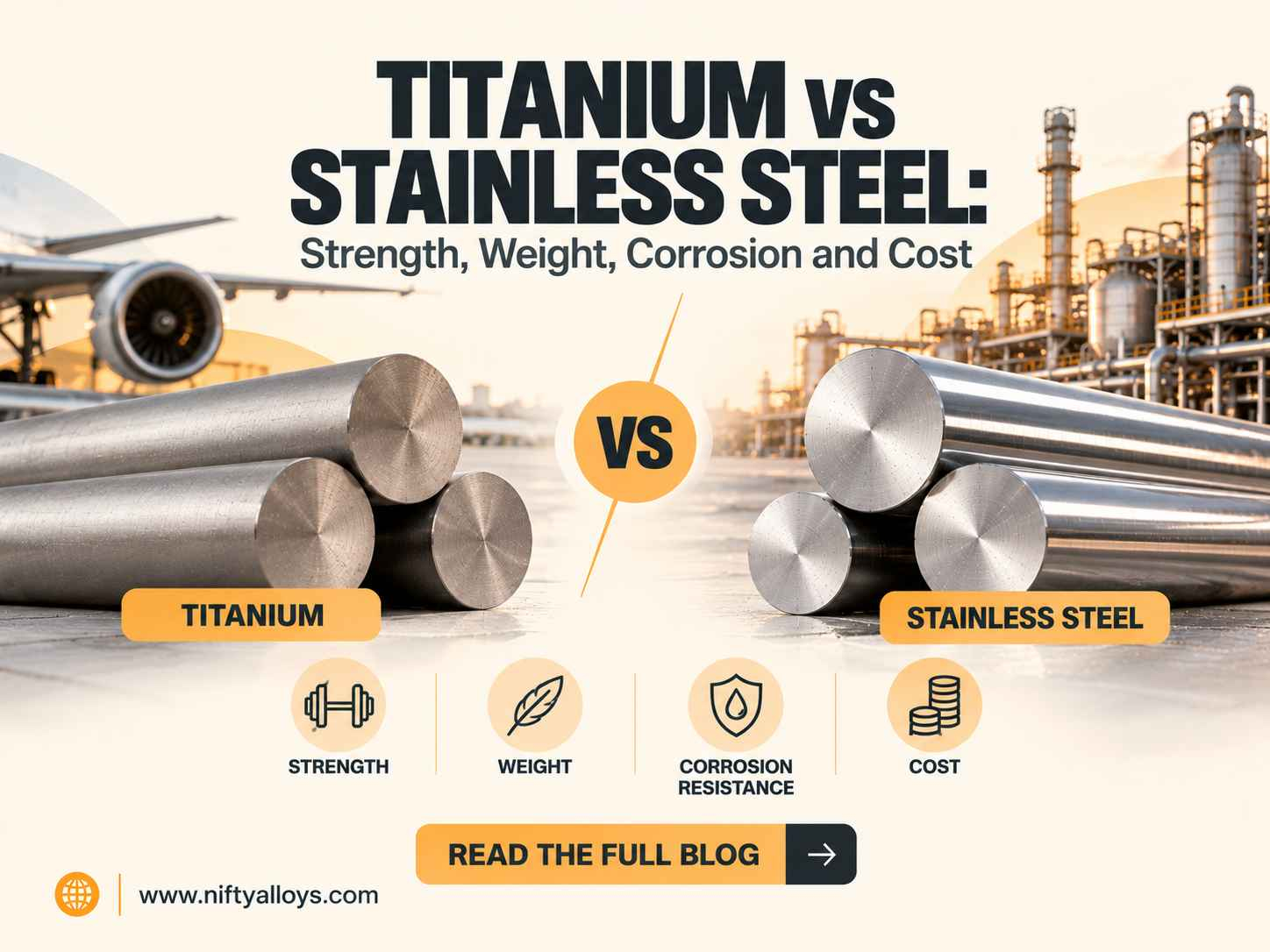
Is titanium stronger than stainless steel?" is one of the most common questions in materials selection, and the honest answer is that it depends which titanium and which stainless steel. Commercially pure titanium is weaker than many stainless steels. Titanium alloys such as Grade 5 are stronger than most of them. And on a weight-for-weight basis, titanium wins comfortably.
This guide compares the two materials the way engineers and buyers actually need to: by grade, on strength, weight, stiffness, corrosion, temperature and total cost, so you can decide which one your application really needs.
Is Titanium Stronger Than Stainless Steel?
It depends on the grades being compared. The table below uses specification minimums for bar, which is a fairer comparison than the typical or maximum values often quoted.
| Material | Tensile strength, min | Yield strength, min | Density |
| Titanium Grade 2 (CP), ASTM B348 | 345 MPa | 275 MPa | 4.51 g/cm³ |
| Titanium Grade 5 (Ti-6Al-4V), ASTM B348 | 895 MPa | 828 MPa | 4.43 g/cm³ |
| 316L stainless, ASTM A479 | 485 MPa | 170 MPa | About 8.0 g/cm³ |
| 2205 duplex, ASTM A479 | 620 MPa | 450 MPa | About 7.8 g/cm³ |
| 17-4 PH, H1150 condition | 930 MPa | 725 MPa | About 7.8 g/cm³ |
Grade 5 titanium has nearly five times the minimum yield strength of 316L and outperforms duplex and 17-4 PH in the H1150 condition. Grade 2 titanium, the grade most used for corrosion service, has a higher yield strength than 316L but is weaker than duplex. Yield strength is the figure that governs design, as explained in our guide to tensile strength vs yield strength.
Which Is Lighter, Titanium or Stainless Steel?
Titanium, by a wide margin. At about 4.5 g/cm³, it is roughly 56% of the density of stainless steel at about 8.0 g/cm³; see our guide to the density of steel for the full figures. A titanium part of the same size weighs about 45% less.
Combine density and strength and the gap widens. Grade 5 titanium has a strength-to-weight ratio around eight to nine times that of 316L, which is why it dominates weight-critical aerospace, offshore riser and high-performance applications.
Stiffness and Hardness: Where Stainless Steel Wins
Strength is not the whole story. Titanium’s elastic modulus is about 105–115 GPa, roughly half that of stainless steel at about 193–200 GPa. A titanium shaft or beam of the same dimensions will deflect about twice as much under the same load, so titanium designs often need larger sections where stiffness rather than strength governs.
Titanium also has poor wear and galling resistance. Titanium threads, sliding fits and valve parts can seize unless they are coated, lubricated or paired with a dissimilar material. Annealed 316L is softer than Grade 5 titanium, but hardened stainless grades such as 17-4 PH and 440C offer far better wear performance than any titanium.
How Do They Compare for Corrosion Resistance?
This is titanium’s strongest advantage. Its oxide film makes it practically immune to seawater, brine and most chloride environments at normal temperatures, without the pitting and crevice corrosion that limits 316L. Titanium is also highly resistant to wet chlorine and many oxidising chemicals.
Stainless steel performance depends heavily on grade. 316L is prone to pitting, crevice corrosion and chloride stress corrosion cracking in seawater, especially above about 60 °C. Super duplex stainless steel narrows the gap considerably and is a common, cheaper alternative to titanium in seawater piping.
Warning: Where Titanium Fails
Titanium is not universally corrosion resistant. It is attacked by reducing acids such as hydrochloric and sulfuric acid unless inhibited or a palladium-alloyed grade is used, and by hydrofluoric acid and fluoride-bearing solutions. It can react violently with dry chlorine gas. In hot brine, crevice corrosion becomes a risk for Grade 2, where Grade 7 or Grade 12 is often specified. Check the full chemistry before assuming titanium is the safe choice.
Which Handles Temperature Better?
Stainless steel. Austenitic grades such as 321, 347 and 310 are used well above 600 °C, whereas titanium alloys are generally limited to around 400–500 °C, above which oxidation and embrittlement set in. At the other extreme, austenitic stainless steels keep their toughness down to cryogenic temperatures, which is why they are standard in LNG service.
Titanium also expands only about half as much as austenitic stainless steel when heated. That can be an advantage for dimensional stability, but it creates thermal stresses where the two materials are joined.
How Much More Does Titanium Cost?
Titanium typically costs several times more per kilogram than stainless steel, and it is slower and more demanding to machine and weld. Welding requires full inert-gas shielding of the weld and the hot metal behind it, because titanium picks up oxygen and nitrogen and becomes brittle.
The comparison narrows on a per-part basis, because a titanium part weighs about 45% less, and narrows further over the life of the equipment. In seawater heat exchangers and desalination plants, titanium tubes are often chosen precisely because they can last for the life of the plant with very little maintenance, where cheaper materials need replacement.
When Should You Choose Titanium or Stainless Steel?
Choose titanium when
- The equipment handles seawater, brine or wet chlorine, especially in heat exchangers, condensers and desalination plants.
- Weight is critical, as in aerospace, offshore and high-performance components.
- Lifecycle cost and minimal maintenance outweigh the initial material cost.
Choose stainless steel when
- Cost is the main constraint and the environment is within the grade’s limits.
- The part runs hot, above about 400–500 °C, or in cryogenic service.
- Stiffness, wear resistance or thread galling matter.
- Fabrication needs to be straightforward and widely available.
Nifty Alloys supplies both: see our stainless steel range for austenitic, duplex and precipitation-hardening grades.
What Should Buyers Specify?
- Titanium grade: Grade 2 for corrosion service, Grade 5 for strength, Grade 7 or 12 for hot crevice or reducing conditions.
- Titanium standards: ASTM B348 for bar, B265 for plate and sheet, B338 for heat exchanger tubes, B381 for forgings; AMS specifications such as AMS 4928 for aerospace Ti-6Al-4V bar.
- Stainless standards: ASTM A479 for bar, A240 for plate, A312 for pipe.
- Certification: EN 10204 3.1 as a minimum; see our EN 10204 certificate guide.
Frequently Asked Questions
Is titanium stronger than stainless steel?
Grade 5 titanium is stronger than most stainless steels. Commercially pure Grade 2 titanium is stronger than 316L but weaker than duplex and 17-4 PH. Weight for weight, titanium is much stronger.
Is titanium harder than stainless steel?
Grade 5 titanium is harder than annealed 304 or 316, but hardened stainless steels such as 17-4 PH and 440C are harder and far more wear resistant than titanium.
Why is titanium so expensive?
Titanium is costly to extract and refine, and it is slower to melt, machine and weld than steel. Those processing costs, not scarcity, drive most of the price.
Is titanium magnetic?
No. Titanium is non-magnetic. Austenitic stainless steels are essentially non-magnetic when annealed but can become slightly magnetic after cold working, while ferritic, martensitic and duplex grades are magnetic.
Titanium and Stainless Steel from Dubai
Nifty Alloys LLC supplies titanium alloys and stainless steels to marine, desalination, oil and gas, and engineering buyers across the UAE, GCC and export markets. Every order ships with an EN 10204 3.1 mill test certificate, reviewed by our QA/QC team under our quality and certification standards.
Not sure whether your application needs titanium? Send our team the operating environment, temperature and load requirements, and we will help you compare the options before you order.
 Let's Talk
Monel is used in marine engineering because its roughly two-thirds nickel, one-third copper composit...
Petrochemical plants use 304L and 316L for general process service, 321 and 347 for high-temperature...
Aircraft use aluminium because it is about one-third the density of steel while offering good streng...
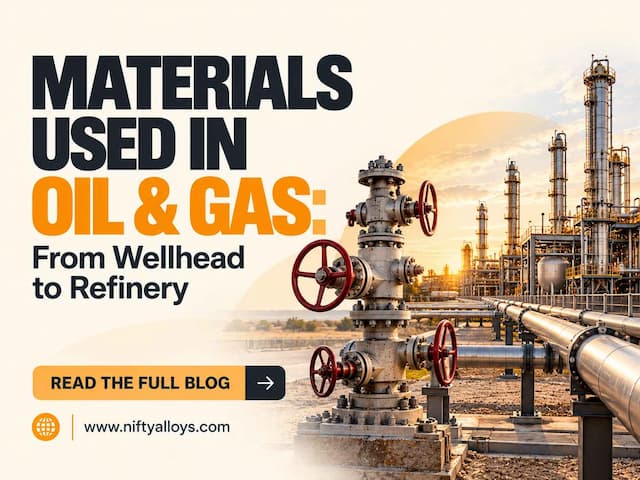
Oil and gas relies mainly on carbon and low-alloy steels, upgraded to corrosion-resistant alloys whe...




Elevate Your Projects with
 Our Superior Steels
