

Monel 400 vs Monel K500: Strength, Corrosion and Uses
Monel 400 (UNS N04400) is a solid-solution nickel-copper alloy that can be strengthened only by cold work. Monel K500 (UNS N05500) adds aluminium and titanium so it can be age-hardened, giving roughly three times the yield strength and twice the tensile strength of annealed 400. Corrosion resistance is broadly similar, but aged K500 can be more prone to stress corrosion cracking in some environments.
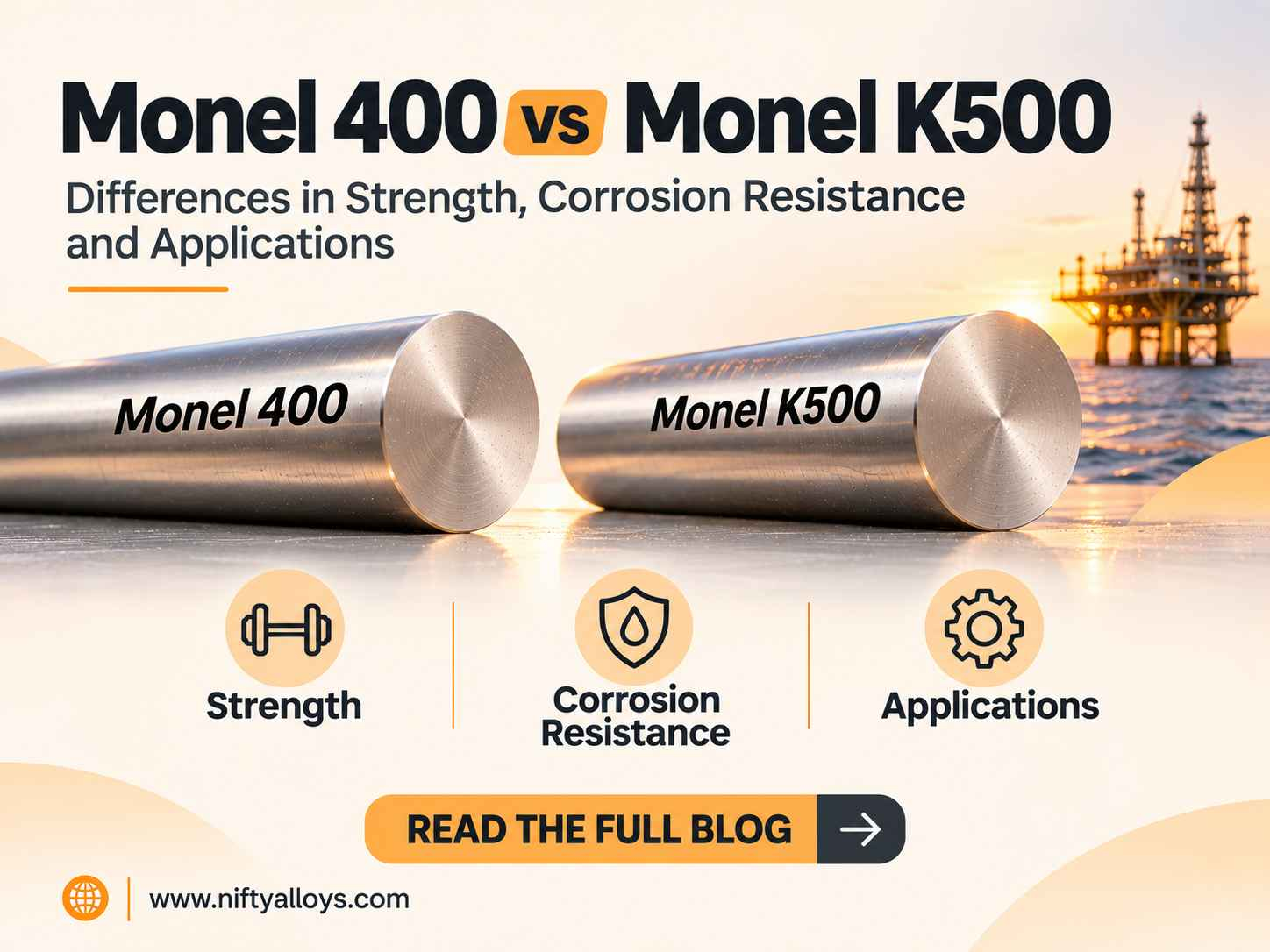
Monel 400 and Monel K500 come from the same nickel-copper family and look identical on a rack, so they are often treated as interchangeable on enquiries and purchase orders. They are not. The decision usually comes down to one question: does the component need more strength than Monel 400 can provide, and can the design accept the trade-offs that come with age hardening?
This guide compares composition, properties, corrosion behaviour, fabrication and specifications so that buyers can select and order the right grade. For the base alloy alone, see our Monel 400 (UNS N04400) guide.
What Is the Difference Between Monel 400 and Monel K500?
Both alloys contain roughly two-thirds nickel and one-third copper, which gives them their well-known resistance to seawater, alkalis and many non-oxidising acids. The difference is in the minor additions.
Monel K500 contains about 2.3–3.15% aluminium and 0.35–0.85% titanium. During a controlled ageing heat treatment, these elements form very fine Ni₃(Al,Ti) precipitates throughout the matrix. These particles obstruct dislocation movement, which is what raises strength and hardness. Monel 400 has no such additions, so its strength depends on whether it is annealed, hot-finished or cold-worked.
| Element (wt %) | Monel 400 (UNS N04400) | Monel K500 (UNS N05500) |
| Nickel (incl. cobalt) | 63.0 min | 63.0 min |
| Copper | 28.0–34.0 | 27.0–33.0 |
| Aluminium | Not specified | 2.30–3.15 |
| Titanium | Not specified | 0.35–0.85 |
| Iron | 2.5 max | 2.0 max |
| Manganese | 2.0 max | 1.5 max |
| Carbon | 0.3 max | 0.25 max |
| Silicon | 0.5 max | 0.5 max |
| Sulphur | 0.024 max | 0.01 max |
How Much Stronger Is Monel K500 Than Monel 400?
In the age-hardened condition, Monel K500 typically offers about three times the yield strength and twice the tensile strength of annealed Monel 400. The table shows nominal ranges for rod and bar. Guaranteed minimums come from the product specification and the mill test certificate.
| Alloy and condition (rod & bar) | Tensile strength (MPa) | 0.2% yield (MPa) | Elongation (%) | Hardness |
| Monel 400, annealed | 517–620 | 172–345 | 60–35 | 60–80 HRB |
| Monel 400, cold-drawn, stress-relieved | 579–827 | 379–690 | 40–22 | 85 HRB–20 HRC |
| Monel K500, cold-drawn, annealed and aged | 896–1310 | 586–827 | 30–20 | 24–35 HRC |
In practice, the extra strength allows a smaller shaft diameter for the same torque, higher bolt preload or better resistance to wear and galling in moving parts. Monel K500 also retains good mechanical properties from sub-zero temperatures up to about 480 °C.
Why the Supply Condition Matters
Monel K500 can be supplied annealed (softer and easier to machine) or already age-hardened. If it is bought annealed, it must be aged after machining to reach full strength. A typical cycle is around 600 °C for 16 hours, followed by slow furnace cooling to about 480 °C, but the actual cycle should follow the governing specification. Ageing causes a small volume contraction, so finish-machining allowances need to account for it. Always state the required condition on the purchase order.
Is Monel K500 as Corrosion Resistant as Monel 400?
For most environments, yes. The general corrosion resistance of the two alloys is broadly equivalent in seawater, alkalis, salts and non-oxidising acids. Both perform well in flowing seawater, but either can suffer pitting under fouling in stagnant or slow-moving seawater.
The important difference is environmental cracking. In the age-hardened condition, Monel K500 shows a greater tendency to stress corrosion cracking in some environments than Monel 400. Both alloys appear in ISO 15156-3 under defined material conditions, so check the applicable limits in our NACE MR0175 / ISO 15156 guide before specifying either for H₂S service.
Note for subsea and offshore buyers
Age-hardened Monel K500 has a documented history of hydrogen embrittlement failures when connected to cathodic protection systems, particularly in highly stressed bolting. Where cathodic protection is present, confirm the project specification and any hardness or condition restrictions before choosing K500.
Welding and Machining Considerations
Welding. Monel 400 is readily welded using matching nickel-copper filler metal (ERNiCu-7). Monel K500 is best welded in the annealed condition, then stress-relieved before final ageing. Exposure to the ageing range (roughly 480–590 °C) should be avoided except during the final age-hardening treatment. Standard nickel-copper fillers do not age-harden, so the weld usually will not match the strength of aged K500 base metal. For this reason, K500 is used mainly for machined parts.
Machining. Both alloys work-harden. Use rigid setups, sharp tools and heavy, constant feeds so the tool does not dwell and harden the surface. For K500, a common practice is to rough-machine in the annealed condition, age-harden, then finish-machine.
When Should You Specify Monel 400 or Monel K500?
The usual rule is to choose Monel 400 for formed, welded and pressure-containing equipment, and Monel K500 for highly stressed machined components. Many of these uses are covered in our article on why Monel is used in marine engineering.
| Application | Usual choice | Reason |
| Seawater piping, heat exchanger tube, tanks | Monel 400 | Weldable, formable and available in tube, plate and fittings |
| Hydrofluoric acid process equipment | Monel 400 | Established service record in HF; annealed condition preferred |
| Pump shafts and propeller shafts | Monel K500 | High strength with good corrosion fatigue resistance in seawater |
| Valve stems and valve trim | Monel K500 | Strength and wear resistance in corrosive media |
| Marine fasteners and bolting | Either | K500 where higher preload is needed; review cathodic protection exposure |
| Drill collars and non-magnetic instrument housings | Monel K500 | Virtually non-magnetic with high strength |
If neither alloy suits the environment, for example in strongly oxidising acids, other nickel alloy families may be more appropriate. Our comparison of Inconel vs Hastelloy vs Monel covers those alternatives.
Specifications and Documentation to Request
Monel 400 and Monel K500 are covered by different product specifications. A certificate issued against ASTM B164 does not certify K500, so check that the specification on the mill test certificate matches the alloy ordered.
| Item | Monel 400 | Monel K500 |
| UNS / W.Nr. | N04400 / 2.4360 | N05500 / 2.4375 |
| Rod and bar | ASTM B164 / ASME SB164 | ASTM B865; AMS 4676 |
| Plate, sheet, strip | ASTM B127 | Check availability by form |
| Seamless pipe and tube | ASTM B165 | Limited; confirm before design |
| Forgings | ASTM B564 | ASTM B865 (forgings within scope) |
Quotation Checklist
To receive an accurate quotation, include the following details. Our guide on how to specify nickel alloy round bar on a purchase order explains each point.
- Grade and UNS number (N04400 or N05500)
- Product specification and edition, for example ASTM B164 or ASTM B865
- Supply condition: annealed, hot-finished, cold-drawn or age-hardened
- Product form, dimensions, tolerances and quantity
- Hardness limits and NACE MR0175 / ISO 15156 compliance, if required
- Certification level, such as EN 10204 3.1 or 3.2
- Delivery location and required delivery date
Frequently Asked Questions
Is there a Monel K400 grade?
No standard Monel K400 alloy exists. Enquiries that mention “K400” usually mean either Monel 400 or Monel K500. Confirm the UNS number before quoting or ordering.
Can Monel 400 be heat treated to match Monel K500?
No. Monel 400 lacks the aluminium and titanium needed for precipitation hardening. It can be strengthened only by cold work, and heat treatment is used mainly for annealing or stress relief.
Is Monel K500 magnetic?
Monel K500 is virtually non-magnetic down to about −130 °C. A thin magnetic surface layer can form during heat treatment and is normally removed by pickling. Monel 400 can show weak magnetism near room temperature because its Curie point is close to ambient.
Is Monel K500 more expensive than Monel 400?
Generally yes, because of the alloying additions, the ageing treatment and the narrower range of product forms. Actual pricing depends on form, size, quantity and market conditions.
 Let's Talk
Titanium is about 45% lighter than stainless steel. Grade 5 titanium (Ti-6Al-4V) is stronger than mo...
Monel is used in marine engineering because its roughly two-thirds nickel, one-third copper composit...
Petrochemical plants use 304L and 316L for general process service, 321 and 347 for high-temperature...
Aircraft use aluminium because it is about one-third the density of steel while offering good streng...



Elevate Your Projects with
 Our Superior Steels
