

ASTM A276 vs ASTM A479: Which Stainless Bar Spec to Order
ASTM A276 is the general-purpose specification for stainless steel bars and shapes. ASTM A479 covers bars and shapes for boilers and other pressure vessels, adds stricter heat-treatment and intergranular corrosion requirements for austenitic grades, and has an ASME counterpart, SA-479, with allowable stresses for pressure design. Order A479 when the bar becomes a pressure-retaining part.
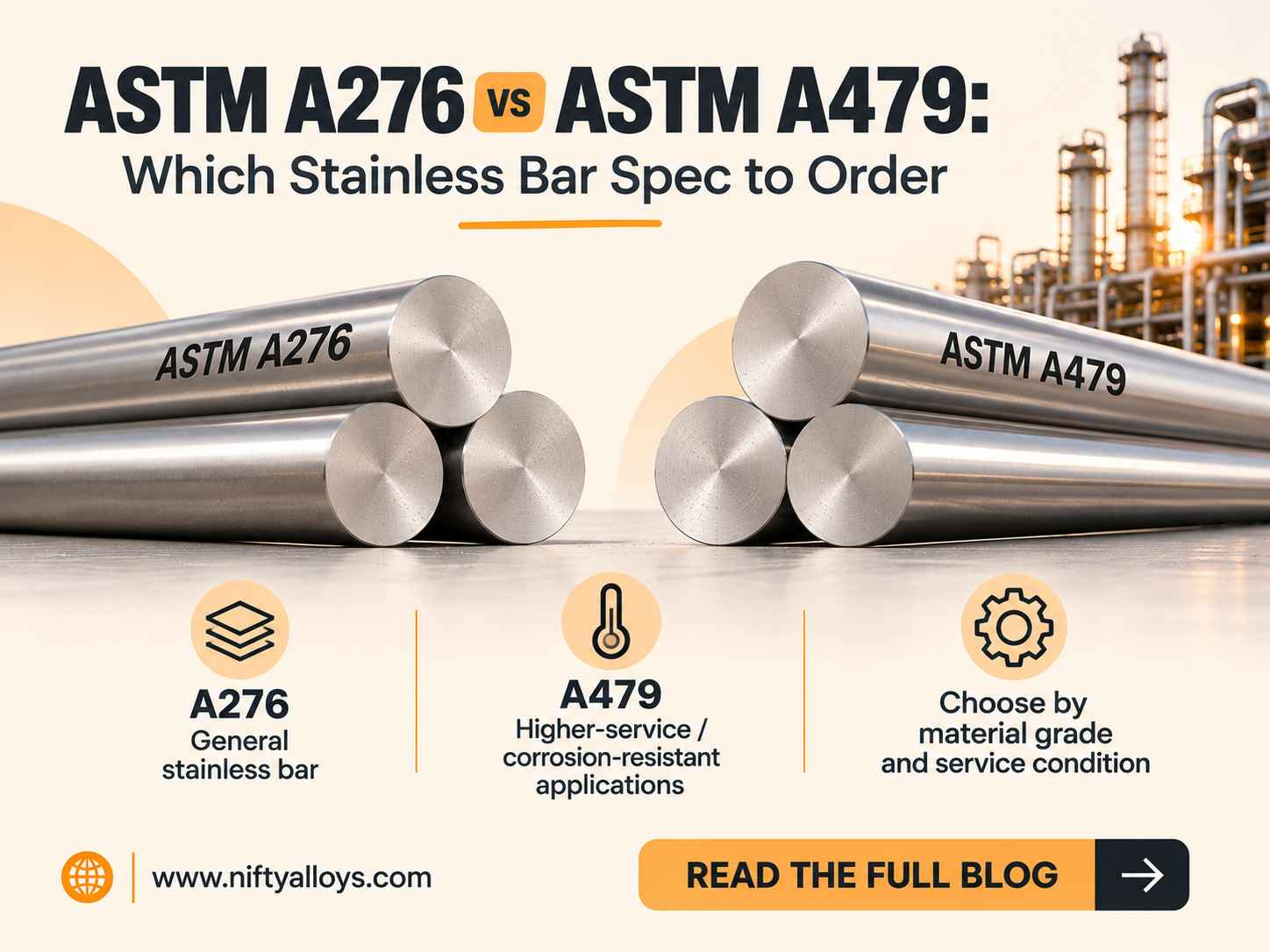
ASTM A276 and ASTM A479 both cover stainless steel bars and shapes, and the same heat of 316L can often be certified to either. The difference lies in intended service. Choosing the wrong specification rarely shows up on the bar itself. It shows up at document review, when an inspector rejects an MTC because the specification on the certificate does not match the purchase order or the design code.
This guide explains how the two specifications differ, when A479 is required, and what to put in an enquiry when sourcing stainless steel bar in the UAE and GCC.
What Does Each Specification Cover?
ASTM A276: general-purpose stainless bar
ASTM A276/A276M covers hot-finished or cold-finished stainless bars, including rounds, squares and hexagons, plus hot-rolled or extruded shapes such as angles, tees and channels. Bars for reforging fall under ASTM A314, and free-machining grades designed for optimum machinability are covered by ASTM A582. Grades span the austenitic, ferritic, martensitic and austenitic-ferritic (duplex) families.
Bars can be ordered in several conditions: Condition A (annealed), Conditions H and T (hardened and tempered at different temperatures), Condition S (strain hardened or lightly cold worked) and Condition B (more severely cold worked). That flexibility suits shafts, fasteners, valve trim and machined parts. It also means that "A276 316" alone does not define the condition you will receive.
ASTM A479: bar for boilers and pressure vessels
ASTM A479/A479M covers the same product forms for use in boiler and pressure-vessel construction. Its counterpart, ASME SA-479, is published in ASME BPVC Section II Part A. Austenitic grades are supplied solution annealed, with defined exceptions such as strain-hardened Type 316 and hot-rolled or strain-hardened XM-19. Austenitic grades also carry intergranular corrosion requirements that reference ASTM A262.
ASTM A276 vs A479: Key Differences at a Glance
| Criterion | ASTM A276 | ASTM A479 |
| Intended service | General engineering and corrosion-resistant applications | Boilers, pressure vessels and pressure-containing parts |
| Product forms | Hot- or cold-finished bars; rolled or extruded shapes | Same product forms |
| Austenitic supply condition | Condition A, S or B, as ordered | Solution annealed, except specified strain-hardened or hot-rolled grades |
| Intergranular corrosion | No equivalent requirement | Requirements for austenitic grades, referencing ASTM A262 |
| ASME status | SA-276 exists, but has no Section II Part D allowable stresses for pressure design | SA-479 has Section II Part D allowable stresses |
| ASME B31.3 Table A-1 | Not listed | Listed |
| General requirements | ASTM A484/A484M | ASTM A484/A484M |
Is the Chemistry or Strength Different?
For most common grades, not significantly. A given UNS designation, such as S31603, S32205 or S32750, has broadly aligned composition limits in both specifications. Annealed minimum tensile and yield values are also typically the same. For example, 316L requires a minimum of 485 MPa tensile and 170 MPa yield, and S32205 a minimum of 655 MPa tensile and 450 MPa yield. These are specification minimums, not typical values, and they apply to the stated condition and size range.
Treat claims that A479 has "tighter chemistry" or "mandatory hardness testing on every bar" with caution. Several published comparisons make these claims, and they are not consistent with each other. The practical differences lie in scope, heat treatment, corrosion testing and code acceptance. Check the actual tables in the edition you are ordering to.
When Should You Order A479 Instead of A276?
Specify ASTM A479 or ASME SA-479 when any of the following apply:
- The bar will be machined into a pressure-retaining part, such as a plug, nozzle, valve body, bonnet or fitting designed to ASME BPVC or ASME B31.3.
- The design calculation uses allowable stresses from ASME Section II Part D.
- The project specification, datasheet or drawing names A479 or SA-479.
- The service is at elevated temperature and the design relies on solution-annealed condition or grain-size control, as with H grades.
A276 is normally sufficient for shafts, pins, brackets, fasteners, non-pressure valve trim and general machined parts, provided the condition is specified. Under ASME B31.3, A276 material cannot be used for pressure-retaining components, although structural attachments with no pressure design are treated differently. That decision belongs to the responsible design engineer, not the supplier.
The same logic applies to duplex and super duplex bar. Grade selection itself is covered in our duplex vs super duplex comparison
Can One Bar Be Certified to Both?
Yes. A large share of 304/304L and 316/316L bar is produced to meet both specifications, and the mill test certificate states "ASTM A276/A479", often with ASME SA-276/SA-479. Dual certification is valid only if the material meets every requirement of each specification listed, including the A479 heat-treatment and corrosion provisions.
When reviewing a dual-certified EN 10204 3.1 certificate, check:
- Both specification numbers, and the ASME "SA" designation if the job is code work.
- The heat number on the certificate matches the marking on the bar.
- The solution annealing temperature and quench method are recorded.
- Intergranular corrosion results are reported where required.
- Tensile, yield, elongation and hardness results meet the tables of the stated edition.
For a section-by-section walkthrough, see our: guide to reading mill test certificates.
What to Include in Your Enquiry
Write the specification exactly as the design requires. A complete enquiry line looks like this: "Round bar, ASTM A479/ASME SA-479 Type 316L (UNS S31603), solution annealed, Ø50 mm × 3,000 mm, peeled, EN 10204 3.1 MTC." For an accurate quotation, include:
- Specification: A276, A479, SA-479 or dual certification, with edition if your project fixes one.
- Grade: type and UNS number.
- Condition: annealed, Condition S or B, or hardened and tempered.
- Form and size: diameter or across-flats size, length and tolerance.
- Surface finish: black, peeled, turned, ground or polished.
- Quantity and delivery: pieces or kg/MT, delivery location and Incoterms.
- Documentation: EN 10204 3.1 or 3.2, PMI, and NACE MR0175/ISO 15156 compliance for sour service.
The same purchase-order discipline applies to other alloys. See how to specify nickel alloy bar on a purchase order.
Frequently Asked Questions
Is ASME SA-479 the same as ASTM A479?
SA-479 is ASME's adoption of ASTM A479, either identical or with modifications stated in Section II. For code-stamped equipment, order and certify to SA-479 in the edition accepted by the applicable Code.
What is the closest European standard to ASTM A479?
EN 10272 covers stainless steel bars for pressure purposes, while EN 10088-3 covers bars for general purposes. They play similar roles to A479 and A276, but grades and requirements are not directly interchangeable. Any substitution needs engineering review.
Does A479 bar cost more than A276?
It depends on what is in stock. Where dual-certified bar is available, there may be little practical difference. Where A479 material must be sourced separately, lead time can matter as much as price. Ask for both options in the quotation.
Source Certified Stainless Bar From Nifty Alloys
Nifty Alloys LLC is a Dubai-based stockist and supplier of stainless, duplex and super duplex bar for buyers across the UAE, GCC and export markets. Material is supplied with EN 10204 3.1 mill test certificates, which our QA/QC team, led by Anup Kurup, reviews against your order requirements. Send your specification, grade, size, quantity and delivery location through our request a quotation to confirm availability and certification options.
 Let's Talk
Monel 400 (UNS N04400) is a solid-solution nickel-copper alloy that can be strengthened only by cold...
Titanium is about 45% lighter than stainless steel. Grade 5 titanium (Ti-6Al-4V) is stronger than mo...
Monel is used in marine engineering because its roughly two-thirds nickel, one-third copper composit...
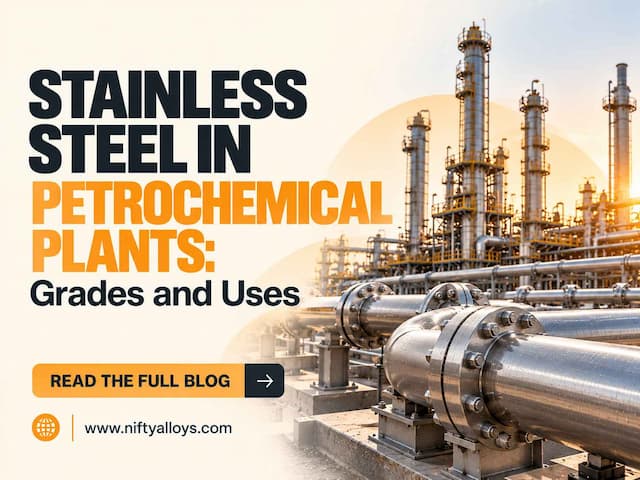
Petrochemical plants use 304L and 316L for general process service, 321 and 347 for high-temperature...



Elevate Your Projects with
 Our Superior Steels
