

Why Monel Is Used in Marine Engineering: Shafts and Valves
Monel is used in marine engineering because its roughly two-thirds nickel, one-third copper composition resists flowing seawater, erosion and chloride stress corrosion cracking. Monel 400 is used for valves, pumps, heat exchanger tubes and splash-zone sheathing. Age-hardened Monel K500 adds two to three times the yield strength, making it the standard for pump shafts, propeller shafts and marine fasteners.
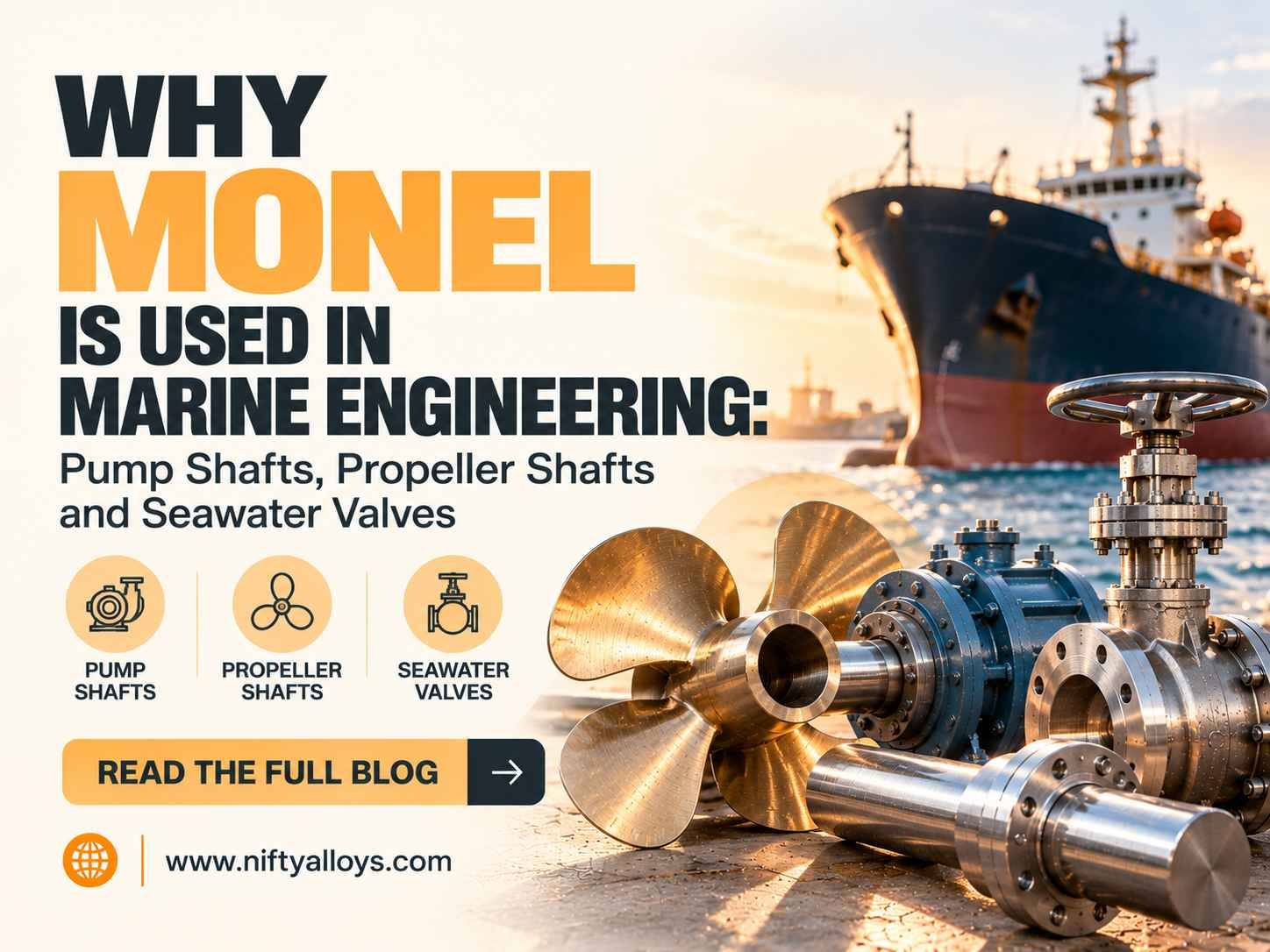
Seawater is hard on rotating and sealing parts. A pump shaft or propeller shaft has to carry torque and bending loads while running in salt water, often at high velocity, and a valve stem has to seal against seawater for years without seizing or pitting. Monel nickel-copper alloys have done these jobs on ships, offshore platforms and coastal plants for decades.
This guide explains why Monel 400 and Monel K500 are used in marine engineering, which parts each one suits, and the limits that every marine buyer and designer should know.
What Makes Monel Suitable for Seawater?
Monel alloys are about 63% nickel and 28–34% copper. That combination behaves very differently from stainless steel in seawater. Instead of relying on a thin chromium oxide film, which can break down at crevices, Monel corrodes very slowly and uniformly in flowing seawater and keeps that resistance at high flow velocities, where copper alloys begin to erode.
Monel is also effectively immune to chloride stress corrosion cracking, a common failure mode for austenitic stainless steels in warm seawater, and it resists erosion and cavitation in pump and propeller service better than most copper-based alloys.
Monel 400 vs Monel K500: What Is the Difference?
| Property | Monel 400 (UNS N04400) | Monel K500 (UNS N05500) |
| Composition | Ni 63% min, Cu 28–34% | Ni 63% min, Cu 27–33%, plus Al and Ti |
| Strengthening | Cold work only | Age hardening (precipitation) |
| Typical yield strength | About 170 MPa annealed | About 690 MPa hot-worked and aged |
| Seawater corrosion resistance | Excellent in flowing seawater | Similar to Monel 400 |
| Typical bar standard | ASTM B164 | ASTM B865 |
| Main marine uses | Valves, pumps, tubing, sheathing | Shafts, valve stems, fasteners, springs |
K500 keeps the corrosion resistance of Monel 400 but adds aluminium and titanium, which form fine strengthening precipitates during an ageing heat treatment. The result is a seawater-resistant alloy with strength comparable to many heat-treated steels.
Where Is Monel Used on Ships and Offshore Structures?
Propeller shafts
Monel K500 is a long-established propeller shaft material for workboats, patrol craft, yachts and other vessels where a corrosion-resistant shaft is preferred over a protected steel one. Its high strength allows smaller shaft diameters, and it is galvanically close to the bronze propellers it usually drives, which limits galvanic corrosion at the coupling.
Pump shafts and impellers
Seawater pumps on ships, platforms and coastal plants commonly use K500 shafts, sometimes with Monel 400 or nickel aluminium bronze impellers and casings. The shaft needs strength and fatigue resistance as well as corrosion resistance, which is exactly what age-hardened K500 provides.
Seawater valves
Monel 400 is used for valve bodies, seats and trim in seawater service, with K500 for stems that need extra strength and resistance to galling. Monel-trimmed valves are a common choice in seawater cooling, ballast and firefighting systems.
Fasteners, springs and splash-zone sheathing
K500 bolts, studs and springs are used where seawater-resistant, high-strength fasteners are needed. Monel 400 sheathing has also long been used to protect offshore platform legs and risers in the splash zone, where alternating wetting and drying attacks carbon steel most aggressively.
What Are Monel’s Limits in Marine Service?
Monel performs best when seawater is moving. Its weaknesses appear in three situations.
- Stagnant seawater and crevices: Monel can pit in stagnant water, under marine fouling, and in crevices such as packing glands and under seals. Shafts on vessels that sit idle for long periods are the most exposed.
- Galvanic coupling to more noble alloys: in chlorinated seawater, Monel is less noble than super duplex stainless steel, titanium and some nickel-chromium alloys, and corrodes faster when connected to them without insulation.
- Hydrogen embrittlement under cathodic protection: age-hardened K500 has suffered hydrogen embrittlement cracking when used subsea under cathodic protection, particularly at higher hardness levels. Subsea K500 parts need controlled hardness and careful CP design, or an alternative alloy.
Warning: Specify the K500 Condition Before Machining
Monel K500 can be supplied annealed or hot-worked for machining, or already age hardened. It machines far more easily before ageing, and ageing causes a small dimensional change, so many workshops rough or finish-machine first and age afterwards. Ordering aged bar when the workshop expects to age the parts itself, or the reverse, is a common and expensive mistake. State the condition on the purchase order.
Our guide on how to specify nickel alloy bar on a purchase order covers how to state the K500 condition, standard and certification on each order line.
How Does Monel Compare with Other Marine Materials?
| Material | Where it is used | Compared with Monel |
| 316 stainless steel | Fittings, trim, general hardware | Cheaper, but prone to crevice corrosion in seawater |
| Duplex and super duplex | Shafts, piping, pump parts | Higher strength and crevice resistance; super duplex needs controlled welding |
| Nickel aluminium bronze | Propellers, pump casings, valves | Usually cast; lower cost for large castings |
| 90/10 copper-nickel | Seawater piping, condensers | Better biofouling resistance; lower velocity limits |
| Alloy 625 | Critical seawater components | Better crevice resistance, higher cost |
For more on the copper-based alternatives, see our guides to naval brass vs naval bronze and cupronickel C70600 vs C71500. For a wider nickel alloy comparison, see our Inconel vs Hastelloy vs Monel guide.
Frequently Asked Questions
Is Monel better than stainless steel in seawater?
In flowing seawater and where chloride stress corrosion cracking is a risk, generally yes. Standard 316 stainless steel is prone to crevice corrosion in seawater. Super duplex and 6Mo stainless steels can match or exceed Monel in some conditions.
Why is Monel K500 used for propeller shafts?
Because it combines seawater resistance with high strength and fatigue resistance after age hardening, and is galvanically compatible with bronze propellers.
Does Monel corrode in seawater?
Very slowly in flowing seawater. It can pit in stagnant seawater, under fouling or in crevices, which is why idle vessels and sealed areas need attention.
Is Monel magnetic?
Monel 400 is weakly magnetic at room temperature. K500 is essentially non-magnetic, which is one reason it is used in some instrument and oilfield tool components.
Monel 400 and Monel K500 from Dubai
Nifty Alloys LLC supplies Monel 400 and Monel K500 as part of our nickel alloy range to shipyards, marine repair yards, pump and valve manufacturers and offshore buyers across the UAE, GCC and export markets. Every order ships with an EN 10204 3.1 mill test certificate, reviewed by our QA/QC team under our quality and certification standards.
Send our team your shaft or valve requirements, including size, condition and certification, and we will confirm availability before quoting.
 Let's Talk
Petrochemical plants use 304L and 316L for general process service, 321 and 347 for high-temperature...

Aircraft use aluminium because it is about one-third the density of steel while offering good streng...

Oil and gas relies mainly on carbon and low-alloy steels, upgraded to corrosion-resistant alloys whe...
Super duplex is used in firewater and seawater piping because its PREN of 40 or more resists pitting...



Elevate Your Projects with
 Our Superior Steels
