

Beryllium Copper vs Copper: Key Differences Explained
Pure copper (C11000) offers the highest electrical and thermal conductivity of any commercially available copper product, but very low strength and no ability to be hardened by heat treatment. Beryllium copper (C17200/C17500) sacrifices some conductivity in exchange for strength approaching that of alloy steel — up to roughly 1,400 MPa after heat treatment — while still retaining useful, though reduced, electrical and thermal conductivity. The choice comes down to whether the application needs maximum conductivity or a combination of strength and conductivity together.
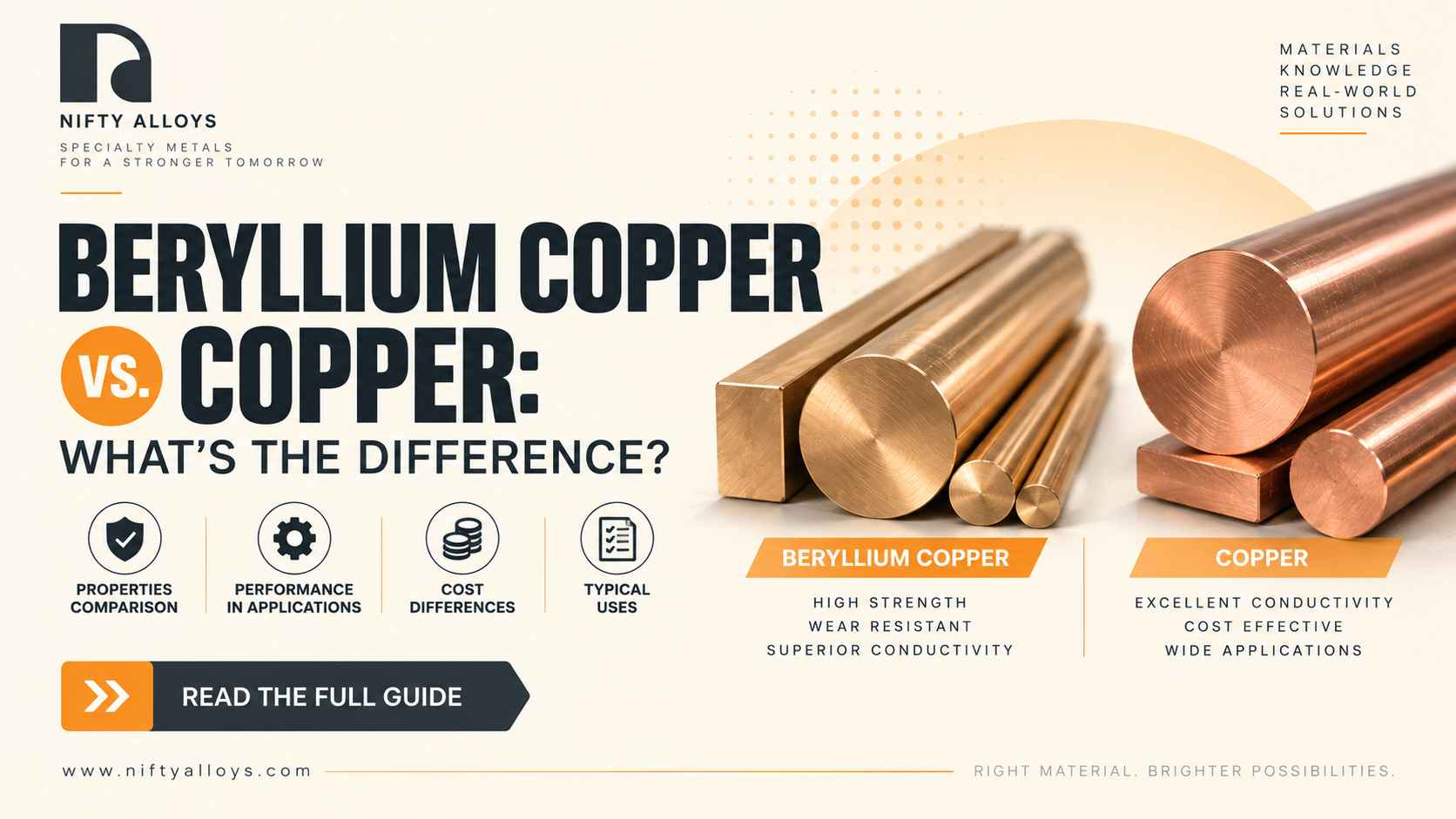
Pure copper and beryllium copper are sometimes treated as interchangeable simply because both are “copper” but they occupy very different positions on the strength-versus-conductivity spectrum, and substituting one for the other in a design can mean the difference between a component that survives its service life and one that fails from fatigue or overheating. This comparison sets out where each material actually fits. For grade-level detail on beryllium copper composition and the differences between C17200 and C17500, see our beryllium copper alloy product page — this guide focuses specifically on how beryllium copper compares to unalloyed copper.
What Is Pure Copper?
Unalloyed copper most commonly supplied as C11000 electrolytic tough pitch (ETP) copper is valued almost entirely for its conductivity. It offers close to 100% IACS (International Annealed Copper Standard) electrical conductivity and excellent thermal conductivity, along with good ductility and corrosion resistance. What it does not offer is strength: pure copper is soft, cannot be hardened by heat treatment, and work-hardens only modestly through cold working before ductility is exhausted.
What Is Beryllium Copper?
Beryllium copper is a precipitation-hardenable copper alloy containing roughly 0.5–3% beryllium, most commonly supplied as C17200 (the highest-strength grade) or C17500 (a lower-strength, higher-conductivity grade). The beryllium addition allows the alloy to be strengthened significantly through age hardening solution treating followed by a lower-temperature aging step reaching tensile strengths comparable to many alloy steels while retaining a meaningful fraction of copper's natural conductivity.
Key Differences at a Glance
| Property | Pure Copper (C11000) | Beryllium Copper (C17200) |
| Electrical conductivity | ~100% IACS | ~20–25% IACS (heat treated) |
| Thermal conductivity | Very high | Moderate |
| Tensile strength | ~220–250 MPa (annealed) | Up to ~1,400 MPa (heat treated) |
| Hardenability | Not heat-treatable | Precipitation (age) hardenable |
| Typical hardness | Low (soft) | Up to ~40 HRC |
| Cost | Lower | Significantly higher |
| Toxicity consideration | None | Beryllium dust/fume hazard during machining |
The pattern is consistent across the property table: wherever beryllium copper gains strength and hardness, it gives up conductivity relative to pure copper. Neither material is a drop-in substitute for the other the selection depends on which property the application actually needs.
Where Each Material Is Actually Used
Pure Copper
- Electrical busbars, windings, and conductors where maximum conductivity is the primary requirement
- Heat exchangers and thermal management components
- Roofing, plumbing, and architectural applications where formability and corrosion resistance matter more than strength
Beryllium Copper
- Springs, connectors, and relay contacts that must maintain spring force while carrying current
- Non-sparking tools for hazardous (explosive atmosphere) environments — combining useful strength with spark resistance
- Precision instrument components, molds, and bearings requiring high strength alongside moderate conductivity
- Oil & gas downhole tools and connectors, where strength, corrosion resistance, and non-magnetic properties are all required together
A Safety Consideration Pure Copper Doesn't Carry
Note
Beryllium copper is not hazardous to handle as solid stock, but machining, grinding, or welding it generates fine dust and fume that can pose a serious inhalation hazard. Anyone machining beryllium copper should follow appropriate exposure controls (local exhaust ventilation, respiratory protection where required) per the applicable occupational exposure limits — this is a genuine practical difference from working with pure copper, which carries no equivalent hazard.
Cost and Availability
Beryllium copper commands a significant cost premium over pure copper, driven both by the alloying element itself and by the more involved processing (solution treatment and aging) required to achieve its mechanical properties. For applications where pure copper's conductivity and lower cost are sufficient, specifying beryllium copper is an unnecessary expense. Conversely, substituting pure copper where a spring, contact, or wear component genuinely needs beryllium copper's strength will result in a part that deforms or fails prematurely in service.
FAQ
Is beryllium copper stronger than steel?
In its highest-strength heat-treated condition, C17200 beryllium copper can reach tensile strengths comparable to many mid-strength alloy steels — around 1,400 MPa — while retaining copper's non-magnetic properties and useful electrical conductivity, which steel does not offer.
Can beryllium copper be used as a direct substitute for pure copper in electrical applications?
Generally no, if maximum conductivity is required. Beryllium copper's conductivity, even in its highest-conductivity grade, is well below that of pure copper. It is chosen specifically for applications needing strength and spring properties alongside adequate (not maximum) conductivity.
Why does beryllium copper cost so much more than pure copper?
The beryllium alloying addition itself is costly and requires careful handling during production, and the alloy typically undergoes an additional solution-treat-and-age heat treatment cycle to develop its full strength — both factors add cost that pure copper, supplied simply annealed or as-drawn, does not carry.
Is beryllium copper magnetic?
No. Like pure copper, beryllium copper is non-magnetic, which is one reason it is specified for certain instrumentation, downhole tooling, and precision measurement applications where magnetic materials would interfere with the equipment's function.
Certified Beryllium Copper and Pure Copper Supply
Nifty Alloys LLC supplies certified beryllium copper alloy (C17200, C17500) alongside stainless steel, duplex and super duplex stainless, nickel alloys, titanium, naval bronzes, tool steels, and alloy steels, to buyers across the UAE, GCC, and export markets. For full grade specifications, forms available, and market outlook, see our beryllium copper alloy product page and our global beryllium copper market outlook.
Contact Nifty Alloys for material availability, certified supply, or a formal quotation referencing your project's grade, form, and certification requirements.
 Let's Talk
Alloy 825 is a nickel-iron-chromium alloy with 2.5–3.5% molybdenum plus copper, suited to sulfuric a...

Carbon equivalent (Ceq) is calculated using the IIW formula — CEV = C + Mn/6 + (Cr+Mo+V)/5 + (Ni+Cu)...
metal magnetism What Is a Ferrous Metal? Ferrous vs Non-Ferrous Explained Quick Answer ...
No metal is entirely immune to all forms of corrosion, but several genuinely resist rust (iron oxide...




Elevate Your Projects with
with
 Our Superior Steels
