

Flange Pressure-Temperature Rating Chart by Material (ASME B16.5)
A flange's pressure-temperature (P-T) rating is the maximum pressure it can safely handle at a given operating temperature, as defined by ASME B16.5. Ratings fall with rising temperature and vary by material group, so a Class 300 stainless steel flange and a Class 300 carbon steel flange are not rated for the same working pressure at elevated temperature.
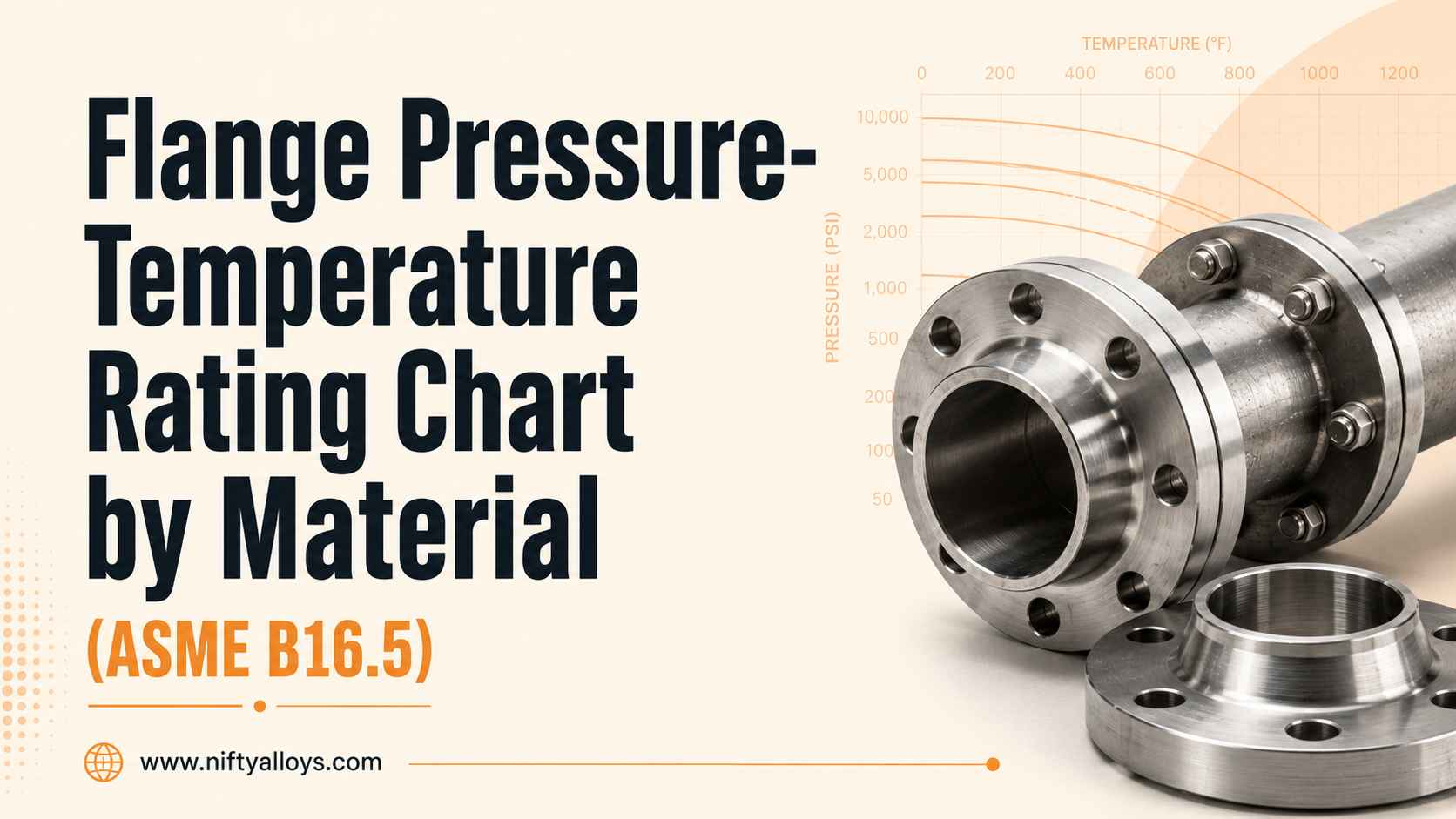
Specifying a flange by pressure class alone is a common and costly mistake. The class number (150, 300, 600, and so on) is dimensionless and does not represent an actual psi or bar value; the true working limit depends on both the operating temperature and the specific material group the flange is made from. This guide sets out the ASME B16.5 pressure-temperature rating system with reference values for the material groups Nifty Alloys stocks most often, so buyers can cross-check a specification before placing an order.
What Is a Flange Pressure-Temperature Rating?
A pressure-temperature rating defines the maximum allowable working pressure a flange can sustain at a specific temperature. As temperature rises, the material's mechanical strength falls, so the flange's allowable pressure is derated accordingly. This relationship is tabulated in ASME B16.5 across 44 material groups, each covering steels and alloys with similar high-temperature behavior.
The pressure class stamped on a flange, such as 150# or 300#, is only a nominal designation. A Class 150 carbon steel flange rated at roughly 285 psi at ambient temperature may be limited to under 150 psi once operating temperature climbs past 600°F. Buyers should always check the rating at the actual operating temperature, not the ambient or room-temperature figure.
ASME B16.5 Pressure Classes and Material Groups
ASME B16.5 defines seven standard pressure classes: 150, 300, 400, 600, 900, 1500, and 2500. Each class-material combination has its own rating table. Materials are grouped by similar mechanical behavior at temperature: carbon steels such as ASTM A105 fall under one group, chrome-moly alloy steels such as F11 and F22 under others, and austenitic stainless steels such as F304 and F316 under separate groups again. Duplex and super duplex grades such as F51 and F55 are rated under their own groups and generally retain higher allowable pressures at a given class than standard austenitic stainless steel.
Pressure-Temperature Rating Reference Table (Class 150 & 300, psi)
The figures below are representative reference values from ASME B16.5 for commonly stocked flange materials, illustrating how rating falls with temperature and how material choice changes the picture. These values are for guidance only — always verify against the current edition of ASME B16.5 before finalizing a design.
| Material | Class | 100°F | 400°F | 600°F | 800°F |
| A105 (Carbon Steel) | 150# | 285 | 200 | 140 | 80 |
| A105 (Carbon Steel) | 300# | 740 | 635 | 550 | 410 |
| F22 (Chrome-Moly Alloy) | 150# | 265 | 200 | 140 | 80 |
| F22 (Chrome-Moly Alloy) | 300# | 695 | 640 | 605 | 510 |
| F304/F304L (Stainless) | 150# | 275 | 190 | 140 | 80 |
| F304/F304L (Stainless) | 300# | 720 | 495 | 435 | 405 |
| F316/F316L (Stainless) | 150# | 275 | 195 | 140 | 80 |
| F316/F316L (Stainless) | 300# | 720 | 515 | 450 | 420 |
At 600°F, the difference between materials becomes clear: A105 carbon steel Class 300 is rated to 550 psi, while F316 stainless steel at the same class holds 450 psi and F22 alloy steel holds 605 psi. Duplex and super duplex grades such as F51 and F55 generally rate higher again at equivalent classes, which is why they're specified for demanding pressure-temperature envelopes in oil and gas and offshore service — for a deeper look at how 304 and 316 stainless steel differ beyond flange applications, our comparison guide covers composition, corrosion resistance, and cost side by side.
Why Rating Falls as Temperature Rises
The underlying cause is material strength loss at elevated temperature. Every material group in ASME B16.5 has a documented allowable stress curve, and the flange rating tables are built directly from those curves. Chrome-moly alloy steels such as F22 are specified precisely because they retain more strength at high temperature than plain carbon steel, which is why F22 is the standard choice for refinery hydroprocessing units and high-temperature steam piping, with its allowable stress governed by the Larson-Miller creep relationship at temperature.
Operating a flange above its rated temperature for the installed pressure class risks creep deformation, bolt relaxation, and gasket failure — the class number does not protect against exceeding these limits, only checking the actual rating table does.
Choosing the Right Class and Material for Your Project
A practical selection sequence:
- Define the maximum operating pressure and temperature, including startup, upset, and blocked-in scenarios
- Identify the required material group based on the process fluid, corrosion environment, and code requirements
- Check the ASME B16.5 rating table for that material group at the actual operating temperature, not ambient
- Select the class where the rated pressure equals or exceeds the operating pressure, with an appropriate safety margin
- Confirm gasket and bolting selection are rated to match, since the flange rating assumes correctly specified bolting and gaskets
Corrosive or chloride-rich service often pushes material selection toward 316 over 304, independent of the pressure-temperature question. Our guide to what stainless steel is and how its grades differ explains how alloying elements change corrosion performance across the family, which is a useful companion check once the pressure-temperature class has been settled.
FAQ: Flange Pressure-Temperature Ratings
Does Class 150 mean the flange is rated for 150 psi?
No. The class number is a dimensionless designation, not a direct psi value. A Class 150 A105 carbon steel flange is actually rated at approximately 285 psi at ambient temperature, and the rating falls further as temperature rises.
Why does a stainless steel flange rate lower than carbon steel at some temperatures?
At certain elevated temperatures, standard austenitic grades like F304 can rate lower than carbon steel or alloy steel at the same class, since each material group has a distinct allowable stress curve. Always check the specific material's table rather than assuming stainless is always stronger.
Can I interpolate between temperatures in the rating table?
Yes, linear interpolation between listed temperature points is permitted under ASME B16.5. Interpolation between pressure classes is not permitted; always round up to the next class.
How do duplex and super duplex flanges compare on pressure rating?
Duplex (F51) and super duplex (F55) grades generally provide higher allowable pressure at a given class compared to standard austenitic stainless steel, particularly at elevated temperature, which is one reason they're specified for demanding oil and gas and offshore applications.
What certification should I request for flange materials?
Request a Mill Test Certificate conforming to EN 10204 3.1, confirming the material's chemical composition and mechanical properties match the ordered grade and specification before the flange is accepted into a project.
Conclusion
Flange pressure class is only meaningful in combination with material and operating temperature. Checking the ASME B16.5 rating table for the specific material group, at the actual operating temperature, is the only reliable way to confirm a flange is fit for service.
Nifty Alloys LLC supplies certified carbon steel, alloy steel, stainless steel, and duplex/super duplex flange materials with EN 10204 3.1 Mill Test Certificates across the UAE, GCC, and export markets. Contact our team to confirm grade, class, and stock availability for your next project.
 Let's Talk
A complete nickel alloy bar order states the UNS number, the ASTM or ASME product standard and grade...
Alloy 825 is a nickel-iron-chromium alloy with 2.5–3.5% molybdenum plus copper, suited to sulfuric a...
Carbon equivalent (Ceq) is calculated using the IIW formula — CEV = C + Mn/6 + (Cr+Mo+V)/5 + (Ni+Cu)...
metal magnetism What Is a Ferrous Metal? Ferrous vs Non-Ferrous Explained Quick Answer ...




Elevate Your Projects with
with
 Our Superior Steels
