

Common Material Specification Mistakes in Oil & Gas Procurement
The six most common material specification mistakes in oil and gas and industrial procurement are: specifying a grade name without the UNS number and ASTM standard; using standard 316 instead of 316L for welded fabrication; omitting the EN 10204 certificate type; failing to state hardness limits for sour service; not specifying the material condition or temper; and using shorthand grade names that create international supply chain ambiguity. Each error can result in non-conforming material, QA holds, or unsafe components in service
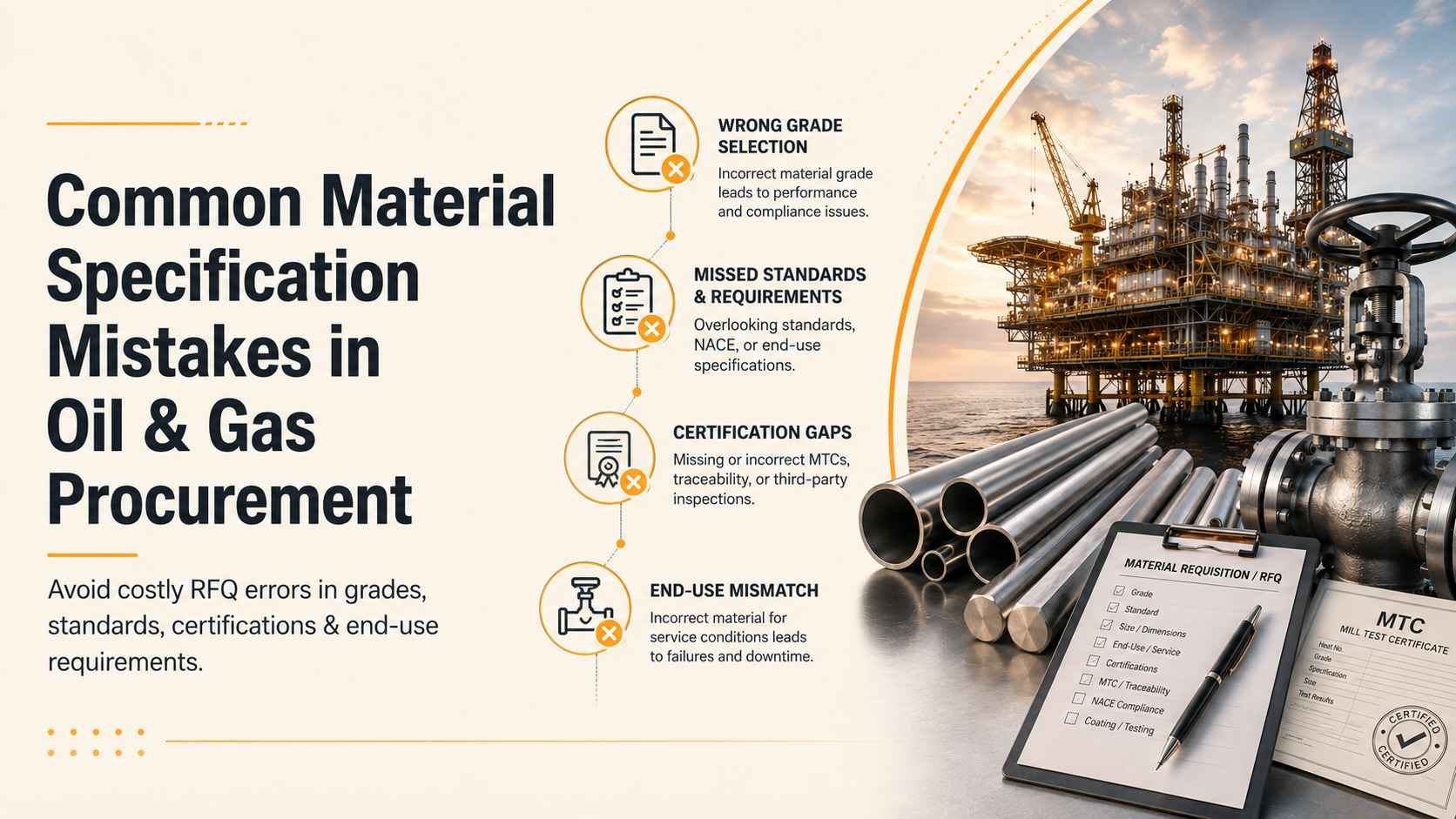
A purchase order for engineered alloys is not just a commercial transaction — it is a technical specification. In oil and gas, offshore, marine, and industrial procurement, the information on that PO defines what the supplier must deliver, what the mill is required to test, and what the project's QA/QC team will verify at incoming inspection. When the specification is incomplete or incorrect, the consequences flow downstream: non-conforming material accepted, certifications rejected, fabrication holds, and in the most serious cases, material entering service without the properties the application demands.
Most of these errors are not made by inexperienced buyers. They are made by experienced procurement teams under time pressure, working from incomplete templates, or relying on shorthand that is clear within one supply relationship but creates real ambiguity internationally. Here are the six mistakes that cause the majority of specification-related problems in industrial metals procurement.
1. Grade Name Without UNS Number or ASTM Standard
Specifying a trade name in isolation — 'Inconel 625 pipe,' 'Hastelloy C-276 bar,' 'Monel 400 tube' — is the most pervasive error in engineered alloy procurement. Trade names are commercial designations, not internationally standardised material specifications. Without the UNS number and applicable ASTM standard, the supplier has no contractually defined compliance baseline. They may supply a different grade variant or product form standard and be technically compliant with what was written.
Incorrect: 'Inconel 625 pipe' | Correct: 'Alloy 625, UNS N06625, ASTM B444 Grade 1, seamless pipe, annealed condition, EN 10204 3.1 MTC'
The UNS designation combined with the ASTM standard defines exact composition limits, mechanical property requirements, and testing obligations for that product form — regardless of where the material is sourced. See our Inconel 625 properties and procurement guide for a practical example of how full specification works for a nickel alloy.
2. Specifying 316 Instead of 316L for Welded Fabrication
Standard 316 (UNS S31600) and 316L (UNS S31603) appear almost identical on a datasheet. The difference is carbon content: 316 allows up to 0.08% C; 316L limits it to 0.03%. For unwelded components this distinction is rarely significant. For any welded assembly in corrosive service, it is critical.
When standard 316 is welded, heat input can cause chromium carbide precipitation in the heat-affected zone — locally depleting chromium below the passive film threshold. This sensitisation creates corrosion-susceptible bands around welds, invisible to visual inspection, that can initiate intergranular corrosion in service. The low-carbon L-grade prevents this completely. Always specify 304L or 316L for welded stainless applications. Never standard 304 or 316.
The broader carbon steel vs stainless steel selection decision is covered in detail in our carbon steel vs stainless steel guide.
3. Omitting the EN 10204 Certificate Type
'Supply with MTC' without stating the EN 10204 type is one of the most common and consequential procurement errors. EN 10204 defines three materially different certificate levels: Type 2.2 (non-specific batch data — no heat traceability), Type 3.1 (specific heat test results — the standard minimum for industrial and oil and gas supply), and Type 3.2 (3.1 plus independent third-party verification — required for offshore and classification society-governed projects).
When a PO leaves the certificate type unstated, the supplier is free to supply a 2.2 document. On most projects, a 2.2 will be rejected at incoming inspection, triggering a QA hold — and retroactive 3.1 certification may not be obtainable if heat traceability was not established at manufacture. Always state 'EN 10204 3.1 MTC' as the minimum, and '3.2 countersigned by [third-party body]' where required.
For a full explanation of each certificate type and when to specify each, see our EN 10204 2.2 vs 3.1 vs 3.2 certification guide. For guidance on how to read the certificate once you receive it, see our mill test certificate (MTC) guide.
4. No Hardness Limit for Sour Service
In oil and gas service where hydrogen sulphide (H₂S) is present, the hardness of carbon and low-alloy steel is a safety-critical parameter. NACE MR0175 / ISO 15156 sets a maximum of 22 HRC (248 HBW) across base metal, weld metal, and heat-affected zone. Exceeding this limit makes the steel susceptible to sulfide stress cracking — a rapid, brittle failure mode with no warning signs that can cause catastrophic failure in pressurised systems.
When a sour service PO does not explicitly state NACE MR0175 compliance and the hardness limit, the supplier has no contractual obligation to control or verify hardness. The MTC must include actual hardness test results — a compliance declaration alone is not sufficient.
For any carbon or low-alloy steel in H₂S service: state 'NACE MR0175 / ISO 15156 Part 2 compliant — max 22 HRC (248 HBW) across base metal, weld metal, and HAZ' on every PO.
For a complete guide to sour service material selection and compliance documentation, see our NACE MR0175 / ISO 15156 guide.
5. Material Condition or Temper Not Stated
For alloy steels, titanium alloys, nickel alloys, and precipitation-hardening stainless steels, the supply condition determines the mechanical properties. The same grade in different conditions can vary in tensile strength by 30–50% or more. Not stating the condition means the supplier defaults to the most available stock — which may not be what the application requires.
Ti-6Al-4V: annealed (~895 MPa) vs solution treated and aged — STA (~1,100+ MPa). If STA strength is required, state it.
4140 alloy steel: annealed, normalised, or quenched and tempered to a specific hardness range — these are fundamentally different supply conditions.
17-4 PH stainless: H900 to H1150 conditions span ~1,000–1,310 MPa tensile. 'Supply 17-4 PH bar' alone leaves the supplier free to choose any condition.
Duplex and super duplex stainless: must be solution-annealed and quenched for correct phase balance and corrosion resistance. State the condition explicitly.
Always state the condition on the PO. If annealed is correct, state 'annealed.' Never leave it blank.
6. Shorthand Grade Names and Internal Abbreviations
Procurement teams working with established suppliers develop internal shorthand that is understood within the relationship but creates ambiguity internationally. When the same PO is issued to an alternative supplier, or when sourcing across borders, shorthand carries real risk:
- 'C276' — not a standardised designation. Correct: UNS N10276, ASTM B622 seamless pipe, annealed condition.
- '625 bar' — does not specify the alloy family, UNS number, or standard. Correct: Alloy 625, UNS N06625, ASTM B446.
- 'Duplex pipe' — does not distinguish S31803 from S32205 or specify the standard and condition.
The discipline is simple: always write the full specification on every PO, regardless of the existing supplier relationship. It protects both parties — the buyer gets what they specified, and the supplier has an unambiguous brief.
Getting the Specification Right
Every correctly specified purchase order for engineered alloys should include: grade name and UNS number, applicable ASTM or EN standard for the product form, material condition or temper, dimensions to applicable tolerances, EN 10204 certificate type (3.1 minimum), NACE MR0175 compliance and hardness limit for sour service, and any additional NDT or testing requirements beyond standard mill tests.
A specification error caught at incoming inspection costs time and logistics. The same error found during fabrication or in service costs far more — in rework, schedule, or in critical service, safety. Getting the PO right before supply is always the correct approach.
 Let's Talk
Discover the mechanical properties, heat treatment procedures, and high-temperature performance of 1...
Looking for a stainless steel round bar supplier in UAE? Compare grades 304, 316, and 316L, key spec...
EN31 bearing steel should be used for applications requiring high hardness, wear resistance, and fat...




Elevate Your Projects with
with
 Our Superior Steels
