

Tensile Strength vs Yield Strength: Key Differences Explained
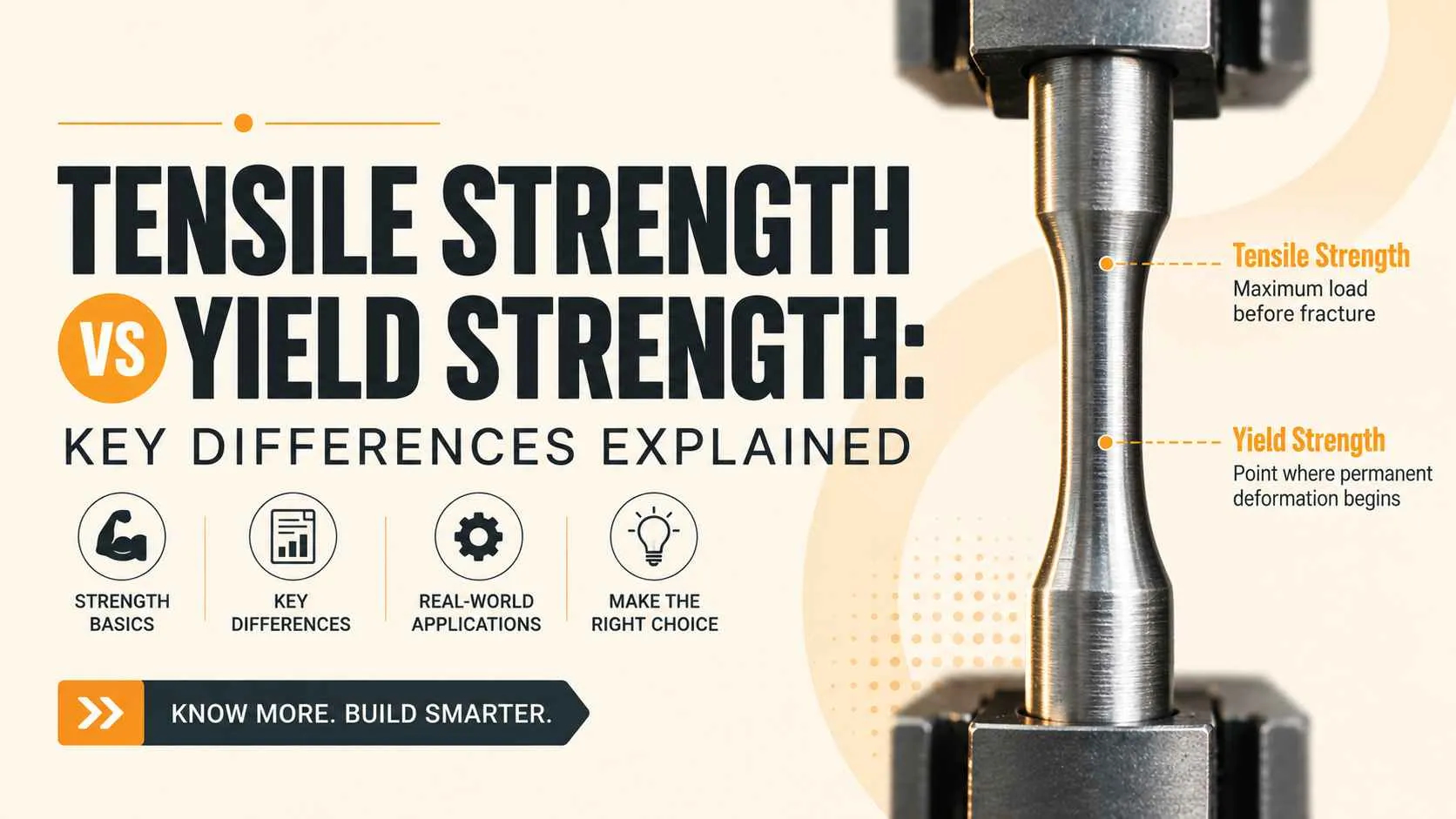
Yield strength is the stress at which a metal begins to deform permanently, while tensile strength (ultimate tensile strength, or UTS) is the maximum stress it can bear before fracturing. Yield strength governs safe working-load limits; tensile strength defines the failure ceiling. Both values are certified on the mill test certificate (MTC) for every grade Nifty Alloys supplies.
For procurement engineers specifying steel, stainless, or nickel alloy for a pressure vessel, structural frame, or fastener, tensile strength and yield strength are the two mechanical property values that decide whether a material is fit for purpose. They are related but not interchangeable, and mixing them up in a spec sheet can lead to an under-rated component or an over-specified, unnecessarily costly order. As a stockist and supplier serving oil & gas, marine, petrochemical, and heavy engineering buyers across the UAE, GCC, and export markets, Nifty Alloys sees this confusion come up regularly during technical clarification calls — so this guide sets out the difference plainly, with the standards and typical values that matter for sourcing decisions.
What Is Yield Strength?
Yield strength is the amount of stress a metal can withstand before it stops behaving elastically and begins to deform permanently (plastically). Below the yield point, a loaded component returns to its original shape once the load is removed. Above it, the deformation is permanent — the part is bent, stretched, or distorted even after the load is taken off.
Because most engineering applications cannot tolerate permanent deformation in service, yield strength is the value design engineers use to set safe working stress limits. It is expressed in MPa or ksi and is reported for every grade on the material's mill test certificate (MTC).
For alloys without a sharply defined yield point — many austenitic stainless steels and nickel alloys fall into this category — the 0.2% offset method is used: yield strength is taken as the stress corresponding to 0.2% permanent strain. This is the figure you will see listed as "0.2% Proof Stress" or "Rp0.2" on a European-format MTC.
What Is Tensile Strength?
Tensile strength — more precisely ultimate tensile strength (UTS) — is the maximum stress a material can withstand while being stretched before it begins to neck down and eventually fracture. It represents the absolute ceiling of a material's load-bearing capacity in tension, not a safe operating limit.
Once a material passes its yield point, it continues to carry increasing load through strain hardening until it reaches UTS. Beyond that point, deformation localizes (necking) and the material's cross-section narrows rapidly until it breaks. UTS is a critical figure for understanding a material's reserve capacity and its behavior in overload or accident conditions, even though components are never intentionally designed to operate near it.
Key Differences at a Glance
| Aspect | Yield Strength | Tensile Strength (UTS) |
| Definition | Stress at onset of permanent (plastic) deformation | Maximum stress before fracture |
| Deformation type | Elastic to plastic transition | Plastic deformation up to failure |
| Used for | Safe working stress / design allowable | Understanding failure margin / overload capacity |
| Typical relation | Always lower than tensile strength | Always higher than yield strength |
| MTC label (common) | Yield Strength / Rp0.2 / Proof Stress | Tensile Strength / UTS / Rm |
| Test standard | ASTM E8 / ISO 6892 | ASTM E8 / ISO 6892 |
A useful shorthand: the ratio of yield strength to tensile strength (the yield ratio) indicates how much reserve capacity a material has beyond its design limit. A lower yield ratio (common in mild and low-alloy steels) means more ductile reserve before fracture; a higher yield ratio (typical in high-strength and precipitation-hardened alloys) means the margin between safe operation and failure is narrower.
How Yield and Tensile Strength Are Tested
Both properties are determined from the same test: a uniaxial tensile test performed on a standardized specimen, per ASTM E8/E8M or ISO 6892-1. A test machine applies a steadily increasing pull while an extensometer records elongation, generating a stress-strain curve.
- Elastic region — stress and strain are proportional (Hooke's Law); the specimen returns to its original length if unloaded.
- Yield point — the curve departs from linearity; for alloys without a distinct yield point, the 0.2% offset method locates it.
- Strain hardening region — stress continues to rise with strain as the material work-hardens.
- Ultimate tensile strength — the peak of the curve, after which necking begins.
- Fracture — the specimen separates; elongation and reduction of area are also recorded at this point.
For certified supply, these results are reported on the mill test certificate against the applicable ASTM, EN, or ASME material specification, typically as an EN 10204 3.1 certificate for traceable, third-party-witnessed test results.
Typical Yield and Tensile Strength by Grade
Approximate values vary by heat, product form, and condition (annealed, cold-worked, solution-treated, or precipitation-hardened) — always confirm against the actual MTC for the heat being supplied. The ranges below illustrate how widely mechanical properties can shift across the grades commonly sourced through Nifty Alloys, from standard austenitic stainless through duplex, nickel alloy, and titanium grades selected for higher-strength or higher-corrosion-resistance service.
| Grade | Typical Yield Strength | Typical Tensile Strength |
| 304/316 Stainless (annealed) | ~205 MPa | ~515–620 MPa |
| Duplex 2205 (UNS S32205) | ~450 MPa | ~655 MPa |
| Super Duplex 2507 (UNS S32750) | ~550 MPa | ~795 MPa |
| 4140 Alloy Steel (Q&T) | ~655–950 MPa | ~950–1080 MPa |
| Monel 400 (annealed) | ~240 MPa | ~550 MPa |
| Inconel 625 (annealed) | ~415 MPa | ~825 MPa |
| Ti-6Al-4V (Grade 5, annealed) | ~830 MPa | ~900 MPa |
| 17-4PH Stainless (H1025) | ~1000 MPa | ~1070 MPa |
The wide spread in the table above is a heat-treatment story as much as a chemistry one — 4140 alloy steel moves from roughly 655 to 950 MPa yield depending on whether it is supplied normalized or quenched and tempered, and the same logic applies to precipitation-hardened grades like 17-4PH. Pair these figures with a look at density of steel when working through weight and load calculations for the same component.
Why This Distinction Matters for Procurement
Specifying the wrong property — or assuming one implies the other — has direct commercial and safety consequences:
- Design allowables are almost always set from yield strength, not tensile strength. A spec that references "strength" without stating which one invites ambiguity at the MTC review stage.
- Two heats of the same grade can meet the minimum yield requirement but differ meaningfully in tensile strength and elongation — this is exactly what an MTC review against the purchase order specification is meant to catch.
- Selecting a grade purely on tensile strength while ignoring yield can result in a component that deforms in service well before it approaches its rated "strength."
- For sour service and NACE MR0175 applications, both yield strength ceilings and hardness limits are specified together — exceeding a maximum yield strength can be as much a rejection criterion as failing a minimum.
Note
When reviewing an MTC, check yield strength, tensile strength, elongation, and hardness together against the purchase specification — a certificate that only meets one of the four values is not necessarily compliant.
FAQ
Is tensile strength always higher than yield strength?
Yes. Tensile strength (UTS) represents the maximum stress before fracture and is always equal to or greater than yield strength, since yielding occurs first as the material transitions from elastic to plastic behavior.
Which value should I use to size a component: yield or tensile?
Design allowables are based on yield strength (with an applied safety factor), not tensile strength. Tensile strength is used to understand ultimate failure margin, not for routine sizing calculations.
Why do some MTCs show "0.2% Proof Stress" instead of "Yield Strength"?
Many stainless steels and nickel alloys do not exhibit a sharply defined yield point on the stress-strain curve. The 0.2% offset method is used instead, and the result is reported as 0.2% proof stress (Rp0.2) — this is functionally equivalent to yield strength for specification purposes.
Do yield and tensile strength change with heat treatment?
Yes, significantly. Quenching and tempering, solution annealing, and precipitation hardening all shift both values — sometimes by a factor of two or more for the same base chemistry, which is why the product condition (e.g., annealed vs. H1025 vs. Q&T) must always be specified alongside the grade.
Where can I find certified yield and tensile values for a specific heat?
On the mill test certificate (MTC) issued for that specific heat number, typically to EN 10204 3.1 for third-party-witnessed certification, cross-referenced against the applicable ASTM, EN, or ASME specification called up on the purchase order.
Need Certified Material Backed by Verified Mechanical Properties?
Nifty Alloys LLC supplies stainless steel, duplex and super duplex stainless, nickel alloys, titanium, naval bronzes, tool steels, and alloy steels with full EN 10204 3.1 certification, to buyers across the UAE, GCC, and export markets. Our QA/QC team reviews mechanical property data — yield strength, tensile strength, elongation, and hardness — against your specification before dispatch.
Contact Nifty Alloys for material availability, certified supply, or a formal quotation referencing your project's grade, condition, and certification requirements.
 Let's Talk
Aircraft use aluminium because it is about one-third the density of steel while offering good streng...

Oil and gas relies mainly on carbon and low-alloy steels, upgraded to corrosion-resistant alloys whe...

Super duplex is used in firewater and seawater piping because its PREN of 40 or more resists pitting...
A complete nickel alloy bar order states the UNS number, the ASTM or ASME product standard and grade...




Elevate Your Projects with
with
 Our Superior Steels
