

Annealing vs Tempering: Key Differences Explained
Annealing is a heat treatment that softens a metal, relieves internal stress, and maximizes ductility by heating it above its recrystallization or critical temperature and cooling it very slowly. Tempering is a follow-up treatment applied after hardening (quenching) to reduce brittleness and restore some toughness, by reheating the hardened metal to a temperature below its critical point. Annealing starts from a soft or as-worked condition; tempering starts from a hardened one.
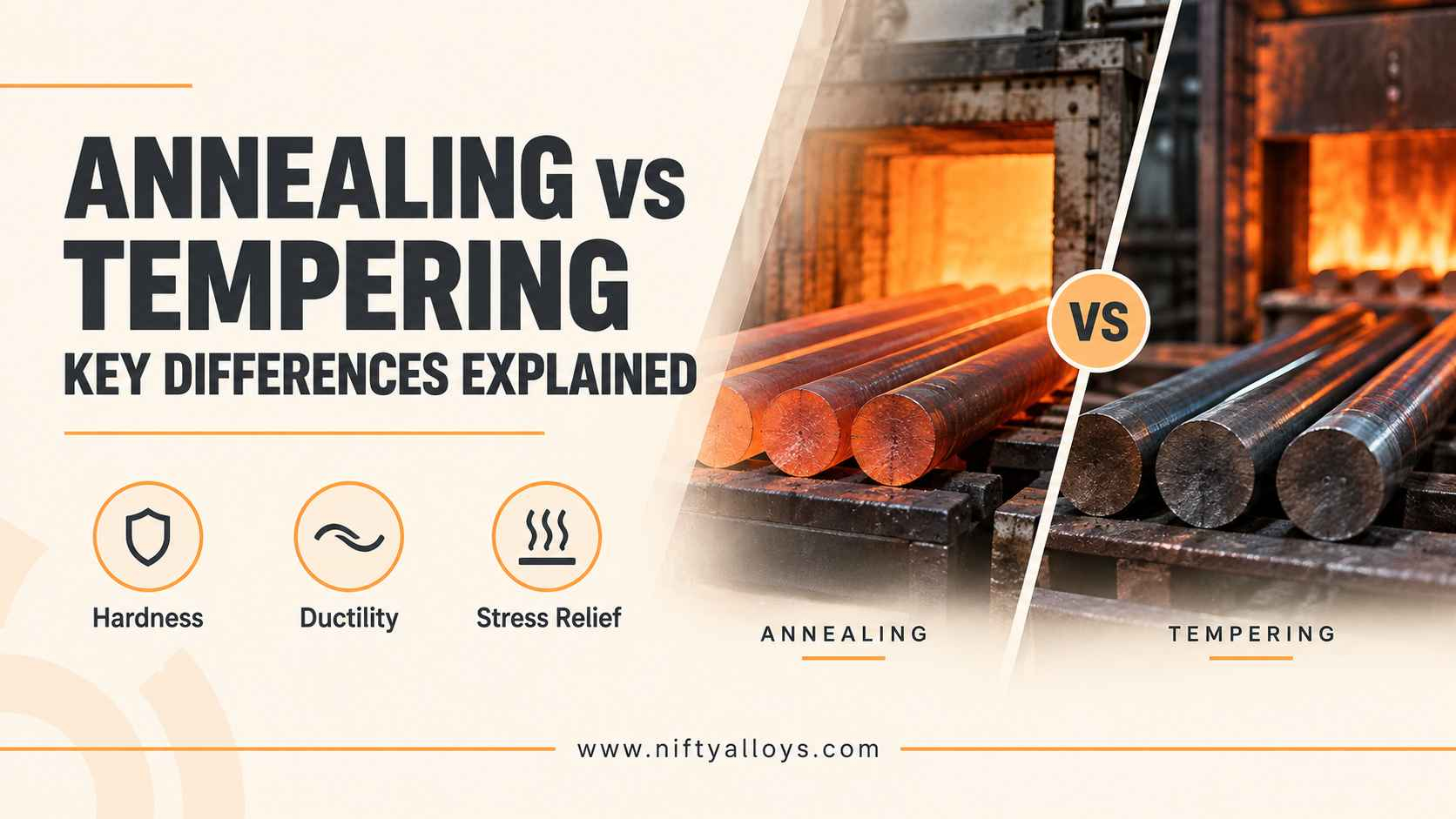
Annealing and tempering are both heat treatments, both involve controlled heating and cooling, and both change a metal's hardness and toughness which is exactly why the two get confused. But they solve different problems and are applied at different points in a metal's processing history. Getting them mixed up on a specification or a technical discussion can lead to the wrong condition being ordered, or the wrong expectation about how a component will perform in service. This guide sets out where each process fits, using the framework buyers and engineers actually need when reviewing a spec sheet or a mill certificate.
What Is Annealing?
Annealing is a softening heat treatment. The material is heated above its recrystallization temperature (for non-ferrous metals) or above its upper critical temperature (for steels), held there long enough for the microstructure to transform, and then cooled very slowly typically inside the furnace itself. The slow cooling is what defines annealing: it allows the grain structure to reform into a soft, stable, low-stress condition.
The purpose is almost always one or more of the following:
- Maximizing ductility and machinability before extensive cold forming, machining, or further processing.
- Relieving internal stresses introduced by prior cold working, welding, or casting.
- Refining grain structure after hot working.
- Reversing the effects of work hardening in cold-worked stainless steels and nickel alloys.
Annealing is typically the starting point in a processing sequence, not the finishing step material is often annealed, then formed or machined, and in the case of hardenable steels, hardened and tempered afterward.
What Is Tempering?
Tempering is not a standalone process it only makes sense in relation to hardening. After a hardenable steel is quenched (rapidly cooled from its austenitizing temperature), it becomes very hard but also very brittle, with high internal stress from the martensitic transformation. In that as-quenched state, most components are unsafe to put into service; they can crack under load or even during handling.
Tempering addresses this by reheating the quenched steel to a temperature below its lower critical temperature, holding it, and then cooling usually in still air. This reduces hardness somewhat but significantly increases toughness and ductility, trading a controlled amount of hardness for a large gain in reliability. The tempering temperature chosen determines exactly how much hardness is sacrificed for how much toughness gained, which is why tempering charts (hardness vs. tempering temperature) are grade-specific and central to any quenched-and-tempered (Q&T) specification.
Key Differences at a Glance
| Aspect | Annealing | Tempering |
| Starting condition | As-worked, as-cast, or work-hardened | As-quenched (hardened) |
| Goal | Maximize softness, ductility, machinability | Reduce brittleness while retaining useful hardness |
| Cooling method | Very slow (typically furnace cooling) | Air cooling after a controlled reheat |
| Typical temperature | Above recrystallization / upper critical temperature | Below the lower critical (A1) temperature |
| When it's used | Before forming, machining, or as a stress-relief step | Always after quenching / hardening |
| Resulting hardness | Lowest achievable for the alloy | Controlled — set by tempering temperature chosen |
For a grade-specific example of how this plays out in practice including a hardness-vs-tempering-temperature chart see our guide to 4140 steel heat treatment, which covers annealed, normalized, and quenched-and-tempered conditions for that specific grade.
Where Does Normalizing Fit In?
Normalizing is often mentioned alongside annealing and tempering, and it sits conceptually between the two. Like annealing, normalizing heats the steel above its upper critical temperature but instead of slow furnace cooling, the steel is cooled in still air, which is faster than annealing but slower than quenching. The result is a finer, more uniform grain structure than annealing typically produces, with moderately higher strength and hardness. Normalizing is commonly specified to improve uniformity in castings and forgings, or as a preparatory step before final hardening and tempering.
Which Heat Treatment Should You Specify?
- Need maximum ductility for deep drawing, cold forming, or extensive machining? Specify annealed condition.
- Need to relieve stress after welding or cold working without significantly softening the material? A stress-relief anneal (a lower-temperature variant) is typically appropriate.
- Need high strength and hardness for a wear surface or a structural fastener? The material will be quenched and then tempered tempering is not optional here, since as-quenched material is generally too brittle for service. This applies to hardenable alloy steels specifically; mild steel does not respond to hardening in the same way.
- Need a specific hardness range for a critical component such as a fastener, shaft, or die? The tempering temperature is the control variable confirm the certified hardness result against the applicable ASTM or EN specification, not just the process name.
Note
"Heat treated" alone is not a specification. A purchase order or drawing should state the exact condition required annealed, normalized, or quenched and tempered to a stated hardness range since each results in materially different mechanical properties from the same base chemistry.
FAQ
Can a metal be tempered without first being quenched?
Not in the conventional sense. Tempering is specifically the post-hardening treatment that reduces the brittleness of quenched (martensitic) steel. Reheating a non-quenched, soft material to a similar temperature range is more accurately described as stress relieving or a form of annealing, not tempering.
Does annealing always produce the softest possible condition?
Generally yes for a given alloy a full anneal, with slow furnace cooling, produces the lowest hardness and highest ductility achievable through heat treatment for that chemistry. Normalizing and stress-relief annealing are less aggressive variants that soften the material less.
Why do quenched and tempered (Q&T) grades list a hardness range instead of a single value?
Because tempering temperature is used precisely to dial in hardness within a controlled range a small change in tempering temperature meaningfully shifts the resulting hardness and toughness balance. The certified range reflects the achievable spread for that grade and tempering process, not measurement uncertainty.
Is normalizing the same as annealing?
No. Both start from a similar heating stage, but normalizing uses air cooling (faster) while annealing uses furnace cooling (much slower). Normalizing produces a finer grain structure with somewhat higher strength than a full anneal.
How is the correct condition verified on delivered material?
Through the mill test certificate, which reports the certified hardness (and often tensile/yield strength) for the specific heat and condition supplied, typically to EN 10204 3.1 for third-party-witnessed results, cross-referenced against the condition and specification called up on the purchase order.
Note
In practice, the most common issue we flag during MTC review isn't a failed hardness value it's a certificate that states "heat treated" without specifying whether the condition was annealed, normalized, or quenched and tempered. That single word is not enough to confirm compliance against a spec that requires a stated condition and hardness range.
Certified Material in the Condition Your Application Requires
Nifty Alloys LLC supplies stainless steel, duplex and super duplex stainless, nickel alloys, titanium, naval bronzes, tool steels, and alloy steels in a range of heat-treated conditions, with full EN 10204 3.1 certification, to buyers across the UAE, GCC, and export markets. Our QA/QC team verifies hardness and mechanical property data against your specification before dispatch.
Contact Nifty Alloys to confirm available conditions, certified supply, or a formal quotation referencing your project's grade, condition, and certification requirements.
 Let's Talk
A complete nickel alloy bar order states the UNS number, the ASTM or ASME product standard and grade...
Alloy 825 is a nickel-iron-chromium alloy with 2.5–3.5% molybdenum plus copper, suited to sulfuric a...
Carbon equivalent (Ceq) is calculated using the IIW formula — CEV = C + Mn/6 + (Cr+Mo+V)/5 + (Ni+Cu)...
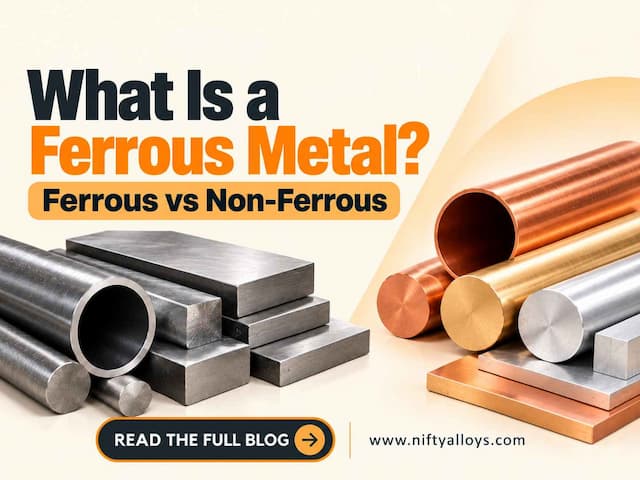
metal magnetism What Is a Ferrous Metal? Ferrous vs Non-Ferrous Explained Quick Answer ...




Elevate Your Projects with
with
 Our Superior Steels
