

Monel 400 (UNS N04400): Properties, Composition, ASTM Standards & Applications
Monel 400 (UNS N04400, DIN 2.4360) is a nickel-copper alloy containing a minimum of 63% nickel and 28–34% copper. It is specified for corrosion resistance in seawater, hydrofluoric acid, deaerated hydrochloric acid, alkaline solutions, and steam — environments where stainless steel grades are inadequate. Available in bar (ASTM B164), plate (B127), pipe and tube (B165), and forgings (B564) with EN 10204 3.1 MTCs.
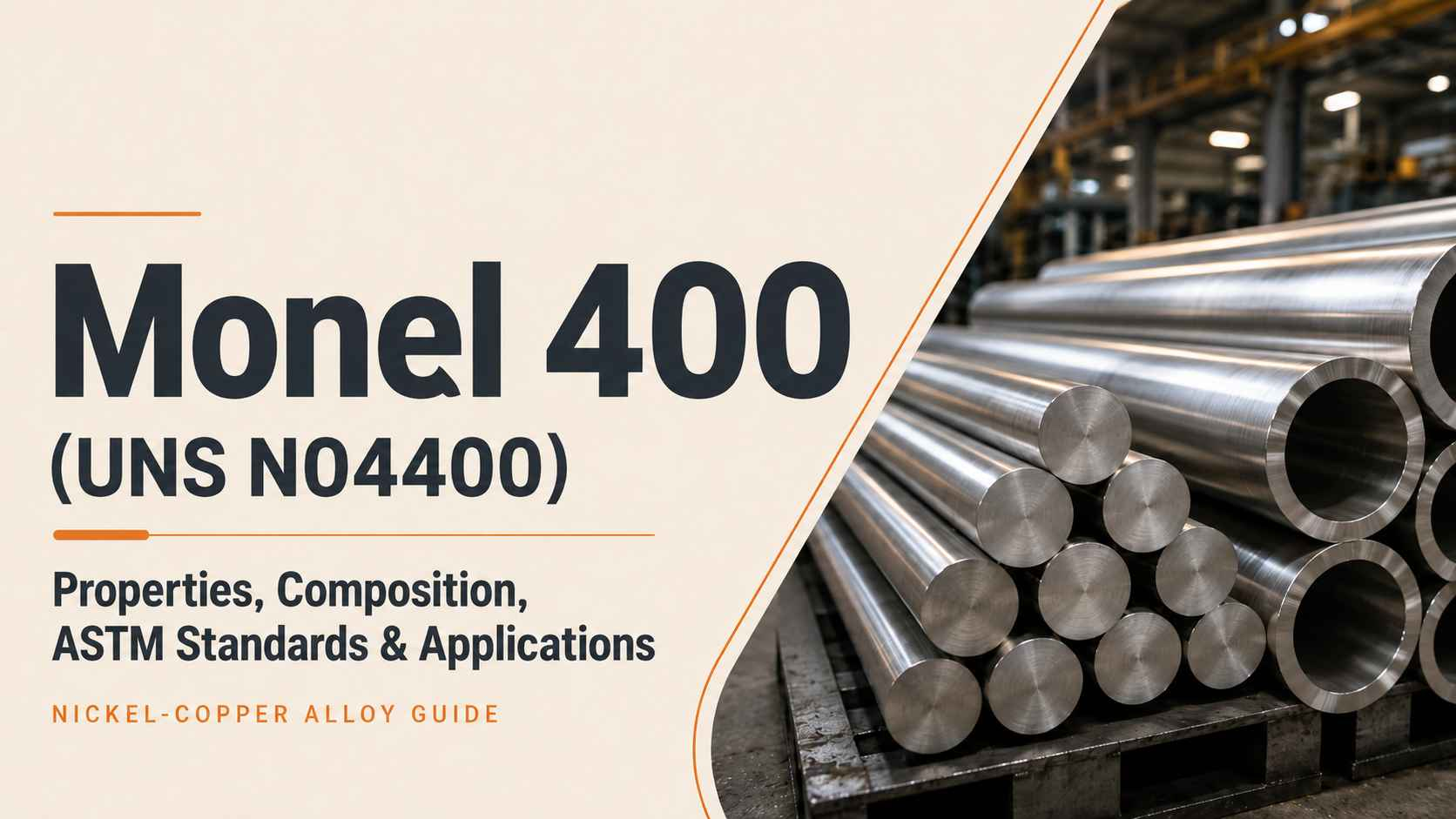
Monel 400 is one of the oldest and most consistently specified nickel alloys in industrial service. Introduced commercially in 1905 as a binary nickel-copper alloy, it has remained in continuous use across marine engineering, oil and gas, chemical processing, and nuclear applications because its combination of corrosion resistance, mechanical strength, and broad chemical compatibility has never been bettered at its price point for the specific environments it handles.
The alloy is registered as UNS N04400 and DIN 2.4360. It is also commercially known as Alloy 400 or Nickel Alloy 400. It sits within the same nickel alloy family as Inconel 625 and Hastelloy C-276, but its nickel-copper composition makes it a distinct class with different strengths — and different limitations.
Composition — What Defines Monel 400
Monel 400 is a solid-solution binary alloy. Nickel and copper are completely miscible in all proportions, giving the alloy a single-phase microstructure that is homogeneous and stable across a wide temperature range. There is no precipitation hardening, no two-phase transformation, and no heat treatment required for corrosion resistance restoration after welding.
Nominal composition per ASTM B164 / UNS N04400:
- Nickel (Ni): minimum 63% — base element; drives seawater, HF, and alkaline corrosion resistance
- Copper (Cu): 28–34% — improves resistance to non-oxidising acids, particularly H₂SO₄ and HF
- Iron (Fe): 2.5% max — minor strengthening addition
- Manganese (Mn): 2.0% max — deoxidiser during melting
- Carbon (C): 0.30% max — low C avoids sensitisation issues
- Silicon (Si): 0.50% max — minor addition
The high nickel content is the primary driver of corrosion resistance. Nickel is stable in reducing environments and in alkaline solutions. Copper extends that stability into non-oxidising acid environments and gives the alloy its characteristic seawater and HF resistance. The absence of chromium means Monel 400 does not depend on a passive oxide film for corrosion protection — it corrodes at a consistently low, uniform rate rather than failing by localised pitting.
Key Properties — UNS N04400 at a Glance
| Property | Monel 400 (UNS N04400) — Annealed |
| UNS Designation | N04400 |
| DIN / EN Designation | 2.4360 |
| Nominal Composition | Ni min. 63% · Cu 28–34% · Fe 2.5% max · Mn 2.0% max · C 0.3% max · Si 0.5% max |
| Tensile Strength | 517–620 MPa (hot-finished annealed) |
| 0.2% Proof Strength | 172–345 MPa (annealed) |
| Elongation | 35–50% |
| Hardness | 120–150 HBW (annealed) |
| Density | 8.83 g/cm³ |
| Melting Range | 1,300–1,350°C |
| Max Service Temperature | 480°C (continuous) / 600°C (short-term) |
| Magnetic Properties | Slightly magnetic at room temperature; non-magnetic above ~40°C |
Corrosion Resistance — Where Monel 400 Is Specified
| Environment | Performance | Notes |
| Seawater and brackish water | Excellent | Resists erosion-corrosion and cavitation in fast-flowing seawater — one of very few alloys to do so reliably |
| Hydrofluoric acid (HF) | Excellent | Unique resistance across all concentrations including deaerated HF — no standard stainless steel grade matches this |
| Hydrochloric acid (HCl) — deaerated | Good | Resistant to deaerated HCl; aerated HCl causes significantly higher attack |
| Sulphuric acid (H₂SO₄) — dilute | Good | Resistant to dilute H₂SO₄ below 85%; higher concentrations or temperature — evaluate carefully |
| Alkaline solutions (NaOH, KOH) | Excellent | Resistant across most concentrations; useful in caustic soda handling |
| Steam and high-temperature water | Very good | Widely specified for steam line components, valves, and fittings |
| Oxidising acids (HNO₃, aerated HCl) | ⚠ Not recommended | Nickel-copper alloys corrode rapidly in oxidising acid environments — do not specify for these |
One Critical Limitation
Monel 400 is not resistant to oxidising environments. Nitric acid, aerated hydrochloric acid, ferric chloride solutions, and other oxidising media will corrode it rapidly. This is the single most important limitation to understand at the specification stage — it is the reason Monel 400 is specified for deaerated acid service, not general acid service. Always confirm whether the process stream is oxidising or reducing before specifying.
ASTM Standards for Monel 400 Supply
| ASTM Standard | Product Form | Notes |
| ASTM B164 | Round bar, rod, and wire | Most commonly specified for bar and machined components |
| ASTM B127 | Plate, sheet, and strip | Pressure vessel and fabricated equipment |
| ASTM B165 | Seamless pipe and tube | Process piping and heat exchanger tubing |
| ASTM B725 | Welded pipe | Where seamless is not required |
| ASTM B564 | Forgings | Flanges, valve bodies, nozzles |
| ASTM B366 | Pipe fittings | Buttweld fittings — WP400 designation |
Always specify the UNS number (N04400) alongside the ASTM standard on every purchase order. Supply should be accompanied by an EN 10204 3.1 MTC as minimum, covering chemical composition, mechanical properties, and heat number traceability. EN 10204 3.2 is required for offshore and classification society-governed projects.
Key Applications
Marine Engineering
Monel 400's resistance to fast-flowing seawater — including resistance to erosion-corrosion and cavitation — makes it the standard material for propeller shafts, seawater valves, pump impellers, marine fasteners, and seawater piping in naval and offshore applications. Very few alloys resist both the chemical attack and the mechanical erosion of fast-moving seawater; Monel 400 is one of them.
Hydrofluoric Acid Service
Monel 400 is one of the very few engineering alloys with reliable resistance to hydrofluoric acid (HF) across all concentrations, including anhydrous HF. It is the standard material for HF alkylation units in petroleum refining — a major application that has driven Monel 400 specification in the downstream oil and gas sector globally for decades. Stainless steels are not suitable for HF service.
Oil and Gas — Sour and Produced Fluid Service
Monel 400 is used in wellhead components, valve trim, pump shafts, and chemical injection equipment in oil and gas service. It is accepted under NACE MR0175 / ISO 15156 for sour service applications with defined hardness limits. Its combination of mechanical strength, seawater resistance, and sour gas resistance makes it particularly useful in subsea and topsides equipment handling produced fluids.
Chemical Processing
Caustic soda (NaOH) handling equipment, alkaline process vessels, dilute acid piping, and steam-heated process equipment are the primary chemical processing applications. Monel 400 is specified where process chemistry alternates between alkaline and mildly acidic conditions — a regime that would attack stainless steel through stress corrosion cracking or pitting but where Monel 400 remains stable.
Cryogenic Service
Monel 400 does not exhibit a ductile-to-brittle transition at low temperatures — it maintains excellent toughness down to −196°C. This makes it suitable for LNG equipment, cryogenic valves, and liquid nitrogen service where carbon steel and some stainless grades lose toughness.
Monel 400 vs Monel K500 — Key Differences
Monel K500 (UNS N05500) is the precipitation-hardened version of Monel 400. Aluminium (2.3–3.15%) and titanium (0.35–0.85%) additions allow age hardening to yield strengths of 690–900 MPa — approximately three to four times that of annealed Monel 400.
- Monel 400: annealed, lower strength (172–345 MPa yield), better toughness, lower cost — general corrosion resistance applications
- Monel K500: age-hardened, high strength (690–900 MPa yield), same corrosion resistance — shafts, fasteners, and springs requiring both strength and corrosion resistance
The corrosion resistance of both grades is essentially equivalent. The choice is driven by mechanical requirements. For most piping, vessel, and process equipment applications, Monel 400 is specified. For load-bearing components — pump shafts, marine propeller shafts, valve stems, subsea fasteners — Monel K500 is preferred. View our Monel K500 product range for availability details.
Purchase Order Specification
A correctly specified Monel 400 purchase order must include:
- Grade and UNS: 'Monel 400, UNS N04400' — state both; 'Alloy 400' or 'Monel' alone are not sufficient
- ASTM standard and product form: e.g. 'ASTM B164 UNS N04400 round bar' — specify product form explicitly
- Condition: 'hot-finished annealed' for bar; 'annealed' for plate and tube — state explicitly
- Dimensions: diameter and length (bar) · OD and wall (pipe/tube) · thickness and width (plate) — to ASTM tolerances
- Certificate: EN 10204 3.1 MTC minimum · EN 10204 3.2 for offshore / class society projects
For guidance on common procurement errors when ordering nickel alloys, see our material specification mistakes guide.
Source Certified Monel 400 from Dubai
Nifty Alloys LLC supplies certified Monel 400 (UNS N04400 / DIN 2.4360) in bar, plate, sheet, pipe, tube, and forgings — to ASTM B164, B127, B165, B564, and B366 — with EN 10204 3.1 MTCs as standard. Supply to marine, oil and gas, chemical processing, and offshore projects across the UAE, GCC, and global markets.
View our Monel 400 product page or contact our team for availability, certification requirements, and quotation.
 Let's Talk
A complete nickel alloy bar order states the UNS number, the ASTM or ASME product standard and grade...
Alloy 825 is a nickel-iron-chromium alloy with 2.5–3.5% molybdenum plus copper, suited to sulfuric a...
Carbon equivalent (Ceq) is calculated using the IIW formula — CEV = C + Mn/6 + (Cr+Mo+V)/5 + (Ni+Cu)...
metal magnetism What Is a Ferrous Metal? Ferrous vs Non-Ferrous Explained Quick Answer ...




Elevate Your Projects with
with
 Our Superior Steels
