

Naval Brass vs Naval Bronze: C46400 vs C95800
Naval brass (C46400) is a copper-zinc alloy with a small tin addition that resists dezincification in seawater, while naval bronze (C95800) is a copper-aluminum alloy that forms a protective aluminum oxide layer and offers roughly double the strength. Naval brass is typically specified for fasteners, valve stems, and condenser plates, while naval bronze is specified for ship propellers, pump impellers, and components exposed to erosion-corrosion.
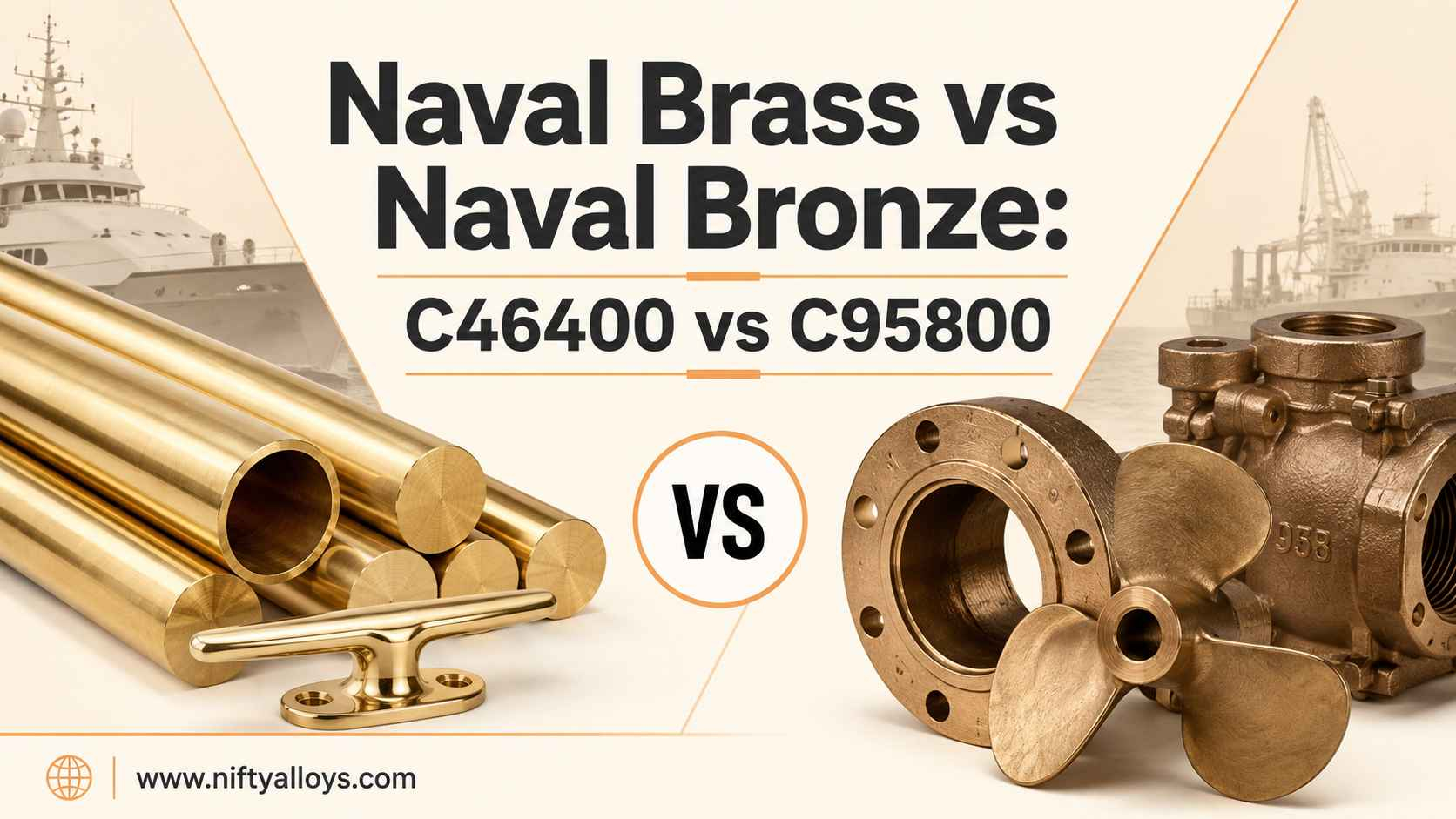
Naval brass and naval bronze both get specified for marine hardware, and the names invite confusion — "naval" describes the service environment, not a shared alloy family. Despite both offering strong seawater performance, they are chemically unrelated, protect against corrosion through different mechanisms, and are not interchangeable once strength and erosion resistance enter the picture.
What Is Naval Brass (C46400)?
Naval brass, UNS C46400, is a 60/40 copper-zinc alloy with roughly 1% tin added specifically to resist dezincification, the selective loss of zinc that plain copper-zinc brasses suffer in seawater. This two-phase alpha-beta structure gives naval brass good strength and excellent hot workability, which is why it is commonly supplied as forgings, valve stems, and condenser end plates for desalination and marine water treatment equipment.
Typical composition sits at approximately 60% copper, 39% zinc, and 1% tin. For a broader look at how naval brass compares with standard copper-zinc alloys used outside marine service, see our Brass Bar product page, which covers both naval and general-purpose brass grades stocked for UAE and GCC fabrication.
What Is Naval Bronze (C95800)?
Naval bronze, UNS C95800, is a nickel-aluminum bronze: primarily copper with roughly 8-9% aluminum, 4-5% nickel, and smaller additions of iron and manganese. Instead of a tin-inhibited zinc mechanism, its corrosion resistance comes from a thin, adherent aluminum oxide film that forms on the surface, similar in principle to the passive layer on stainless steel, though chemically distinct.
This alloy carries substantially higher tensile and yield strength than naval brass, along with strong resistance to cavitation erosion and impingement attack from fast-moving or turbulent seawater. That combination is exactly why C95800 is the standard material for ship propellers, pump and valve bodies, and impellers, applications where naval brass's mechanical properties would fall short.
Nifty Alloys stocks C95800 naval bronze as part of its bronze alloys range for marine and industrial fabrication, alongside phosphor bronze and aluminum bronze grades for bearings, bushings, and pump components.
Naval Brass vs Naval Bronze: Side-by-Side Comparison
| Factor | Naval Brass (C46400) | Naval Bronze (C95800) |
| Base composition | ~60% Cu, 39% Zn, 1% Sn | ~82% Cu, 9% Al, 4-5% Ni, Fe/Mn additions |
| Corrosion mechanism | Tin-inhibited dezincification resistance | Aluminum oxide passive film |
| Tensile strength (typical) | ~400-500 MPa | ~750-900 MPa |
| Erosion/cavitation resistance | Moderate | Excellent |
| Typical forms | Bar, forgings, plate | Castings, bar, forgings |
| Typical applications | Fasteners, valve stems, condenser plates, marine hardware | Ship propellers, pump impellers, valve bodies, bushings |
| Relative cost | Lower | Higher |
Naval bronze offers roughly double the tensile strength of naval brass, which is the primary reason it is specified for high-load, erosion-prone components like propellers rather than general marine hardware.
Naval Brass or Naval Bronze: Which Should You Specify?
- Fasteners, valve stems, condenser end plates, general marine hardware → naval brass (C46400) is typically sufficient and more cost-effective
- Ship propellers, pump impellers, valve bodies exposed to fast-flowing or turbulent seawater → naval bronze (C95800) resists erosion-corrosion where brass would wear
- High-strength structural marine components → naval bronze's higher tensile and yield strength make it the better fit
- Budget-sensitive fabrication where erosion is not a concern → naval brass remains the practical, lower-cost choice
Neither alloy is a universal substitute for the other. Specifying naval brass in a propeller or impeller application, where erosion-corrosion is the dominant failure mode, risks premature wear that naval bronze is specifically designed to resist.
Certification for Marine-Grade Copper Alloys
Marine and offshore projects referencing classification society rules (ABS, DNV-GL, Lloyd's Register) typically require Mill Test Certificates for naval brass and naval bronze components. Our detailed guide to EN 10204 2.2 vs 3.1 vs 3.2 certification explains which certificate level applies to shipbuilding, FPSO fabrication, and other marine and offshore applications, and names naval bronze (C95800) specifically as a material typically procured with 3.2 certification where class society sign-off forms part of the fabrication scope.
FAQ: Naval Brass vs Naval Bronze
Is naval bronze stronger than naval brass?
Yes. Naval bronze (C95800) typically offers roughly double the tensile strength of naval brass (C46400), which is why it is specified for high-load components like ship propellers and pump impellers.
Are naval brass and naval bronze the same alloy family?
No. Naval brass is a copper-zinc alloy with a tin addition, while naval bronze is a copper-aluminum-nickel alloy. They share the word "naval" because both are engineered for seawater service, not because they are chemically related.
Why is naval brass called naval brass if it's not used on ship hulls?
Naval brass is named for its resistance to seawater corrosion via dezincification resistance, not for hull plating specifically. It is used extensively in marine hardware such as fasteners, valve stems, and condenser plates rather than structural hull components.
What is naval bronze used for on ships?
Naval bronze (C95800) is the standard material for ship propellers, pump and valve bodies, and impellers, due to its high strength and resistance to cavitation erosion from fast-moving seawater.
Which is more expensive, naval brass or naval bronze?
Naval bronze is generally more expensive than naval brass due to its higher nickel and aluminum content and the more demanding casting or forging processes typically used to produce components like propellers.
Conclusion
Naval brass and naval bronze both perform well in seawater, but through different mechanisms and at different strength levels. Naval brass suits general marine hardware where cost matters and erosion is not a primary concern; naval bronze earns its higher price in high-load, erosion-prone components like propellers and impellers, where its strength and cavitation resistance directly prevent premature failure.
Nifty Alloys LLC supplies certified naval brass (C46400) and naval bronze (C95800) across the UAE, GCC, and export markets, with EN 10204 3.1 and 3.2 Mill Test Certificates available for marine and offshore projects. Contact our team to confirm grade, form, and certification for your application.
 Let's Talk
Petrochemical plants use 304L and 316L for general process service, 321 and 347 for high-temperature...

Aircraft use aluminium because it is about one-third the density of steel while offering good streng...

Oil and gas relies mainly on carbon and low-alloy steels, upgraded to corrosion-resistant alloys whe...

Super duplex is used in firewater and seawater piping because its PREN of 40 or more resists pitting...




Elevate Your Projects with
with
 Our Superior Steels
