

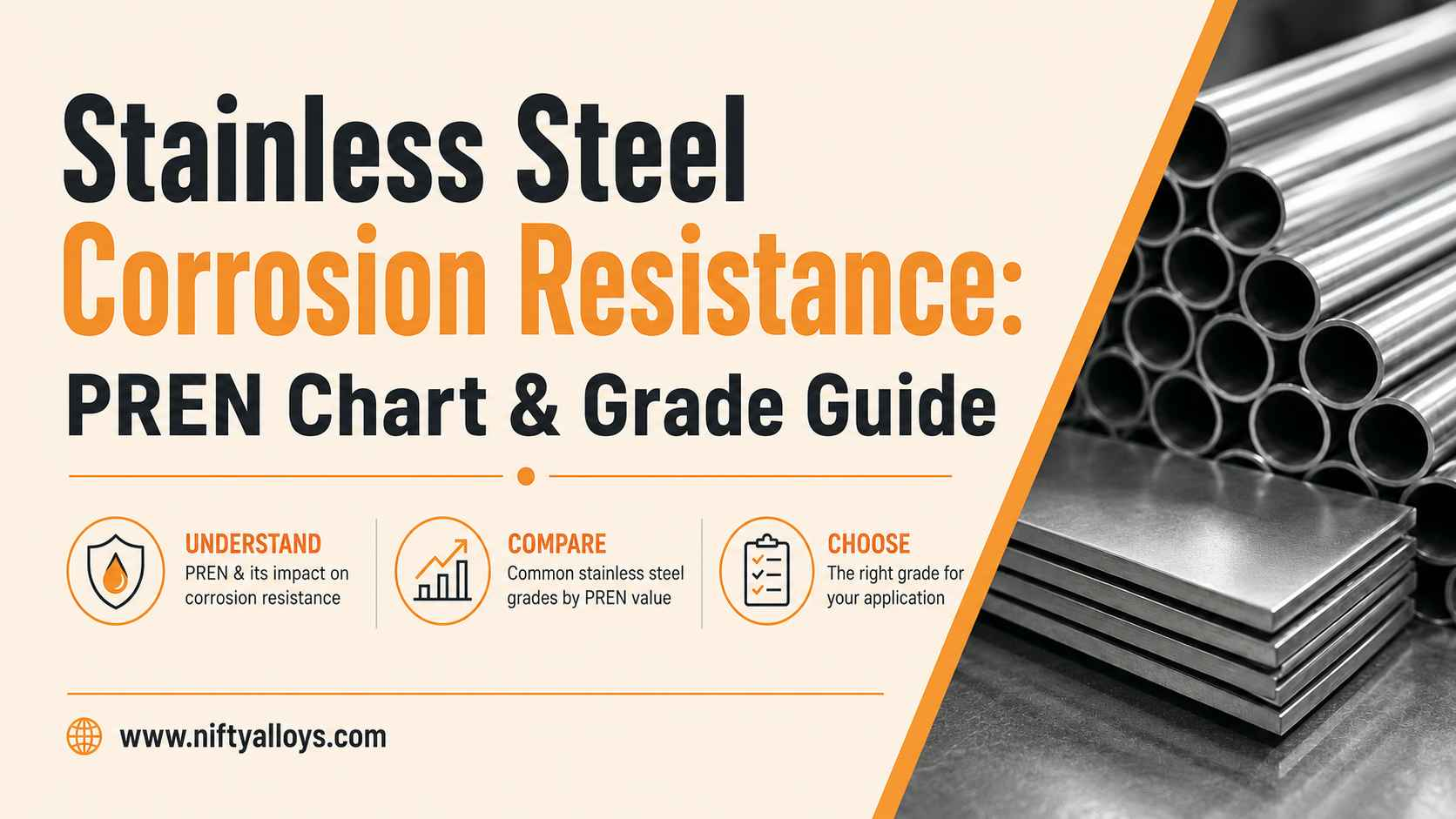
Stainless Steel Corrosion Resistance: PREN Chart & Grade Guide
Stainless steel corrosion resistance is measured using the Pitting Resistance Equivalent Number (PREN), calculated from chromium, molybdenum, and nitrogen content. Grades with PREN above 32 resist seawater pitting; PREN above 40 is typically required for crevice-prone chloride service. Match the grade to the environment, not just the family name.
Specifying stainless steel by family name alone — "304" or "316" — is not enough once chlorides, acids, or elevated temperature enter the picture. Corrosion performance varies sharply within each family, and the grade that performs well in one environment can fail within months in another. The PREN framework gives procurement engineers and QA/QC teams a single, comparable number to evaluate that risk before specification, alongside the passive-layer chemistry covered in our Carbon Steel vs Stainless Steel guide.
What Is PREN and How Is It Calculated
The Pitting Resistance Equivalent Number is derived from a grade's alloy composition: PREN = %Cr + 3.3(%Mo) + 16(%N). Chromium builds the base passive oxide film, molybdenum stabilizes it against chloride attack, and nitrogen strengthens resistance in duplex and super duplex grades. The higher the PREN, the more resistant the steel is to localized pitting and crevice corrosion in chloride-rich environments — though PREN does not account for stress corrosion cracking or general acid attack, which need separate evaluation.
PREN Comparison Chart by Grade
| Grade / UNS | Family | Approx. PREN | Typical Service Limit |
| 304 / S30400 | Austenitic | 18–19 | Freshwater, mild atmospheric |
| 316 / S31600 | Austenitic | 24–26 | Light chloride, coastal atmospheric |
| 316L / S31603 | Austenitic | 24–26 | Same as 316, welded sections |
| 410 / S41000 | Martensitic | 12–13 | Low-chloride, mechanical wear duty |
| 430 / S43000 | Ferritic | 16–17 | Mild indoor, non-chloride |
| 17-4PH / S17400 | PH | 16–17 | Structural, moderate corrosion duty |
| 2205 / S32205 | Duplex | 34–36 | Seawater, moderate chloride process |
| 2507 / S32750 | Super Duplex | 42–45 | Aggressive chloride, offshore, subsea |
For a deeper breakdown of composition and mechanical properties behind these numbers, see our 304 vs 316 Stainless Steel comparison, and our Duplex vs Super Duplex Stainless Steel guide for the 2205/2507 family in detail.
Matching Grades to the Corrosive Environment
Chloride and Marine Service
Seawater, produced water, and coastal atmospheric exposure are the most common causes of stainless steel failure in the GCC. As a general benchmark, a PREN above 32 is considered the minimum for reliable seawater pitting resistance, while PREN above 40 is typically specified where crevice geometry (flanges, gaskets, threaded connections) is unavoidable. This is why 2205 and 2507 dominate offshore and desalination specifications — see our full Super Duplex Stainless Steel page for grade-specific data. 316 remains adequate for lighter coastal atmospheric duty but is not a substitute for duplex grades in submerged or crevice-heavy service.
Acidic Process Fluids
PREN is a chloride-pitting index, not a general acid-resistance index. In sulfuric, phosphoric, or organic acid service, molybdenum content and passivation practice matter more than the PREN figure alone — 316L is a common baseline, with duplex or higher-alloy grades specified as acid concentration and temperature increase.
Atmospheric and General Industrial Use
For dry indoor environments without chloride exposure, 304 and 430 perform reliably at lower cost. Our Stainless Steel Grades Explained guide covers the full family breakdown — austenitic, ferritic, martensitic, duplex, and PH — for use cases beyond corrosion alone, including strength and machinability trade-offs.
High Strength With Moderate Corrosion Duty
Where strength and hardness matter as much as corrosion resistance — structural fittings, shafts, fasteners — precipitation-hardening grades like 17-4PH offer a practical middle ground. Our 15-5PH Stainless Steel guide compares this family in more detail for applications demanding both properties together.
Selection Checklist Before Specifying
- Identify the chloride concentration and whether crevice geometry (flanges, threads, gaskets) is present in the design.
- Confirm operating temperature — PREN benchmarks assume ambient to moderate conditions; resistance drops as temperature rises.
- Check for acid or reducing-environment exposure separately, since PREN does not model general acid attack.
- Weigh cost against risk — duplex and super duplex carry a price premium justified only where chloride exposure is confirmed.
PREN estimates chloride pitting resistance only. It does not predict performance against stress corrosion cracking, general acid attack, or high-temperature oxidation — those require separate evaluation against the specific service condition.
FAQ
What PREN value is needed for seawater service?
A PREN above 32 is generally considered the minimum for reliable resistance to seawater pitting; PREN above 40 is typically required where crevice corrosion risk is present, such as flanged or gasketed joints.
Is 316 stainless steel sufficient for chloride environments?
316 (PREN 24–26) performs well in light coastal atmospheric exposure but is not adequate for submerged, crevice-heavy, or high-chloride process service — duplex or super duplex grades are specified in those conditions.
Does a higher PREN always mean better overall corrosion resistance?
No. PREN specifically measures chloride pitting and crevice resistance. Acid resistance, stress corrosion cracking, and high-temperature oxidation resistance depend on other compositional and metallurgical factors and must be assessed separately.
Nifty Alloys LLC supplies certified stainless steel bars, plates, and pipes across the full corrosion-resistance range — from 304 and 316 through duplex, super duplex, and PH grades — to buyers across the UAE, GCC, and global markets. Contact our team to confirm grade availability, mill certification (EN 10204 3.1), and sourcing support for your specific service environment.
 Let's Talk
A complete nickel alloy bar order states the UNS number, the ASTM or ASME product standard and grade...
Alloy 825 is a nickel-iron-chromium alloy with 2.5–3.5% molybdenum plus copper, suited to sulfuric a...

Carbon equivalent (Ceq) is calculated using the IIW formula — CEV = C + Mn/6 + (Cr+Mo+V)/5 + (Ni+Cu)...
metal magnetism What Is a Ferrous Metal? Ferrous vs Non-Ferrous Explained Quick Answer ...




Elevate Your Projects with
with
 Our Superior Steels
