

Why Super Duplex Is Used in Firewater and Seawater Piping
Super duplex is used in firewater and seawater piping because its PREN of 40 or more resists pitting and crevice corrosion in seawater, its yield strength is more than three times that of 316L, it tolerates high flow velocities, and it keeps its integrity in a fire. Its main limits are seawater temperature, crevices and weld quality.
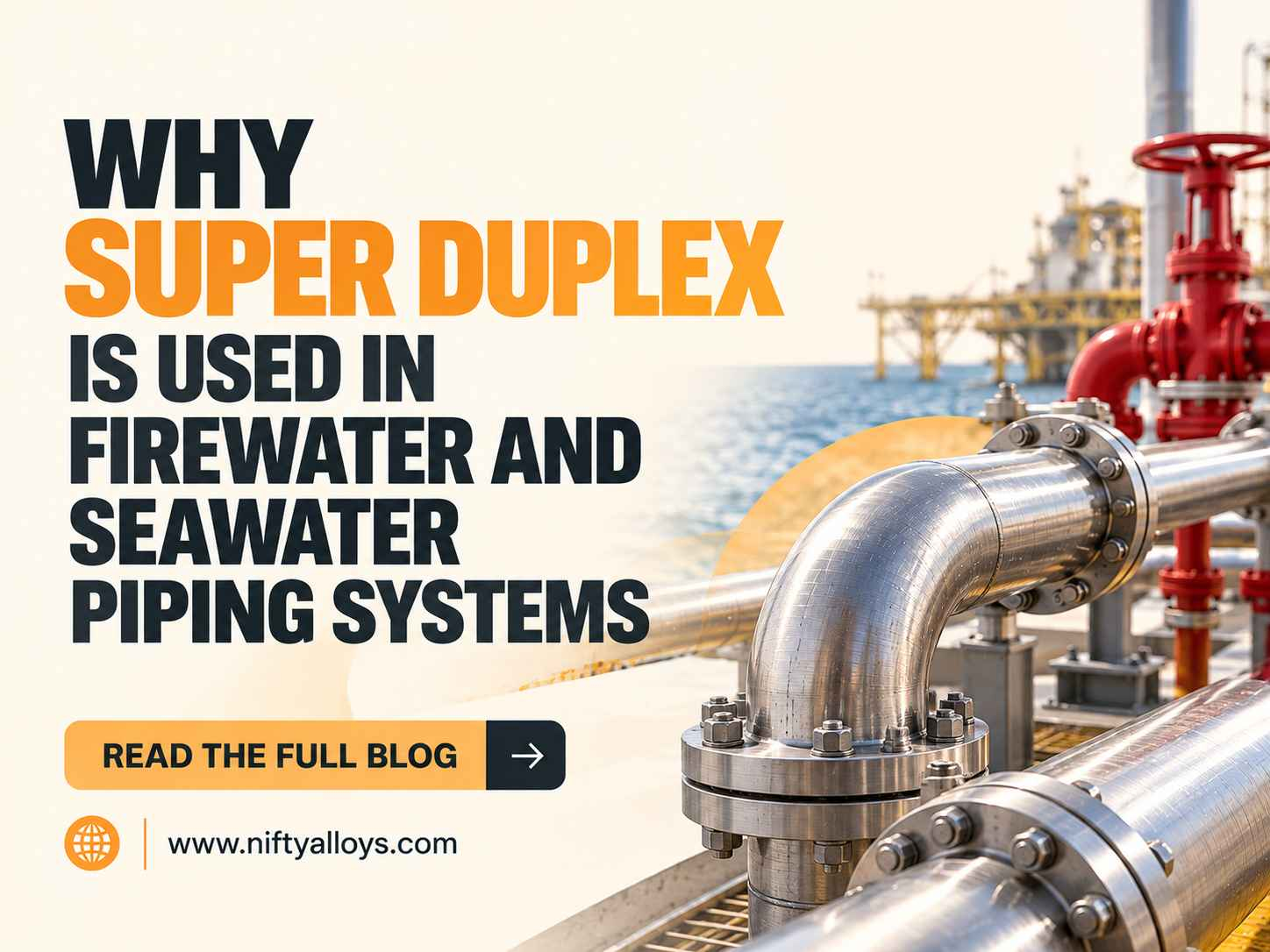
Firewater and seawater systems are some of the most corrosive services on any offshore platform, LNG terminal or coastal plant. Seawater attacks most stainless steels at crevices and welds, chlorination makes it more aggressive, and a firewater ring main can sit stagnant for months before it has to deliver full flow in an emergency.
Super duplex stainless steel, UNS S32750 and S32760, has become a standard answer to that problem. This article explains why, where its limits sit, and what buyers need to specify so the system performs as designed.
What Makes Seawater and Firewater Service So Demanding?
Seawater combines high chloride content with dissolved oxygen and biological activity. Chlorination, used to control marine growth, raises the corrosion potential and makes crevice attack more likely. Firewater systems add their own problems: long periods of stagnant water, microbiological activity in dead legs, wet and dry cycling in deluge lines, and sudden high-velocity flow during testing or an emergency.
A material for this service has to resist localised corrosion at flanges and welds, stand up to erosion, and still work after years of standing idle. Most carbon steels, copper alloys and standard stainless steels each fail at least one of those tests.
Why Is Super Duplex the Preferred Choice?
Pitting and crevice corrosion resistance
Super duplex contains about 25% chromium, 3–5% molybdenum and a high nitrogen addition, giving a pitting resistance equivalent number (PREN) of 40 or more. That is the level generally regarded as necessary for long-term seawater service. Standard 22% chromium duplex, by comparison, is not considered suitable for unprotected seawater at elevated temperatures.
Strength and weight saving
ASTM A790 requires a minimum yield strength of 550 MPa for S32750 pipe, against 170 MPa for 316L. Higher allowable stress means thinner walls, lighter spools and smaller supports, which matters on offshore topsides where every tonne carries a cost.
Erosion resistance and flow velocity
Copper-nickel alloys are limited to relatively low flow velocities before erosion-corrosion sets in. Super duplex tolerates much higher velocities, so lines can be smaller in diameter for the same flow, and sand-laden seawater does less damage.
Fire performance and chloride SCC resistance
As a metallic system, super duplex keeps its integrity in a jet or pool fire without the passive fire protection that GRP piping usually needs. Its ferritic-austenitic structure also gives far better resistance to chloride stress corrosion cracking than austenitic grades such as 316L.
How Does Super Duplex Compare with Other Firewater Materials?
| Material | Strengths | Limitations |
| Galvanised carbon steel | Low cost; easy to fabricate | Corrodes once zinc is consumed; corrosion products can block deluge nozzles |
| 90/10 copper-nickel | Good seawater resistance; resists biofouling | Velocity limits; sensitive to polluted or sulfide-bearing water |
| GRP (glass-reinforced plastic) | No corrosion; light weight | Needs fire protection; impact damage; joint quality critical |
| 6Mo austenitic stainless | PREN above 40; good weldability | Lower strength than super duplex; reported crevice problems at flanges |
| Super duplex (S32750 / S32760) | High strength, PREN of 40 or more, erosion and fire resistant | Temperature limits in seawater; demanding weld control |
| Titanium | Practically immune to seawater corrosion | High material and fabrication cost |
Copper-nickel remains a strong option for lower-velocity seawater cooling, as covered in our cupronickel C70600 vs C71500 guide. Super duplex tends to win where weight, velocity or fire performance drive the design.
What Temperature Limits Apply in Seawater?
This is the main constraint. NORSOK M-001, one of the most conservative standards, limits unprotected super duplex to 20 °C in both chlorinated and natural seawater. Supplier experience is more generous: with sound welds, pitting is not expected up to about 40 °C, although crevice corrosion can start at lower temperatures. Many operators set their own limits somewhere between these values.
For GCC projects this matters. Arabian Gulf seawater can exceed 30 °C in summer, well above the NORSOK limit. Projects in the region need a clear design temperature, controlled chlorination levels, and crevice mitigation at flanges, such as Alloy 625 weld overlay on flange faces or suitable non-absorbent gaskets. Where temperatures are too high even with these measures, titanium or GRP may be the better option.
Where Do Super Duplex Systems Go Wrong?
Almost always at the welds. Super duplex depends on a balanced mix of ferrite and austenite. Too much heat input, poor interpass temperature control or inadequate back-purging can create detrimental intermetallic phases or unbalanced weld metal, and the weld then corrodes long before the pipe does. Severe weld corrosion has been documented in at least one offshore firewater system for exactly this reason.
Galvanic coupling is the second risk. Super duplex is noble in chlorinated seawater, so it can accelerate corrosion of less noble materials it is connected to, such as Monel 400, copper alloys or carbon steel, unless the joint is insulated.
Warning: The Pipe Is Only as Good as the Weld
Make sure the welding procedure qualification includes ferrite measurement, ASTM A923 testing for intermetallic phases and ASTM G48 corrosion testing, and that production welds are made within the qualified heat-input range. A mill certificate for the pipe says nothing about the welds made on site.
What Should You Specify When Buying Super Duplex?
- Grade by UNS number: S32750 or S32760. Both have a PREN of 40 or more and are widely accepted for seawater; S32760 adds copper and tungsten.
- Product standards: ASTM A790 for seamless and welded pipe, A928 for larger welded pipe with filler metal, A182 F53 (S32750) or F55 (S32760) for forgings and flanges, and A815 for fittings.
- Condition: solution annealed and water quenched.
- Testing: ferrite content within the project window, ASTM A923 for intermetallics, ASTM G48 corrosion testing, and impact testing where the specification requires it.
- Certification: EN 10204 3.1 as a minimum, or 3.2 where third-party witnessing is required. Our EN 10204 2.2 vs 3.1 vs 3.2 guide explains which to request.
Frequently Asked Questions
What is the maximum seawater temperature for super duplex?
It depends on the standard and operator. NORSOK M-001 sets 20 °C for unprotected service, while supplier experience indicates no pitting up to about 40 °C with sound welds. Crevices are the limiting factor, so define the limit in the project specification.
Is super duplex better than copper-nickel for firewater?
Where flow velocity, weight or fire performance matter, usually yes. Copper-nickel can be more economical for low-velocity seawater cooling and resists biofouling better.
Can 2205 duplex be used for seawater piping?
Not for unprotected seawater at elevated temperatures. Standard 22% chromium duplex is vulnerable to pitting and crevice corrosion in seawater even at moderate temperatures.
What is the difference between S32750 and S32760 for seawater?
Corrosion performance is comparable, as both have a PREN of 40 or more. S32760 contains copper and tungsten additions. Many specifications accept either, so check which your project allows.
Certified Super Duplex Supply from Dubai
Nifty Alloys LLC supplies duplex and super duplex stainless steels, along with nickel alloys for flange overlay and seawater components, to marine, offshore and process industry buyers across the UAE, GCC and export markets. Material is supplied with EN 10204 3.1 mill test certificates, reviewed by our QA/QC team before dispatch under our quality and certification standards.
Send your seawater or firewater specification to our team, including design temperature, chlorination level and product forms, and we will confirm grade, condition and testing before quoting.
 Let's Talk
A complete nickel alloy bar order states the UNS number, the ASTM or ASME product standard and grade...
Alloy 825 is a nickel-iron-chromium alloy with 2.5–3.5% molybdenum plus copper, suited to sulfuric a...

Carbon equivalent (Ceq) is calculated using the IIW formula — CEV = C + Mn/6 + (Cr+Mo+V)/5 + (Ni+Cu)...
metal magnetism What Is a Ferrous Metal? Ferrous vs Non-Ferrous Explained Quick Answer ...




Elevate Your Projects with
with
 Our Superior Steels
