

Aerospace Aluminium Alloys: 2024, 6061 & 7075 Uses Explained
Aircraft use aluminium because it is about one-third the density of steel while offering good strength, fatigue resistance and manufacturability. 2024 is used for fatigue-critical parts such as fuselage skins. 7075 is used where maximum strength is needed, such as wing spars and fittings. 6061 is used for weldable, corrosion-resistant secondary structure and general parts.
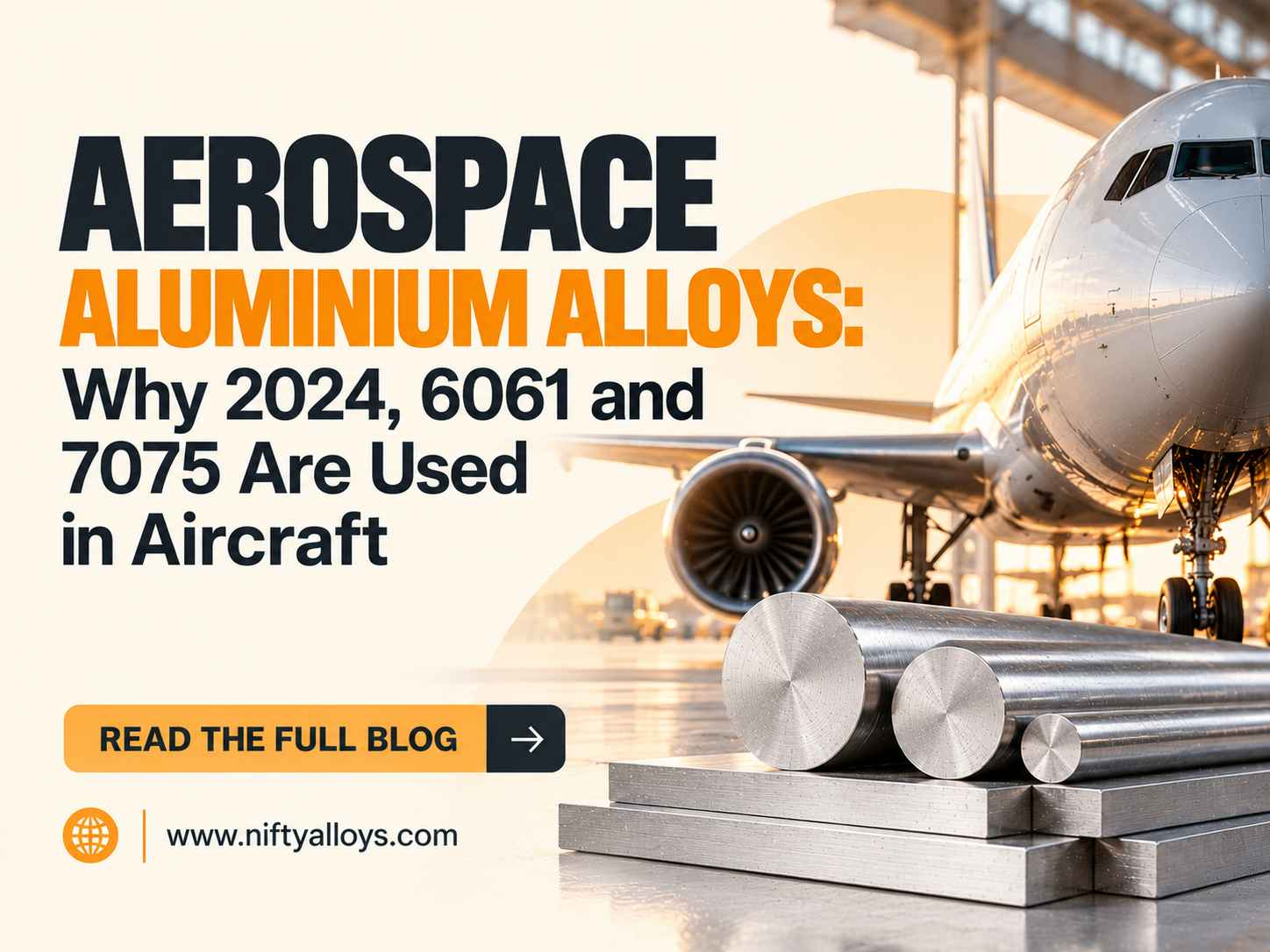
Aerospace Aluminium Alloys: Why 2024, 6061 and 7075 Are Used in Aircraft
Despite the rise of carbon-fibre composites, aluminium is still the main structural material in most commercial and business aircraft flying today. Three alloys do most of that work: 2024, 7075 and 6061. Each was adopted for a different reason, and each sits in a different part of the airframe.
This guide explains why aluminium is used in aircraft, what makes these three alloys different, where each one is used, and what buyers need to know before ordering material for aerospace work.
Why Is Aluminium Used in Aircraft?
Weight drives almost every aircraft design decision, and aluminium has a density of about 2.7 g/cm³, roughly one-third that of steel, as explained in our guide to the density of steel. High-strength aerospace alloys combine that low density with strength approaching some structural steels, giving an excellent strength-to-weight ratio.
Weight is not the only reason. Aluminium alloys have predictable fatigue and fracture behaviour, which is essential for damage-tolerant design. They are easy to machine, form and rivet, have decades of certification data behind them, and cost far less than titanium or composites. A metallic fuselage also conducts lightning strikes safely around the cabin, something composite structures need embedded metal mesh to achieve.
What Makes 2024, 7075 and 6061 Different?
All three are heat-treatable alloys, strengthened by solution treatment and ageing, but their main alloying elements lead them in different directions.
| Property | 2024-T3 | 7075-T6 | 6061-T6 |
| Alloy series | 2xxx (Al-Cu-Mg) | 7xxx (Al-Zn-Mg-Cu) | 6xxx (Al-Mg-Si) |
| Typical tensile strength | About 480 MPa | About 570 MPa | About 310 MPa |
| Typical yield strength | About 345 MPa | About 505 MPa | About 275 MPa |
| Fatigue and damage tolerance | Excellent | Good | Moderate |
| Corrosion resistance | Poor; usually clad or coated | Moderate; stress corrosion risk in T6 | Good |
| Fusion weldability | Poor | Poor | Good |
These are typical values for common tempers, not specification minimums. Yield strength is the figure that governs structural design, as explained in our guide to tensile strength vs yield strength.
Where Is Each Alloy Used in an Aircraft?
2024: fuselage skins and tension-loaded structure
2024 was developed for aircraft and remains the classic fuselage alloy. Its strength in the T3 temper is lower than 7075, but its resistance to fatigue crack growth is better, and fuselage skins are loaded in tension every time the cabin is pressurised. It is also used for lower wing skins, which carry tension in flight. Because 2024 corrodes readily, sheet is usually supplied as Alclad, with a thin layer of pure aluminium bonded to each surface.
7075: wing spars, stringers and high-strength fittings
7075 is among the strongest commercial aluminium alloys. It is used where strength matters most: upper wing skins and stringers that carry compression, spars, frames, and highly loaded machined fittings. In the peak-strength T6 temper it is susceptible to stress corrosion cracking, particularly through the thickness of plate, so critical parts often use the overaged T73 or T7351 tempers, which trade some strength for much better stress corrosion resistance.
6061: secondary structure and general parts
6061 is lower in strength but weldable, corrosion resistant and easy to machine and extrude. That makes it a common choice for secondary structure, brackets, ducting, fluid fittings, light aircraft structures and ground support equipment, where welding or corrosion resistance matters more than peak strength.
What Do Aircraft Tempers Mean?
Aluminium alloys are always specified with a temper, which describes how the material was heat-treated and worked. For background on why heat treatment changes properties so much, see our annealing vs tempering explainer.
- T3: solution heat-treated, cold worked and naturally aged. Common for 2024 sheet.
- T351: solution heat-treated, stress relieved by stretching, then naturally aged. Common for 2024 plate and bar.
- T6: solution heat-treated and artificially aged for peak strength. Standard for 6061 and 7075.
- T73 and T7351: overaged to improve stress corrosion resistance in 7075, at some cost in strength.
Is Aluminium Being Replaced by Composites?
Partly. Newer widebody aircraft such as the Boeing 787 and Airbus A350 are about half composite by weight. But aluminium remains the main structural material in most narrowbody fleets, business jets, helicopters and military aircraft, and in vast quantities of spare parts and repairs for aircraft that will fly for decades. Newer aluminium-lithium alloys and thick-plate alloys such as 7050 are also keeping aluminium competitive in new designs.
Warning: "Aircraft Grade" Is Not a Specification
Material sold as "aircraft grade" 7075 or 2024 is not automatically acceptable for flight hardware. Aerospace parts are made to AMS specifications, such as the AMS-QQ-A-250 series for sheet and plate, or to aircraft manufacturers’ own material specifications, with full traceability back to the producing mill. Commercial material to ASTM B209 (sheet and plate) or B211 (bar) can share the same alloy and temper but not the certification chain. Check what your drawing or approved supplier list requires before ordering.
What Should Aerospace and Engineering Buyers Specify?
- Alloy and temper: for example 7075-T7351, not just "7075".
- Material specification: AMS or customer specification for flight hardware; ASTM B209, B211 or B221 for general engineering.
- Product form and size: sheet, plate, bar or extrusion, with thickness or diameter and length.
- Cladding: Alclad or bare, for 2024 and 7075 sheet.
- Certification and traceability: mill certificate with heat or lot traceability. Our EN 10204 2.2 vs 3.1 vs 3.2 guide explains certificate types for general engineering supply.
Frequently Asked Questions
Which aluminium alloy is most used in aircraft?
2024 and 7075 have been the two dominant structural alloys for decades, with 2024 typical for fuselage skins and 7075 for high-strength wing and fitting parts. 6061 is widely used for secondary and general parts.
Is 7075 stronger than 2024?
Yes. 7075-T6 has noticeably higher tensile and yield strength than 2024-T3. 2024 is chosen where fatigue resistance and damage tolerance matter more than peak strength.
Can 7075 and 2024 be welded?
Neither is considered suitable for conventional fusion welding because of hot cracking. Aircraft structures in these alloys are riveted or bolted, although friction stir welding can join them.
Why is 6061 used if it is weaker?
Because it can be welded, resists corrosion well and is easy to machine and extrude. For many non-critical parts, those properties matter more than maximum strength.
Aluminium Alloys from Dubai
Nifty Alloys LLC supplies aluminium alloys for engineering and industrial applications to buyers across the UAE, GCC and export markets, with EN 10204 3.1 mill test certificates reviewed by our QA/QC team before dispatch.
If your order is for flight hardware, tell our team which specification and certification your drawing requires, and we will confirm what we can supply before quoting. Our approach to certification is set out in our quality standards.
 Let's Talk
Oil and gas relies mainly on carbon and low-alloy steels, upgraded to corrosion-resistant alloys whe...
Super duplex is used in firewater and seawater piping because its PREN of 40 or more resists pitting...
A complete nickel alloy bar order states the UNS number, the ASTM or ASME product standard and grade...
Alloy 825 is a nickel-iron-chromium alloy with 2.5–3.5% molybdenum plus copper, suited to sulfuric a...



Elevate Your Projects with
 Our Superior Steels
