

Alloy 825 vs Alloy 625: When Is 825 Good Enough?
Alloy 825 is a nickel-iron-chromium alloy with 2.5–3.5% molybdenum plus copper, suited to sulfuric acid, phosphoric acid and moderate sour service. Alloy 625 is a nickel-chromium alloy with 8–10% molybdenum and niobium, giving far better pitting, crevice and seawater resistance plus higher strength. Use 825 for cost-sensitive, low-chloride duty; specify 625 for seawater, hot chlorides or elemental sulfur.
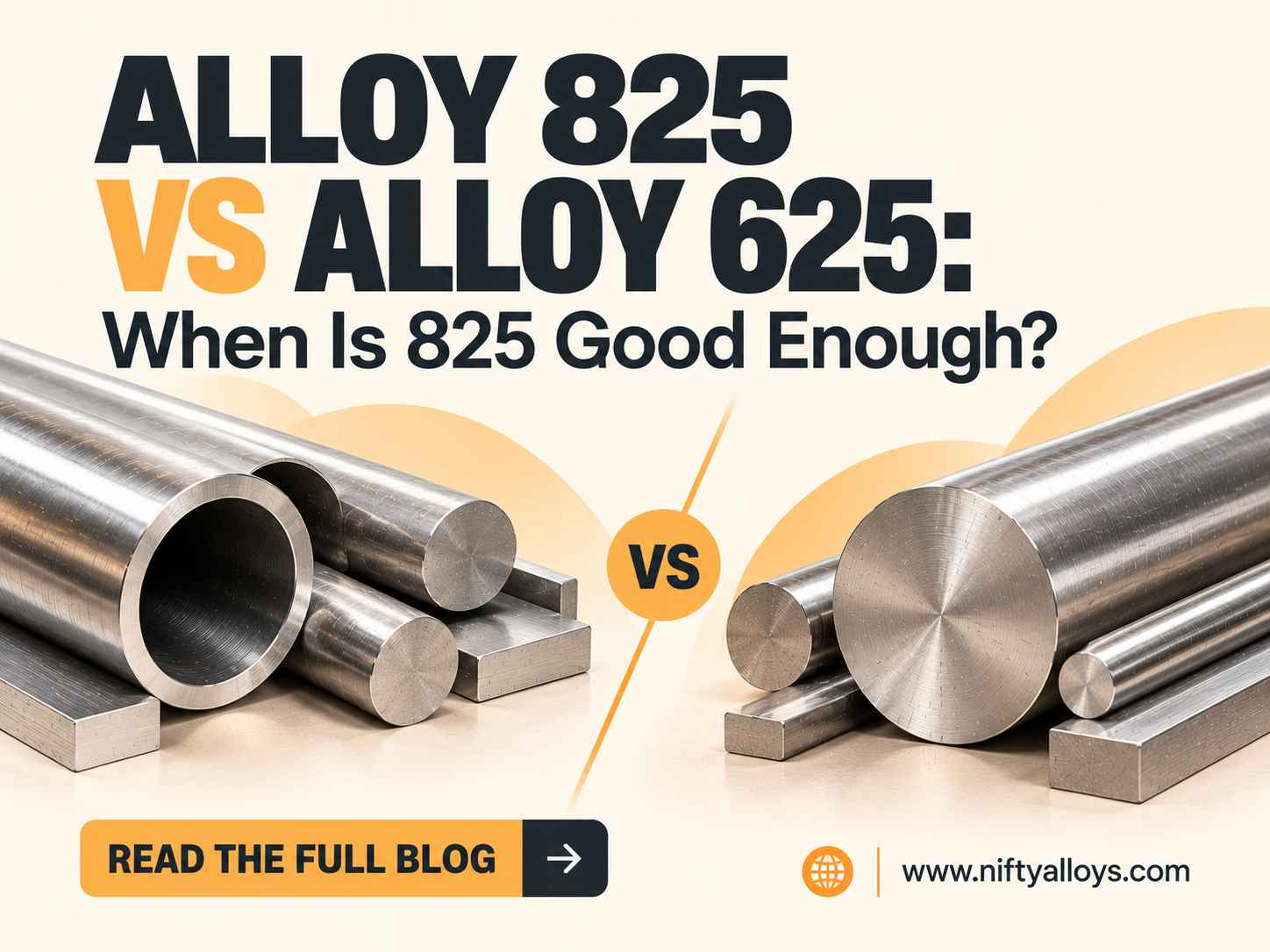
Alloy 625 is the default answer on many nickel alloy enquiries, and that habit is expensive. Alloy 825 (UNS N08825) carries far less nickel, about a third of the molybdenum and no niobium, so it is significantly cheaper than Alloy 625 (UNS N06625). In a good share of process and oil and gas services, it does the job.
The two alloys are not interchangeable, though. Put 825 where 625 was needed and the usual result is pitting or crevice corrosion in chloride service. This guide sets out where the line actually sits, so procurement and engineering teams can make the call with confidence.
What Is the Difference Between Alloy 825 and Alloy 625?
The difference starts with chemistry. Alloy 825 is roughly 40% nickel with a substantial iron balance; Alloy 625 is at least 58% nickel with very little iron. The molybdenum gap is the number that drives most selection decisions.
| Element | Alloy 825 (N08825) | Alloy 625 (N06625) | Why it matters |
| Nickel | 38.0–46.0% | 58.0% min | Chloride SCC resistance; main cost driver |
| Chromium | 19.5–23.5% | 20.0–23.0% | General and oxidising-acid resistance; similar in both |
| Molybdenum | 2.5–3.5% | 8.0–10.0% | Pitting and crevice resistance; the decisive gap |
| Iron | 22.0% min (balance) | 5.0% max | Lowers the cost of 825 |
| Copper | 1.5–3.0% | — | Gives 825 its sulfuric acid resistance |
| Niobium + Tantalum | — | 3.15–4.15% | Solid-solution strengthening in 625 |
| Titanium | 0.6–1.2% | 0.40% max | Stabilises 825 against sensitisation |
| PREN (Cr + 3.3Mo) | ≈ 30–33 | ≈ 48–52 | Screening index for chloride pitting |
Both alloys are austenitic and highly resistant to chloride stress corrosion cracking, which is why both appear on corrosion-resistant alloy (CRA) shortlists. Where they part ways is localised corrosion.
How Do Alloy 825 and 625 Compare in Chloride and Seawater Service?
PREN is a useful screen, but critical temperatures tell the more practical story. In published ASTM G48 ferric chloride testing, Alloy 825 shows a critical pitting temperature of around 30 °C, while Alloy 625 typically exceeds 85 °C. The crevice data is more telling still: published producer data puts the onset of crevice attack on 825 at about 0 °C, against roughly 45 °C for 625.
In practice, Alloy 825 should not be relied on where seawater can stagnate or crevices exist: flange faces, tube-to-tubesheet joints, under deposits, or uncoated external surfaces in a marine atmosphere. Corrosion failures of 825 equipment have been reported offshore, and many piping engineers coat 825 externally while leaving 625 bare. For seawater cooling, firewater and splash-zone duty, specify 625, or a seawater-proven copper alloy such as those compared in our cupronickel C70600 vs C71500 guide.
Is Alloy 825 Acceptable for Sour Service Under NACE MR0175?
Yes, with qualifications. NACE MR0175 / ISO 15156-3 lists both annealed Alloy 825 and annealed Alloy 625 among the solid-solution nickel alloys acceptable for H2S service. On paper, that makes them equivalent for sulfide stress cracking.
Operating experience is less generous to 825. Many operators set their own temperature ceilings for 825, commonly in the 100–120 °C range, even where the standard allows more. Elemental sulfur is the other red flag: laboratory work has shown 825 suffering stress corrosion cracking and accelerated corrosion under sulfur deposits in hot, high-H2S, high-chloride conditions. If the stream can drop elemental sulfur, or runs hot with high chlorides, 625 is the conservative choice.
Strength and Temperature: Can 625 Reduce Wall Thickness?
Alloy 625 is considerably stronger. That is why designers of high-pressure systems sometimes find 625 cheaper on an installed basis: a higher allowable stress means thinner walls, less weight and less weld metal.
| Property (bar, minimum) | Alloy 825 — ASTM B425, annealed | Alloy 625 — ASTM B446, Grade 1 |
| Tensile strength | 586 MPa | 827 MPa (up to 100 mm) |
| 0.2% yield strength | 241 MPa | 414 MPa (up to 100 mm) |
| Elongation | 30% | 30% |
| Typical upper design temperature | About 538 °C | About 593 °C (Grade 1); Grade 2 for creep service above this |
| Hardening | Cold work only | Cold work only |
The yield figure is the one that sets wall thickness. If the difference between the two minimums is unclear, our explainer on tensile strength vs yield strength covers how each value is measured and used.
When Should You Specify Alloy 825?
- Sulfuric and phosphoric acid handling, pickling lines and acid-plant equipment, where the copper addition gives 825 strong performance at a lower cost.
- Downhole tubing, flowlines and process piping in sweet or moderately sour service, within operator temperature limits and with no elemental sulfur.
- Internal CRA cladding of carbon steel pipe and vessels, with external surfaces coated or otherwise protected.
- Heat exchangers and process equipment in fresh water, controlled-chloride cooling water or mildly corrosive chemical duty.
When Is Alloy 625 Worth the Extra Cost?
- Seawater, brine and marine atmosphere exposure, including uncoated external surfaces and crevice-prone joints.
- Hot, high-chloride sour service, or any service where elemental sulfur may deposit.
- High-pressure piping where the higher strength of 625 cuts wall thickness enough to offset the material premium.
- Elevated-temperature duty beyond the useful range of 825, such as flare systems and hot process lines.
- Welding consumables and corrosion-resistant overlays, where 625 filler (ERNiCrMo-3) is the industry norm.
Warning: Check the Weld, Not Just the Base Metal
Alloy 825 is routinely welded with Alloy 625 filler metal, which overmatches the parent metal for pitting resistance. Check that the WPS and filler certificates reflect this. Many operators also refuse to treat 825 weld overlay as equal to solid or roll-bonded 825 in sour service, because dilution from the carbon steel lowers the alloy content.
Clad pipe needs the same discipline. One published subsea case traced a sour gas leak to a girth weld where grinding to correct misalignment went through the 3 mm Alloy 825 clad layer and exposed the X65 carrier pipe.
Why Does Alloy 625 Cost More, and How Should You Compare Prices?
Price follows chemistry. Alloy 625 contains roughly 40–50% more nickel than 825, about three times the molybdenum and 3–4% niobium, and each of these metals trades in its own volatile market. Movements in the nickel price therefore hit 625 harder.
For a fair comparison, look at installed cost over the design life rather than price per kilogram: wall thickness, external coating for 825, inspection frequency, and the cost of an unplanned shutdown if the cheaper alloy fails early. On small-bore, low-chloride lines 825 usually wins. On high-pressure seawater or hot sour systems, 625 often turns out to be the cheaper decision.
What Should Your Purchase Order Specify?
UNS number, not trade name: UNS N08825 or UNS N06625. Trade names vary by producer and invite substitution.
- Product standard: 825 to ASTM B425 (bar), B423 (seamless pipe and tube), B424 (plate and sheet) or B564 (forgings); 625 to ASTM B446, B444, B443 or B564 respectively.
- Condition: annealed for 825; Grade 1 (annealed) or Grade 2 (solution annealed) for 625.
- Sour service: an explicit NACE MR0175 / ISO 15156 requirement, with hardness reported on the certificate.
- Certification: EN 10204 3.1 as a minimum, or 3.2 where third-party witnessing is required. Our EN 10204 2.2 vs 3.1 vs 3.2 guide explains which to request.
Frequently Asked Questions
Is Incoloy 825 the same as Alloy 825?
Yes. Incoloy 825 is a trade name for UNS N08825, and Inconel 625 is a trade name for UNS N06625. Specify by UNS number and ASTM standard so that any compliant producer’s material is acceptable.
Can Alloy 825 replace Alloy 625?
Only after checking chloride level, temperature, crevice exposure, elemental sulfur and design pressure. It is a sound cost-down substitution in acid and low-chloride service, but not in seawater or hot sour service.
Which is better for seawater, Alloy 825 or Alloy 625?
Alloy 625. Its higher molybdenum content gives far better crevice resistance, while 825 is prone to pitting and crevice attack in stagnant seawater and marine atmospheres unless it is protected.
Is Alloy 825 NACE MR0175 compliant?
Annealed Alloy 825 is listed in ISO 15156-3, but confirm the selection against operator limits, temperature and the risk of elemental sulfur, and require a compliance statement on the mill test certificate.
Source Certified Alloy 825 and Alloy 625 from Dubai
Nifty Alloys LLC is a Dubai-based stockist and supplier of certified nickel alloys to oil and gas, petrochemical, marine and process industry buyers across the UAE, GCC and export markets. We supply Alloy 825 and Alloy 625 with EN 10204 3.1 mill test certificates, and every certificate is reviewed by our QA/QC team before dispatch under our quality and certification standards.
Not sure whether 825 meets your specification? Send us your operating temperature, chloride level, H2S partial pressure and product form, and our team will help you confirm the right grade before you quote.
 Let's Talk
Carbon equivalent (Ceq) is calculated using the IIW formula — CEV = C + Mn/6 + (Cr+Mo+V)/5 + (Ni+Cu)...
metal magnetism What Is a Ferrous Metal? Ferrous vs Non-Ferrous Explained Quick Answer ...
No metal is entirely immune to all forms of corrosion, but several genuinely resist rust (iron oxide...
Pure copper (C11000) offers the highest electrical and thermal conductivity of any commercially avai...




Elevate Your Projects with
with
 Our Superior Steels
