

API 5L X65 Line Pipe: Properties & Specification Guide
API 5L X65 (also designated L450) is a high-strength carbon-manganese line pipe grade with a minimum yield strength of 450 MPa (65,300 psi) and minimum tensile strength of 535 MPa (77,600 psi). It is supplied in PSL1 or PSL2, seamless or welded, and is used for onshore gas transmission and offshore/subsea pipelines requiring high pressure ratings with reduced wall thickness.
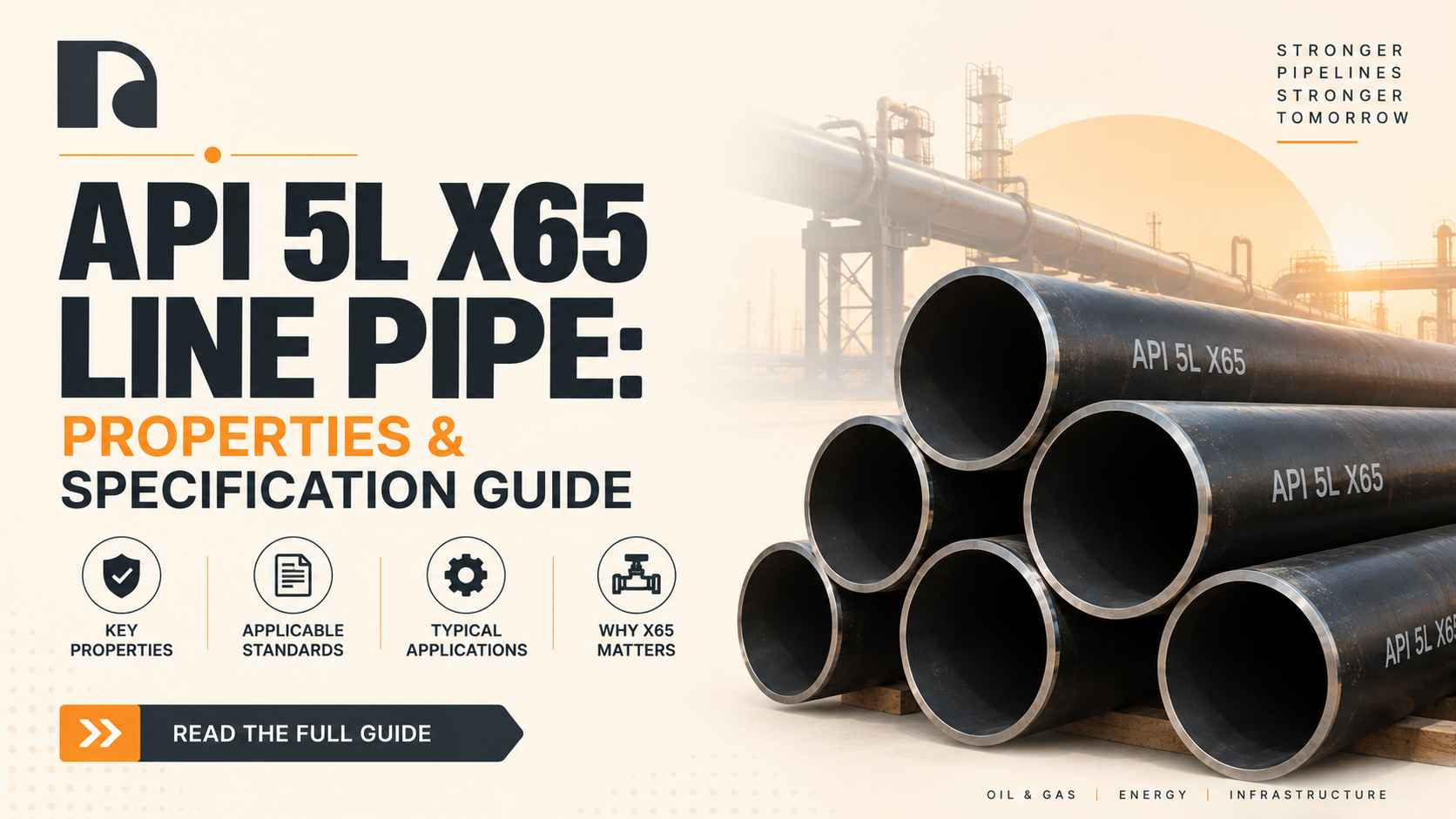
API 5L X65 is one of the most widely specified high-strength line pipe grades in the oil and gas industry, used across onshore transmission networks, offshore trunk lines, and subsea flowlines. For procurement engineers and QA/QC teams, getting the chemistry, mechanical properties, and PSL level right at the enquiry stage avoids costly rejections at the mill test certificate (MTC) review stage. This guide sets out the X65 specification in full — chemical composition, mechanical property limits, sour service variants, and the checkpoints a certificate reviewer looks for before accepting material against an order.
What Is API 5L X65 Line Pipe?
API 5L (API Spec 5L), harmonised with ISO 3183, is the American Petroleum Institute specification governing line pipe used to transport oil, gas, and water in petroleum and natural gas pipeline systems. Grades are designated by the letter X followed by a two-digit number denoting minimum yield strength in ksi — X65 therefore carries a minimum specified yield strength (SMYS) of 65,000 psi (448–450 MPa depending on rounding convention used).
The grade sits between X60 and X70 in the API 5L strength ladder and is the default choice for applications where a higher pressure rating is needed without increasing wall thickness — a key consideration for offshore installation loads and long-distance transmission economics.
Chemical Composition PSL1 vs PSL2
API 5L splits requirements into two Product Specification Levels. PSL1 covers standard-quality line pipe; PSL2 adds tighter chemistry limits, mandatory Charpy V-notch (CVN) impact testing, and a controlled maximum yield strength to preserve ductility and weldability.
| Element | PSL1 Max (%) | PSL2 Max (%) | Notes |
| Carbon (C) | 0.28 | 0.24 (CE ≤ 0.43) | Sour service grades lower still (≤0.12–0.10%) |
| Manganese (Mn) | 1.40 | 1.70 | Controlled for weldability |
| Phosphorus (P) | 0.030 | 0.025 | Sour service: ≤0.020% |
| Sulfur (S) | 0.030 | 0.015 | Sour service: ≤0.002–0.003% |
| Nb, V, Ti (combined) | No limit specified | ≤0.15 (typical mill practice) | Microalloying for grain refinement |
Mechanical Properties
Mechanical acceptance criteria are where most order clarifications happen. As covered in our guide to tensile strength vs yield strength, yield strength governs the safe working-pressure envelope while tensile strength defines the failure ceiling — both are certified per heat/lot on the MTC and both must be checked against the PSL level ordered, not just the grade.
| Property | PSL1 | PSL2 |
| Min Yield Strength (SMYS) | 450 MPa (65,300 psi) | 450 MPa (65,300 psi) |
| Max Yield Strength | Not specified | 600 MPa (seamless) / 635 MPa (welded) |
| Min Tensile Strength (SMTS) | 535 MPa (77,600 psi) | 535 MPa (77,600 psi) |
| Max Tensile Strength | Not specified | 760 MPa |
| Max Yield/Tensile Ratio | Not specified | 0.93 |
| CVN Impact Testing | Not mandatory | Mandatory, per size/temperature |
Sour Service Variants: X65Q and X65M
Where the line will see wet H2S service, PSL2 X65 is typically ordered as X65Q (quenched and tempered) or X65M (thermo-mechanically controlled processed). Both carry tightened carbon, phosphorus, and sulfur limits and must be qualified to NACE MR0175/ISO 15156 for resistance to sulfide stress cracking and hydrogen-induced cracking. The heat treatment route — Q vs M — affects toughness and weldability, and should be confirmed against the project's material selection diagram (MSD) before ordering rather than assumed from grade alone.
Manufacturing Forms: Seamless vs Welded
X65 is supplied seamless or welded (ERW, LSAW/SAWL, or HSAW/SSAW), and the choice affects both cost and application fit. Our seamless vs welded pipe comparison covers this in detail, but as a quick guide: seamless X65 is generally preferred for smaller diameters and higher-pressure, sour-service duty where the absence of a weld seam removes a potential crack-initiation site, while LSAW is standard for large-diameter transmission trunk lines where seamless production is impractical.
Typical Applications
X65 is specified across UAE, GCC, and international oil & gas projects wherever a high-pressure rating is needed at economical wall thickness. Typical applications include:
- Onshore cross-country gas and oil transmission pipelines
- Offshore trunk lines and subsea flowlines (PSL2, sour-service grades)
- Deepwater risers where reduced wall thickness lowers installation load
- LNG plant transfer piping and process gas gathering systems
- Water injection and produced-water lines in oil & gas fields
MTC Review Checklist
Before accepting X65 pipe against an order, a QA/QC review of the mill test certificate should confirm the following against the purchase order and applicable code:
- PSL level and grade designation match the PO exactly (X65 vs X65Q vs X65M vs L450 equivalents)
- Chemical composition and carbon equivalent (CE) within the specified PSL/sour-service limits
- Yield and tensile results within both the minimum and, for PSL2, the maximum bounds
- Y/T ratio ≤0.93 reported for PSL2 orders, particularly for strain-based design applications
- CVN impact test results reported at the specified test temperature, for PSL2
- NACE MR0175/ISO 15156 compliance statement present where sour service is specified
- Certificate issued as EN 10204 3.1, third-party witnessed where the project specification requires it
Common Non-Conformance
The most frequent MTC rejection point on X65 orders is a PSL2 certificate reporting yield strength above the 600/635 MPa ceiling without a documented concession — this fails the ductility intent of PSL2 even though it appears to 'exceed' the minimum requirement.
X65 vs X60 vs X70: Quick Comparison
| Grade | Min Yield Strength | Min Tensile Strength | Typical Use |
| X60 | 414 MPa (60,200 psi) | 517 MPa (75,400 psi) | Standard onshore transmission |
| X65 | 450 MPa (65,300 psi) | 535 MPa (77,600 psi) | High-pressure onshore/offshore |
| X70 | 483 MPa (70,300 psi) | 565 MPa (82,100 psi) | Ultra-high-pressure, deepwater trunk lines |
Frequently Asked Questions
What does X65 mean in API 5L?
The number 65 denotes a minimum specified yield strength of 65,000 psi (approximately 450 MPa) for the pipe body, as tested per API 5L / ISO 3183.
Is API 5L X65 the same as L450?
Yes. X65 and L450 refer to the same grade — X65 uses the US customary (psi) designation, while L450 uses the SI (MPa) designation. Both appear on certificates and enquiries interchangeably.
What is the difference between X65 PSL1 and PSL2?
PSL2 adds a maximum yield and tensile strength ceiling, mandatory Charpy V-notch impact testing, tighter chemical composition limits, and a controlled yield-to-tensile ratio. PSL1 has none of these upper bounds or mandatory toughness testing.
Can API 5L X65 be used for sour service?
Only the qualified sour-service variants — typically X65QS/MS with tightened carbon, phosphorus, and sulfur limits — and only when certified against NACE MR0175/ISO 15156. Standard PSL2 X65 without this qualification is not automatically suitable for wet H2S service.
What sizes and wall thicknesses is X65 available in?
X65 is produced across a wide OD and wall thickness range in both seamless and welded (ERW/LSAW/HSAW) forms; exact availability depends on the manufacturing route and should be confirmed against the specific project dimensional requirement at enquiry stage.
Conclusion
API 5L X65 remains the workhorse grade for high-pressure onshore and offshore pipeline projects, but getting the PSL level, sour-service qualification, and MTC checkpoints right at the enquiry stage prevents delays further down the supply chain. Nifty Alloys LLC supplies API 5L X65 line pipe — Grade B through X70, PSL1 and PSL2, seamless and welded — from our Dubai warehouse with EN 10204 3.1 mill test certification, backed by in-house QA/QC review before dispatch. View our full API 5L line pipe range or contact our team with your project specification for a certified supply quotation to the UAE, GCC, or your export destination.
 Let's Talk
Petrochemical plants use 304L and 316L for general process service, 321 and 347 for high-temperature...
Aircraft use aluminium because it is about one-third the density of steel while offering good streng...
Oil and gas relies mainly on carbon and low-alloy steels, upgraded to corrosion-resistant alloys whe...
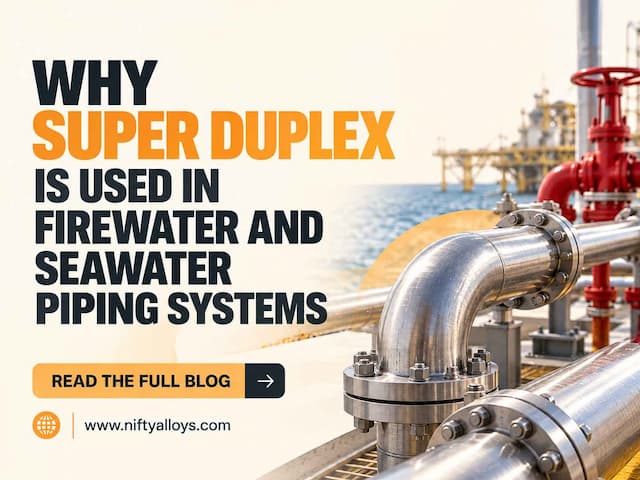
Super duplex is used in firewater and seawater piping because its PREN of 40 or more resists pitting...




Elevate Your Projects with
with
 Our Superior Steels
