

Materials Used in Oil and Gas: From Wellhead to Refinery
Oil and gas relies mainly on carbon and low-alloy steels, upgraded to corrosion-resistant alloys where conditions demand. Downhole and wellhead equipment uses low-alloy steels, 13Cr, duplex and nickel alloys such as 718 and 825. Pipelines use API 5L carbon steel, sometimes clad. Topsides use carbon steel, duplex and super duplex. LNG uses 9% nickel steel and austenitic stainless. Refineries use Cr-Mo steels.
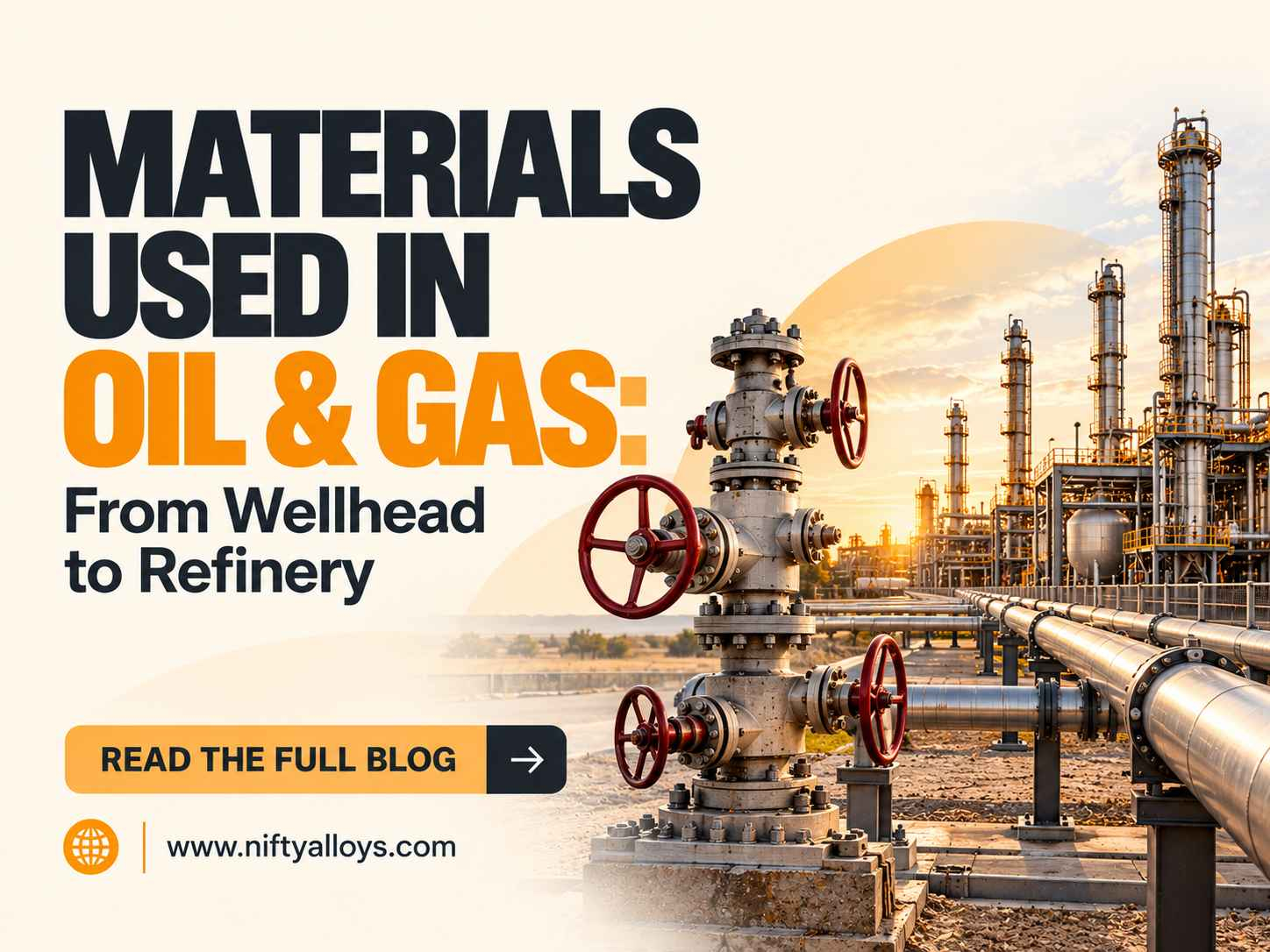
Materials Used in the Oil and Gas Industry: From Wellhead to Refinery
A single hydrocarbon molecule may pass through a dozen different materials on its way from the reservoir to a refinery product: low-alloy steel tubing, a nickel-alloy valve stem, duplex flowlines, carbon steel vessels, super duplex seawater systems and chromium-molybdenum heater tubes. Each was chosen because the conditions at that point in the chain would defeat a cheaper material.
This guide follows that chain segment by segment, explaining which materials are used where and why, so engineers and buyers can see how the whole picture fits together.
What Decides Material Selection in Oil and Gas?
Six factors drive almost every material decision in the industry:
- CO2 (sweet corrosion): causes general and localised metal loss in carbon steel, driving upgrades to 13Cr or duplex.
- H2S (sour service): causes cracking, and brings in NACE MR0175 / ISO 15156 hardness and alloy limits.
- Chlorides: cause pitting and stress corrosion cracking in stainless steels, especially as temperature rises.
- Temperature: cryogenic service needs toughness at low temperature, and high-temperature service needs creep and hydrogen resistance.
- Pressure: favours high-strength materials that reduce wall thickness and weight.
- Lifecycle cost: a cheaper material that needs inhibitors, inspection and early replacement can cost more over the field life.
Downhole and Wellhead Materials
Production tubing and casing are made to API 5CT. Grades such as J55, N80 and P110 cover general service, while restricted-yield grades such as L80 Type 1, C90 and T95 are used in sour wells. Where CO2 corrosion is significant, 13Cr and super 13Cr martensitic stainless tubing takes over, followed by duplex, Incoloy 825, and finally nickel alloys such as 625 and C-276 for the most severe high-pressure, high-temperature sour wells.
Wellheads and Christmas trees are built to API 6A, which defines material classes from AA (general service, carbon and low-alloy steel) through DD and EE (sour service) to FF and HH (stainless and corrosion-resistant alloys). Bodies are typically 4130 or 4140-type low-alloy steel forgings, with Alloy 625 weld overlay on sealing surfaces. Stems, hangers and other high-strength parts are commonly Alloy 718 to API 6A718, as covered in our Inconel 718 guide.
Subsea and Pipeline Materials
Most pipelines are carbon steel line pipe to API 5L, in grades from X52 to X70, with PSL 2 sour-service requirements where H2S is present. For corrosive well fluids, operators use clad or lined pipe, with a thin layer of 316L, Incoloy 825 or Alloy 625 bonded to a carbon steel carrier, or solid 22Cr and 25Cr duplex flowlines.
Subsea brings an extra risk: hydrogen embrittlement from cathodic protection. Duplex and some high-strength alloys can suffer hydrogen-induced stress cracking under CP, so subsea designs follow guidance such as DNV-RP-F112 on stress and microstructure.
Topsides and Processing Facility Materials
Process piping on platforms and onshore plants is mostly carbon steel, such as ASTM A106 Grade B, with A333 Grade 6 for low-temperature service. Stainless steel 316L handles mildly corrosive streams, 22Cr duplex is used where chlorides and CO2 combine, and 25Cr super duplex is the standard for seawater and firewater systems.
Pressure vessels are usually carbon steel plate, such as SA-516 Grade 70, specified HIC-resistant for sour service, and often internally clad with 316L, 825 or 625. Seawater systems use super duplex, copper-nickel, titanium for plate heat exchangers, and nickel aluminium bronze for seawater lift pumps.
Valves combine carbon steel or duplex bodies with harder trims such as 410, 17-4 PH or Stellite-overlaid seats. Bolting is mostly A193 B7, B7M in sour service, and A320 L7 for low-temperature duty.
LNG and Cryogenic Materials
Liquefied natural gas is stored at about -162 °C, where ordinary carbon steel becomes brittle. The inner tanks of full-containment LNG storage tanks are commonly 9% nickel steel. Cryogenic piping uses austenitic stainless steels such as 304L and 316L, which keep their toughness at these temperatures, while brazed aluminium heat exchangers are common in liquefaction trains. Invar (36% nickel iron) is used in some membrane containment systems and transfer lines because of its very low thermal expansion.
Refinery Materials
Refineries deal with high temperatures and hydrogen rather than produced water. Chromium-molybdenum steels such as P11, P22, P5 and P9, and P91 in some services, handle high-temperature and hydrogen service, selected against the Nelson curves in API RP 941. Stabilised stainless steels 321 and 347 resist polythionic acid stress corrosion cracking during shutdowns, and heater and reformer tubes move into 9Cr, 347H and cast HP alloys.
Nickel alloys appear at specific trouble spots: Monel 400 in HF alkylation units and crude tower overheads, and Incoloy 825 and Alloy 625 in overhead condensers. Refining follows NACE MR0103 / ISO 17945 for wet H2S, rather than MR0175. For the differences between these nickel alloy families, see our comparison of Inconel, Hastelloy and Monel.
Oil and Gas Materials at a Glance
| Segment | Typical materials | Main driver |
| Downhole tubing and casing | API 5CT carbon and low-alloy steel, 13Cr, super 13Cr, duplex, 825, 625, C-276 | CO2, H2S, chlorides, pressure |
| Wellhead and tree | 4130 / 4140 forgings, 625 overlay, 718, 17-4 PH | Pressure, sour service, sealing |
| Pipelines and flowlines | API 5L X52–X70, clad pipe (316L, 825, 625), 22Cr / 25Cr duplex | Corrosion, pressure, cost over distance |
| Topsides process | A106 / A333 carbon steel, 316L, 22Cr duplex | CO2, chlorides, temperature |
| Seawater and firewater | 25Cr super duplex, copper-nickel, titanium, NAB | Seawater corrosion, weight, fire |
Note: Material Grade Is Only Half the Specification
The same grade can pass or fail in service depending on condition, hardness and testing. A 4140 forging is acceptable in sour service only if its hardness and heat treatment meet NACE MR0175; Alloy 718 needs the right ageing treatment; duplex needs the right ferrite balance. Always specify the standard, condition and testing, not just the grade.
Our guide on how to specify nickel alloy bar on a purchase order shows how to write those requirements into each order line.
Frequently Asked Questions
What is the most common material in the oil and gas industry?
Carbon steel. It makes up the large majority of pipelines, vessels and piping by weight. Corrosion-resistant alloys are used where carbon steel would corrode or crack.
Why are nickel alloys used in oil and gas?
Because they resist the combination of H2S, CO2, chlorides and high pressure found in severe wells, where stainless steels would crack or pit. Alloy 718, 625 and 825 are the most common.
What material is used for oil and gas pipelines?
Mostly API 5L carbon steel line pipe. For corrosive fluids, clad or lined pipe or solid duplex stainless steel is used.
Which standard covers materials for sour service?
NACE MR0175 / ISO 15156 for oil and gas production, and NACE MR0103 / ISO 17945 for refining.
Certified Oil and Gas Materials from Dubai
Nifty Alloys LLC supplies nickel alloys, duplex and stainless steels and alloy steels to oil and gas operators, EPC contractors and fabricators across the UAE, GCC and export markets. Every order ships with an EN 10204 3.1 mill test certificate, reviewed by our QA/QC team under our quality and certification standards.
Send our team your material requirements, service conditions and product forms, and we will confirm grade, condition and certification before quoting.
 Let's Talk
Super duplex is used in firewater and seawater piping because its PREN of 40 or more resists pitting...
A complete nickel alloy bar order states the UNS number, the ASTM or ASME product standard and grade...
Alloy 825 is a nickel-iron-chromium alloy with 2.5–3.5% molybdenum plus copper, suited to sulfuric a...
Carbon equivalent (Ceq) is calculated using the IIW formula — CEV = C + Mn/6 + (Cr+Mo+V)/5 + (Ni+Cu)...




Elevate Your Projects with
with
 Our Superior Steels
